

Electric Scooter Maintenance: Complete Checklist
A scooter that feels fine on one ride can still have a loose bolt, worn tire, weak brake response, or charging problem waiting to become a safety issue.
A short inspection before riding, plus careful battery and hardware care, helps you catch small problems before they interrupt your commute or weekend plans.
A practical electric scooter maintenance routine includes checking the tires, brakes, controls, lights, frame, folding hardware, battery, and charger, then cleaning and storing the scooter according to its manual. Riders can handle visual inspections and gentle cleaning, but damaged batteries, charging faults, loose wiring, motor issues, and structural defects belong with a qualified technician.
Visit Voltaire's Bend service center for scooter repair guidance
The most useful checklist starts by separating routine observations from repairs that should stop the ride. That makes it easier to build safe habits without guessing at model-specific tire pressures, service intervals, or electrical procedures.
What Does Electric Scooter Maintenance Include?
Electric scooter maintenance includes routine safety inspections, gentle cleaning, manufacturer-directed adjustments, and professional diagnosis when a problem involves electrical, battery, motor, brake, or structural components. The exact schedule is model-dependent, so use your scooter manual rather than a universal mileage or time interval.
Daily or before each ride: Look for visible damage and confirm that the handlebars, brakes, throttle, lights, tires, cables, frame, guards, and covers appear secure and intact. Check that the brake functions and that the wheels are not visibly worn. The U.S. Consumer Product Safety Commission's micromobility guidance and the University of South Florida both recommend these basic checks.
Periodic care: Follow the manufacturer's maintenance directions for your specific scooter. This may include checking bolts, folding hardware, covers, tires, controls, and other wear points. While cleaning, inspect the scooter rather than treating cleaning as a cosmetic task. A rag and gentle cleaner are appropriate for routine dirt, but high-pressure water can damage electrical systems.
Seasonal or storage care: Review the manual before storing the scooter for extended periods, especially regarding battery temperature, charging, and moisture. Avoid guessing at battery percentages, tire pressures, lubricant types, or service intervals.
Use this simple sequence when building an electric scooter maintenance habit:
- Read the scooter manual for model-specific charging, tire, folding, and service instructions.
- Inspect the controls, tires, brakes, lights, frame, cables, and folding hardware before riding.
- Clean gently and look for loose, damaged, wet, or unusually worn parts.
- Record changes such as reduced range, unusual heat, charging changes, or new sounds.
- Stop riding and arrange qualified service when a safety-critical or electrical fault appears.
Inspection means observing, cleaning, and identifying a concern. Repair means correcting the underlying problem. Stop riding and seek qualified service for loose wiring, brake faults, battery damage, structural defects, or an issue you cannot safely identify. Never open a battery pack or motor system at home.
How Often Should You Check Tires, Brakes, and Folding Hardware?
Check the scooter before every ride, then complete the manufacturer's recommended maintenance on its stated schedule. A quick inspection should cover tire and wheel condition, brake response, lights, cables, the stem, visible bolts, guards, and the folding latch. If anything is damaged, loose, or behaving differently, do not ride until the problem is corrected.
Before setting out, look closely at both tires and wheels. Check for visible cuts, embedded objects, unusual wear, or damage, and confirm that nothing appears loose. Do not guess at tire pressure or use a universal number. Follow the pressure range and inspection guidance in your scooter manual. Small scooter tires can stop suddenly when they meet an object or uneven surface, so tire condition is a safety issue, not just a comfort concern. The electric scooter pre-ride safety checks provide a useful companion checklist.
Test the brakes at low speed in a clear area. The controls should respond predictably, without unusual noise, excessive travel, rubbing, or a feeling that stopping power has changed. Confirm that the headlight, taillight, reflectors, bell, and other required visibility equipment work before riding in low-light conditions. CPSC guidance also calls out the handlebars, brakes, throttle, bell, lights, tires, cables, and frame as items to check for damage before use: CPSC micromobility safety guidance.
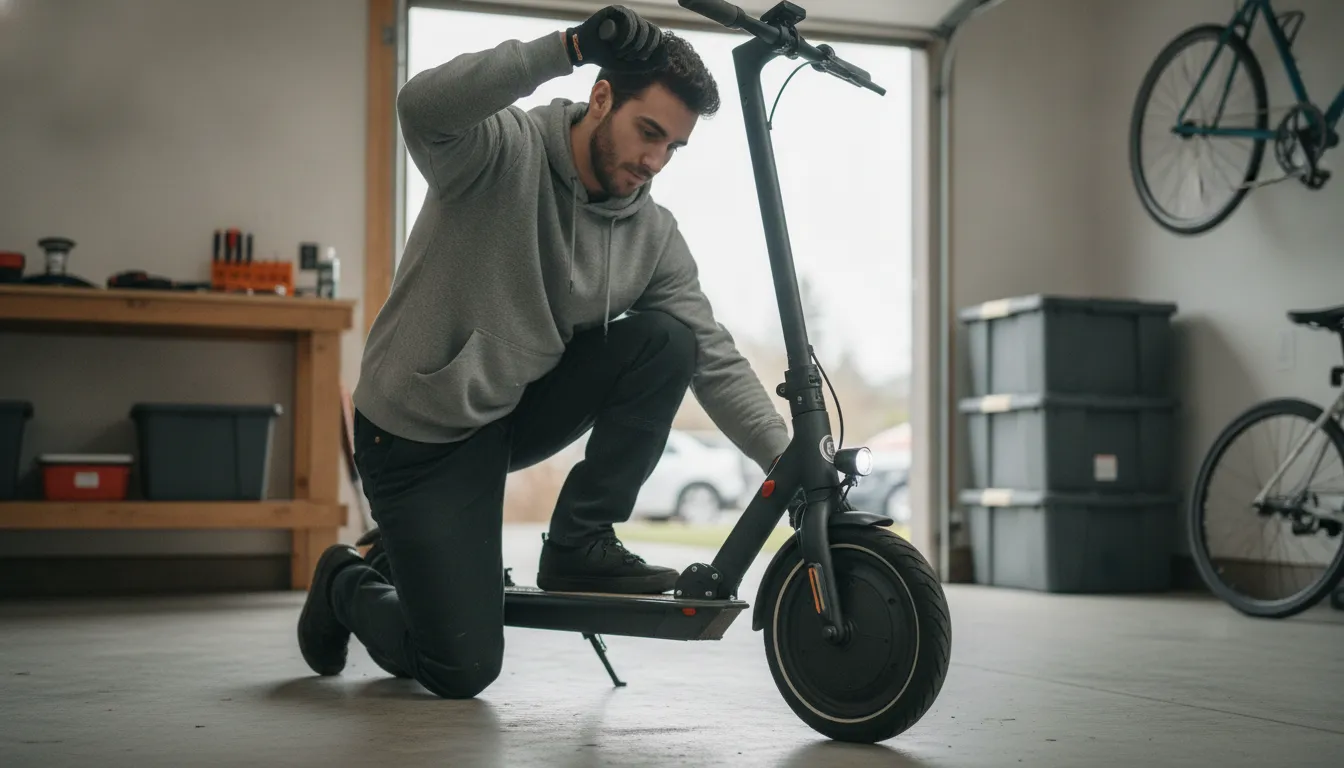
During a walk-around, inspect the stem, visible fasteners, guards, and covers. Bolts should not be missing or visibly loose, and guards should remain in place and undamaged. Operate the folding mechanism only as the manual describes. Make sure the latch fully engages and that the stem does not wobble, shift, or resist normal locking. Do not apply an unlisted torque value or force a stubborn latch. Loose wiring, a damaged frame, a defective folding joint, or a brake problem belongs with a qualified technician rather than a roadside adjustment.
How Do You Care for the Battery and Charger?
Care for an electric scooter battery by using the charger supplied or approved by the manufacturer, charging while you are present, and following the model manual. Unplug the scooter when charging is complete, keep the charging area clear of combustible materials, and stop using the battery if you see physical damage or unusual performance.
Start with the charger. Use the exact charger provided with the scooter, or one specifically recommended by its manufacturer. A charger that fits the connector is not necessarily electrically appropriate. The U.S. Consumer Product Safety Commission advises following the device maker's charging instructions, remaining present while charging, and never charging while asleep or away from home. See the CPSC micromobility safety guidance for the complete recommendation.
Charge on a stable, nonflammable surface in a designated area away from sofas, beds, paper, clothing, and other combustible materials. Do not leave the battery connected for days. When the manual indicates charging is complete, unplug the device. Keep the charger and cable dry, and inspect them regularly for cuts, crushed sections, bent connectors, melting, discoloration, or other damage.
Temperature matters, especially during Central Oregon winters and hot summer storage. Washington State University recommends storing lithium-ion batteries within 50 to 77 degrees Fahrenheit, and cautions against direct sun, hot cars, and freezing conditions. If a battery has frozen, allow it to warm to room temperature before charging. Do not try to speed that process with a heater or other direct heat source.
Before charging or riding, look for a puffy, bulging, deformed, punctured, crushed, or leaking battery case. Discoloration, terminal corrosion, substantially shorter distance on a full charge, unusually long charging, rapid drain, flickering power, or a battery that dies soon after charging also deserves attention. Damage, overheating, overcharging, and non-approved chargers can increase lithium-ion battery risk, so do not open the pack or attempt an electrical repair at home.
If you notice these electric scooter battery warning signs, stop riding and disconnect the charger if it is safe to do so. Move away from a smoking, hot, leaking, or visibly deformed battery, and seek qualified service rather than diagnosing it remotely. Your scooter manual remains the authority for model-specific charging, storage, and inspection instructions.
How Should You Clean, Lubricate, and Store a Scooter?
Clean an electric scooter gently with a soft rag and, where your manufacturer permits it, a mild degreaser. Keep water away from openings and electrical components, and never use a pressure washer or high-pressure spray. The force can drive water into the electrical system. Maryland's micromobility maintenance guide recommends a rag and gentle degreaser, and specifically warns against high-pressure water on e-bikes and e-scooters: Maryland's maintenance guide.
Cleaning is also a useful inspection. Look over the deck, stem, folding hardware, guards, cables, wheels, and frame as you work. Watch for cracks, loose parts, damaged covers, unusual rubbing, or exposed wiring. Check bolts for tightness, but do not guess at a torque value. If wiring is loose or a structural part does not feel secure, stop riding and have a qualified technician assess it.
What lubricant should you use?
Use lubricant only where your scooter manual or manufacturer specifically allows it, and use the approved product or specification for your model. There is no universal lubricant that is appropriate for every scooter. Apply only a small amount to the designated moving part, then wipe away excess. Keep all lubricant off brake rotors, brake pads, tires, wheel contact surfaces, and the deck. Contamination in those areas can reduce traction or braking performance. Do not lubricate sealed electrical, motor, or battery components.
How should you store a scooter?
Store the scooter indoors or in another clean, dry, protected location. Keep it away from rain, puddles, mud, direct sun, extreme heat, and freezing conditions. Let a wet scooter dry naturally before storage, and follow the manual for model-specific battery storage and charging guidance. Avoid leaving the scooter where it can be knocked over or where the folding mechanism can be loaded accidentally. If storage reveals damage, unusual heat, or a charging concern, do not troubleshoot the battery or motor at home. Set the scooter aside and seek qualified service.
Which Maintenance Can Riders Do, and What Needs a Technician?
Riders can handle visual inspections, gentle cleaning, and simple checks described in the scooter manual. A technician should handle electrical faults, battery work, motor systems, controller programming, wiring, and repairs that affect braking, structure, or folding security. If a problem could cause sudden power loss or loss of control, stop riding rather than testing it on the road.
That boundary is not about making routine care complicated. It keeps owners from opening sealed electrical systems or guessing at a safety-critical repair. Maryland's micromobility maintenance guidance specifically advises taking loose wiring to a repair shop and having motor-system work completed by a properly trained mechanic: maintenance guidance from Maryland.
Rider-level care
- Check tires, wheels, brakes, lights, guards, covers, cables, frame, stem, bolts, and the folding latch for visible damage or looseness.
- Clean with a suitable method, keep moisture away from electrical components, and inspect the scooter while cleaning.
- Follow the manufacturer manual for model-specific adjustments. Do not open a battery pack or motor housing.
Technician-level work
- Diagnose brake faults, structural concerns, loose wiring, damaged connectors, and folding hardware that will not secure correctly.
- Perform electrical diagnostics, battery testing or replacement, motor repair or replacement, and controller programming or updates when supported.
- Investigate charging faults, unusual power loss, overheating, connectivity problems, and other symptoms that require testing equipment.
For model-specific examples, see our Segway scooter repair guidance. Voltaire Cycles' service center offers multi-brand diagnostics and mechanical and electrical capabilities, but service availability depends on the scooter model and the issue. Review the repair and service center information before bringing in a scooter, and ask about your specific situation.
When Does Electric Scooter Maintenance Need a Technician?
Electric scooter maintenance needs a technician when the problem involves the battery, charger, brakes, wiring, motor, or structural hardware, or when the scooter behaves unpredictably. Stop riding, disconnect the charger if it is safe to do so, and arrange qualified service instead of opening a battery pack or motor system at home.
Seek professional help promptly if you notice any of the following:
- Battery damage: A puffy, bulging, deformed, discolored, or leaking battery case is a stop-riding warning. Washington State University also identifies punctures, crush damage, and corrosion as signs that require caution. Do not probe, tape, open, or attempt to repair the pack. WSU lithium-ion battery guidance explains these hazards.
- Charging faults: Stop using the scooter if the approved charger will not charge normally, takes substantially longer than usual, becomes unusually hot, or shows damaged wiring. Do not substitute an unapproved charger or keep charging while asleep or away from home.
- Brake or structural failure: Do not ride if the brakes do not respond reliably, the stem or folding latch moves unexpectedly, a guard or cover is damaged, or a critical bolt will not stay secure. A technician can inspect the mechanical system without guessing at the cause.
- Electrical or performance changes: Loose wiring, flickering power, sudden power loss, rapid drain, or a battery that dies soon after charging can indicate an electrical or motor-system problem. Maryland's maintenance guidance recommends taking loose wiring to a repair shop and leaving motor-system work to a properly trained mechanic.
Voltaire's Bend service center offers multi-brand diagnostics and may be able to help with battery testing, electrical troubleshooting, motor or controller work, and mechanical repairs, depending on the scooter and issue. Confirm compatibility before bringing in a model.
Visit Voltaire's repair and service center for electric scooter maintenance help
Rider and technician maintenance comparison:
| Rider checks | Technician work |
|---|---|
| Tires, brakes, lights, and folding latch | Brake, frame, wiring, and latch faults |
| Gentle cleaning and manual-based adjustments | Battery, motor, charger, and controller diagnosis |
| Stop riding when damage or unusual behavior appears | Test and repair safety-critical or electrical faults |
Frequently Asked Questions
Do electric scooters require maintenance?
Yes. Routine maintenance helps you spot wear, loose hardware, tire damage, brake changes, lighting faults, and battery or charger problems before they become a safety issue. Follow the maintenance and charging instructions for your specific model, because components and service requirements vary.
What regular maintenance should I do on my e-scooter?
Before riding, check the handlebars, brakes, throttle, lights, tires, cables, frame, guards, and folding hardware for damage or looseness. The U.S. Consumer Product Safety Commission recommends checking these areas before use: CPSC micromobility safety guidance. Clean gently, inspect the scooter as you work, and charge only with the supplied or manufacturer-approved charger.
What are the most common problems with electric scooters?
Common warning signs include reduced range, unusually long charging, rapid power loss, flickering power, brake changes, damaged tires, loose folding parts, and worn cables. A swollen or deformed battery, leaking residue, overheating, or a charging fault is not a routine adjustment. Stop riding and seek qualified service rather than opening the battery or motor system.
What is the average lifespan of an electric scooter?
There is no dependable universal lifespan. Service life depends on the model, riding conditions, storage, charging habits, load, maintenance, and availability of replacement parts. Use the manufacturer manual as the reference for service and replacement decisions, and have a technician evaluate recurring faults or unsafe wear.
What type of lubricant should I use on my electric scooter?
Use only the lubricant specified or approved in your scooter's manual. Do not apply an unverified spray, and keep any lubricant away from brake surfaces, tires, electrical connectors, and the battery. If the manual does not clearly identify the part or product, ask a qualified technician before lubricating it.
Ready to Get Help With Scooter Maintenance?
If you want a second set of eyes on your electric scooter, Voltaire Cycles can help you understand which checks belong at home and which may need technician attention. For Bend and Central Oregon riders, visit Voltaire's repair and service center page to get started with maintenance questions for your model.