

Electric Scooter Battery Replacement Guide
When an electric scooter starts losing range, cutting out under load, or refusing to charge, the battery may be nearing the end of its useful service life. It may also be a charger, controller, connector, or wiring problem. That is why electric scooter battery replacement should begin with diagnosis, not a quick order for the first battery that appears to fit.
Need help deciding what to do next? Contact Voltaire Cycles for electric scooter battery testing and repair guidance.
This guide explains the warning signs, the specifications that must match, and the safety issues that make some batteries unsuitable for DIY work. It also explains the difference between replacing a pack and repairing a larger electrical fault. The guide is written for Bend and Central Oregon riders and shoppers who need compatibility guidance before buying online.
The practical goal is simple: identify whether the battery is the problem, choose a safe and compatible path, and return to riding with confidence. A battery that is swollen, leaking, unusually hot, damaged, or producing a burning odor should not be charged or ridden. Set it aside safely and arrange a qualified inspection.
What are the signs you need an electric scooter battery replacement?
Short answer: A replacement becomes more likely when a scooter has sharply reduced range, loses power under normal load. Shuts down unexpectedly, or will not accept a charge after the charger and connections have been checked. Those symptoms are not conclusive by themselves. A qualified diagnostic can separate a worn battery from a failed charger, controller, connector, wiring harness, or motor.
Start with the pattern, not one disappointing ride. A gradual loss of range over time can point toward reduced battery capacity. A scooter that powers on but drops out when climbing or accelerating may have a battery that cannot deliver current as it once did. Intermittent power can also come from a loose connector, damaged cable, or controller fault. If the display shows an error code, record it before disconnecting anything and follow the manufacturer's instructions.
Charging behavior is another useful clue. A pack that never reaches its normal charge indication, reaches it unusually quickly and then drains quickly, or will not charge at all needs testing. Check that the charger is the correct one for the scooter, inspect the plug and port for visible damage, and confirm that connections are secure. Do not keep trying to charge a pack that becomes hot, smells like burning, leaks, changes shape, or shows other visible damage.
Physical symptoms matter more than range. A swollen case, cracked housing, corrosion, leaking material, melted connector, or unusual heat is a stop-using warning. Do not open a lithium-ion pack to replace individual cells. Internal repair requires battery-specific knowledge, appropriate equipment, and a safe process for managing stored energy.
A good inspection looks at the complete system. Voltaire's service operation includes electrical diagnostics, battery testing and replacement, motor and controller work, software updates, and connectivity troubleshooting. The team services electric vehicle brands beyond those sold in the store, so a scooter does not have to be purchased from Voltaire to be considered for service. A systematic inspection, documented work order, quality check, and test ride can help confirm whether a new battery solves the actual problem.
If the scooter is otherwise in good condition and testing shows the pack has lost useful capacity, replacement may restore practical range. If the battery tests normally, spending money on a new pack may not solve the issue. In that case, the next step may be charger testing, connector repair, controller diagnosis, or a broader service decision.
For a related look at warning signs and service decisions, read this electric scooter repair service guide. It complements this article, which focuses specifically on battery replacement decisions.
Can an electric scooter battery be replaced safely?
Short answer: Yes, many scooter battery packs can be replaced, but safe replacement depends on the scooter, battery chemistry, voltage, connectors, enclosure, charger, and battery-management system. A qualified technician should assess a damaged or uncertain pack. A replacement is not safe simply because it fits in the deck or uses the same connector.
Lithium-ion batteries store substantial energy in a compact package. The Occupational Safety and Health Administration identifies hazards during battery use, emergency response, disposal, and recycling. The U.S. Consumer Product Safety Commission also advises micromobility owners to use batteries designed and manufactured for the device and to follow manufacturer directions.
Stop using the battery immediately if you notice an odor, a change in color, excessive heat, a change in shape, leaking, or odd noises. Do not charge it, ride the scooter, press on the case, or try to make an internal repair. Move people and flammable materials away from the area. Seek qualified guidance. If the battery is hot, smoking, or actively burning, leave the area and contact emergency services rather than handling it.
Charging is part of replacement safety. Use the charger supplied with, or specifically recommended for, the scooter. Do not substitute a universal charger because the plug appears compatible. The CPSC says to be present while charging micromobility products, avoid charging while sleeping, and unplug the device when charging is complete. Keep the battery away from direct sunlight and hot vehicles, and follow the manufacturer's temperature and storage instructions.
Do not assume a new pack solves every risk. A replacement should be matched to the scooter's electrical design and physically secured so it cannot move, pinch wiring, or contact conductive surfaces. The technician should confirm the charger and battery-management system are appropriate, inspect connectors and wiring, and test the scooter after installation.
Professional help is especially important when the original pack is sealed, the wiring is unfamiliar, the scooter has been modified, or the battery has been exposed to water or impact. Cell-level rebuilding is different from installing a verified replacement pack. It should not be treated as a casual weekend project.
Voltaire's electric scooter battery safety checklist offers related pre-ride and charging guidance. For a replacement decision, bring the scooter model, a photo of the battery label, charger details, and any error code to a service conversation.
How do you choose the right replacement battery?
Short answer: Match the replacement to the exact scooter model and the original pack's electrical and physical specifications. Confirm voltage, capacity, chemistry, connector and terminal style, dimensions, mounting, charger, and battery-management system. A product described as a scooter battery is not automatically compatible with your scooter.
Use the original battery label, owner's manual, manufacturer documentation, and clear photos as your starting evidence. If the label is missing or unreadable, a technician can help identify the system before you order. Do not guess from the scooter's advertised motor wattage. The battery, controller, charger, and wiring are related, but they are not interchangeable specifications.
| What to match | Why it matters | What to verify |
|---|---|---|
| Model and generation | Manufacturers can change pack shape or wiring between versions. | Exact model name, year or revision when available, and original part number. |
| Voltage | The pack must be appropriate for the scooter's electrical system. | Original voltage and the replacement listing's stated voltage. |
| Capacity | Amp-hours and watt-hours describe stored energy and affect expected range. | Ah or Wh, physical space, and whether the controller and charger support the pack. |
| Chemistry | Chemistry affects charging requirements, handling, and performance. | Battery chemistry on the label or in manufacturer documentation. |
| Connector and terminals | A plug that looks similar may have different wiring or terminal geometry. | Pin count, polarity, terminal style, connector condition, and wire routing. |
| Dimensions and mounting | The pack must fit securely without crushing wires or moving during a ride. | Length, width, height, mounting points, enclosure, and retention method. |
| Charger and BMS | Incorrect charging equipment or battery management can create a safety problem. | Correct charger output, BMS compatibility, and manufacturer guidance. |
Battery catalogs show why these checks matter. Listings are often organized by exact scooter model, voltage, amp-hour capacity, application, terminal type, and warranty category. They are not organized as one universal fit. Some catalogs list multiple amp-hour capacities and terminal styles. That variety is useful for research, but it is not permission to select the largest or cheapest-looking option.
Capacity deserves careful explanation. A higher amp-hour rating can suggest more stored energy, but it may also require more physical space and may not match the charger or control system. Watt-hours can be estimated from volts multiplied by amp-hours, but that calculation does not confirm physical or electronic compatibility. Range also depends on rider weight, terrain, temperature, speed, tires, and riding style.
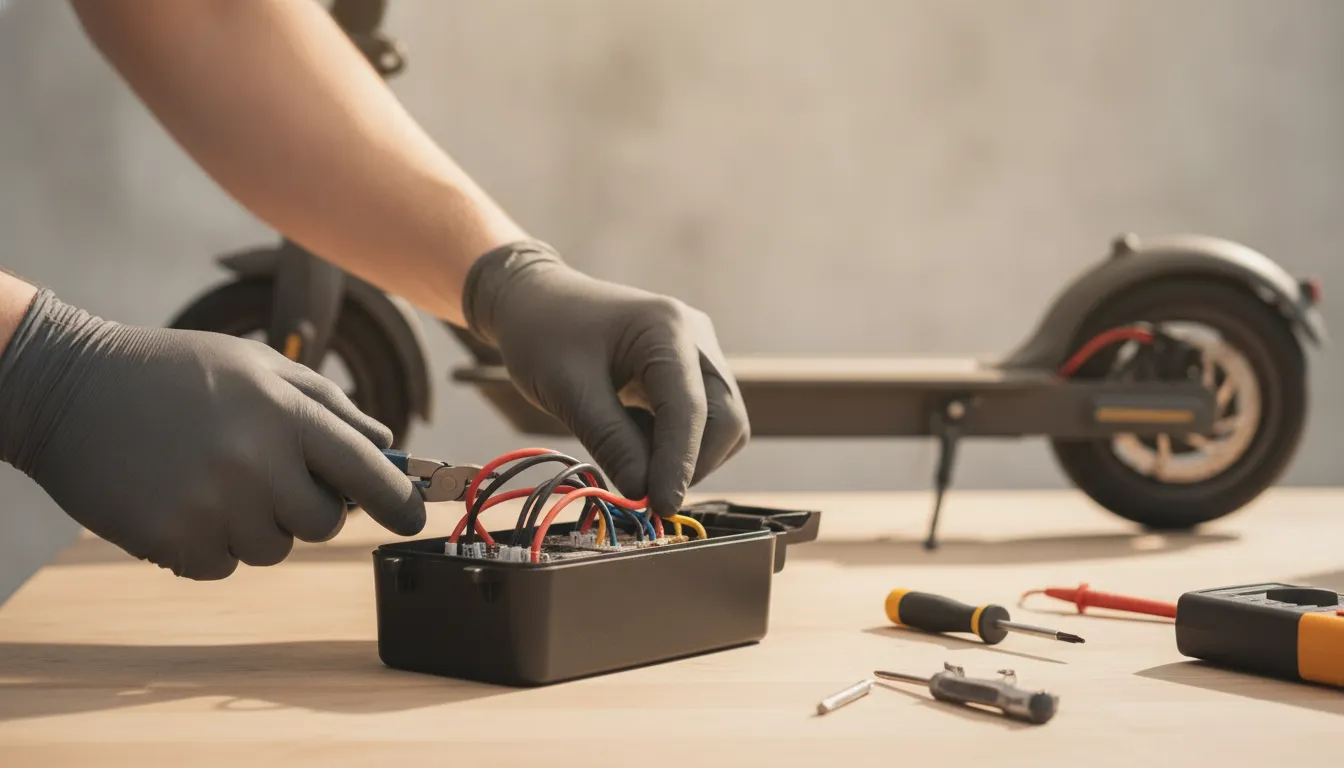
When a model-specific option exists, verify the complete listing against the original pack. For example, Voltaire carries a product page for a 48V scooter replacement battery, but that link should be used only when the scooter model and current product details match. Check availability and compatibility before purchasing.
If the model is not listed, do not force a generic pack into the scooter. Send the model number, battery label, charger label, connector photos, and measurements to a qualified service team. A compatibility review is usually less costly than installing a wrong pack and discovering that the charger, controller, or wiring also needs replacement.
Should you repair, replace, or retire the scooter?
Short answer: Replace the battery when testing confirms that the pack has degraded and the scooter remains a sound platform. Repair the scooter when the battery is healthy but another component is causing the symptom. Consider retiring the scooter when the frame, wiring, charger, controller, enclosure, or other systems have multiple serious faults that make a safe repair impractical.
The decision should follow a diagnostic sequence. First, document the symptom and its timing. Does the scooter lose power only on hills, stop after a particular distance, fail to charge, or shut down when the display shows a code? Next, inspect the charger, charge port, connectors, wiring, and visible battery case. Finally, test the battery and related electrical components rather than assuming the battery is responsible.
This distinction matters because a new pack cannot repair a failed controller, damaged harness, broken charge port, or motor fault. Conversely, replacing a controller when the battery has lost capacity may leave the original range problem unchanged. A system-level diagnosis helps protect the budget and prevents unnecessary parts swapping.
Replacement is often the sensible path when the scooter is structurally sound, the controls and motor are in good condition. The battery is the confirmed failure point, and a safe compatible pack can be identified. Repair may be more appropriate when the issue is a connector, fuse, port, charger, software setting, or wiring fault. A broader service review may be best when the scooter has been modified, stored poorly, exposed to water, or involved in a crash.
Do not make the choice on battery price alone. A low-cost pack that requires a new charger, rewiring, custom mounting, or controller changes may not be the simple replacement it first appeared to be. Voltaire's service team can evaluate multiple electric vehicle brands, including brands not sold in the store, and can look at electrical and mechanical systems together.
Retirement is not a failure of the owner. If the battery is unsafe, parts are unavailable, the frame or enclosure is damaged. Or several systems have reached the end of their useful service life, continuing to invest may not be the responsible option. Ask for an inspection and a clear explanation of what is repairable, what must be replaced, and what should be taken out of service.
For Bend-area riders, the next step is a service conversation. For nationwide shoppers, gather documentation and model information before contacting a retailer or manufacturer. In either case, a qualified opinion is more useful than a universal battery recommendation that ignores the actual scooter.
How should you charge, store, and dispose of the old battery?
Short answer: Use only the correct charger, stay present while charging, store the battery away from heat and flammable materials, and keep a damaged pack out of service. Do not put a lithium-ion battery in household trash or a regular recycling bin. Ask a local hazardous-waste or battery-recycling program how to handle it.
Good habits can reduce avoidable stress on a replacement battery. Charge according to the scooter manufacturer's instructions and use the intended charger. Keep the charging area clear, dry, and visible. Do not charge in a bedroom, inside a hot vehicle, or while sleeping. Follow the product's guidance for temperature, storage charge, and long-term storage rather than relying on a generic schedule.
The U.S. Fire Administration advises storing lithium-ion batteries at room temperature when possible and avoiding charging below 32 degrees Fahrenheit or above 105 degrees Fahrenheit. It also says to stop using a battery when there is an odor, color change, excess heat, change in shape, leaking, or odd noises. These warnings apply to the old pack and the replacement pack.
When a pack reaches the end of its life, do not place it in a curbside bin. The U.S. Environmental Protection Agency explains that lithium-ion batteries can be damaged or crushed in municipal recycling and become a fire hazard. It recommends separate recycling or household hazardous-waste collection, with terminals covered using non-conductive tape or each battery placed in its own plastic bag when appropriate for the program.
- Stop riding and charging a pack that is swollen, leaking, unusually hot, damaged, or producing a burning odor.
- Keep the battery away from direct sunlight, hot vehicles, water, and materials that can burn.
- Identify the battery chemistry and model from the case, manual, or product markings without opening the pack.
- Contact a qualified service or local waste program for handling instructions before transporting a damaged battery.
- Use the correct charger and follow the manufacturer's storage and charging directions for the replacement.
Ready for a compatibility or safety review? Ask Voltaire Cycles about battery testing and replacement service.
For broader charging and lifespan principles, see this battery charging and lifespan guide. The chemistry and hardware can differ between e-bikes and scooters, so use it for general care principles and follow your scooter manufacturer's instructions for the final word.
What does electric scooter battery replacement look like in Bend or online?
Short answer: Bend and Central Oregon riders can start with a hands-on inspection and battery test through Voltaire Cycles' service team. Nationwide shoppers can use the same diagnosis-first approach online by sending the scooter model, battery label, charger details, photos, and measurements before ordering or shipping a part.
Local support is useful when the symptom is unclear. A technician can inspect the charge port, wiring, battery enclosure, motor, controller, and mounting space in context. Testing can confirm whether the battery is actually underperforming and whether the replacement needs to address a wider electrical issue. This is particularly valuable for older, modified, or less common scooters.
Voltaire's service center supports electrical diagnostics, battery testing and replacement, controller programming, motor work, software updates, and connectivity troubleshooting. The team works across electric vehicle brands, including brands not sold in the store. Its service process includes inspections, documentation, quality control, and test-ride verification before returning a vehicle.
For a Bend visit, bring the scooter if it is safe to transport, the charger, the owner's manual if available, and any previous service notes. If the scooter has a damaged or swollen battery, do not transport it casually. Contact the service team first for handling guidance. A clear photo of the battery label and connector can help start a conversation.
Online shoppers should collect the exact model and generation, battery part number, and voltage. Add the amp-hour or watt-hour rating, connector and terminal photos, dimensions, charger output, and a description of the symptom. Do not remove a sealed battery just to obtain information. The original label, manual, or manufacturer documentation is safer evidence.
Voltaire serves Bend, Redmond, Sisters, Sunriver, and surrounding Central Oregon communities, while online purchasing extends the store's reach beyond the region. Service availability, shipping requirements, stock, and compatibility depend on the specific vehicle and should be confirmed directly. The goal is not to promise that every pack can be replaced. It is to give each rider a clear and safe next step.
Start with the electric scooter repair and battery service page to share your model and situation. If the scooter needs a different solution, a diagnostic conversation can help identify that before you purchase a part.
Frequently Asked Questions
How much does it cost to replace a battery in an electric scooter?
There is no responsible single price for every scooter. The total depends on the model, battery chemistry, voltage, capacity, physical design, availability, charger needs, and whether diagnosis finds another failed component. Ask for a compatibility review and service estimate after the scooter and battery information are checked.
Can an electric scooter battery be replaced?
Often, yes. The scooter must have a compatible replacement option, a sound enclosure and wiring system, and a charger and battery-management system that match the pack. Some batteries are model-specific or difficult to source. A professional can test the original system before you order.
How do you revive a dead e-scooter battery?
Do not attempt to revive a swollen, leaking, hot, damaged, or odor-producing pack. Do not open a lithium-ion battery or connect an unknown charger to it. Have the battery and charging system assessed by a qualified technician. A dead display does not prove that the battery alone has failed.
How much does an electric scooter battery cost?
Battery cost varies with the scooter and the required specifications. A higher capacity or different chemistry is not automatically an upgrade, and a generic listing may not fit the controller, charger, enclosure, or connector. Match the complete system before comparing products.
What information should I gather before ordering a replacement?
Gather the scooter model and generation, original battery label, voltage, capacity, connector and terminal photos, dimensions, charger information, and the symptoms you observed. Include an error code if the scooter displays one. This information makes a compatibility review more reliable and helps avoid an unsafe guess.
Get a clear battery replacement next step
A battery problem does not have to become a guessing game. Voltaire Cycles of Central Oregon can help Bend and Central Oregon riders start with the right questions: Is the battery actually failing? Is the charger or controller involved? Which replacement specifications must match? And is the scooter otherwise ready to return to the road?
Share the scooter model, battery label, charger details, photos, and symptoms when you reach out. If the battery is swollen, leaking, unusually hot, damaged, or producing a burning odor, stop using it and ask for safe handling guidance before transporting it.