

Segway Ninebot electric scooter review: E2 Pro vs E3 Pro
Choosing a Segway Ninebot scooter is less about chasing a headline specification and more about matching the scooter to your daily rides. In this product-page review, we compare the Segway Ninebot E2 Pro and E3 Pro for shoppers in Bend and across Central Oregon, with practical attention to ride quality, usable range, portability, service support, and safety. This is a product-page review based on current model information, not independent lab testing.
Talk with Voltaire Cycles about the right electric ride
Review answer: The right Segway Ninebot electric scooter review should explain which model fits your rider, routes, storage needs, and expectations, rather than treating every specification as equally important. The E2 Pro may suit simpler urban trips, while the E3 Pro deserves a closer look when comfort and capability matter more.
We will also clarify who should buy, who may be better served by another type of electric mobility, and what local support can add after the sale. Start by looking at the questions a useful review should answer before comparing features.
What does a Segway Ninebot electric scooter review need to tell you?
A useful Segway Ninebot electric scooter review should do more than repeat a product page. It should identify the exact model and variant, explain how the scooter fits a real rider and route, set realistic range expectations, and discuss storage, charging, and service. The best reviews separate published specifications from observations made during independent testing.
Start with the exact scooter. Ninebot is a broad product family, and trim names can conceal meaningful differences in motor output, tire design, suspension, controls, lighting, folding hardware, and included equipment. A trustworthy review states the model being evaluated, notes the tested configuration, and flags changes between model years or regional versions. Without that context, a conclusion may sound precise while applying to a different scooter.
Next, look for a clear test framework. A review should explain the route, surface, weather, rider weight, hills, stops, and traffic conditions behind its observations. Acceleration on a smooth, flat path does not tell you how a scooter will feel on rough pavement or a Central Oregon incline. The same is true of range. A manufacturer's estimate is useful for comparison, but actual distance depends on speed, terrain, temperature, payload, tire pressure, and riding style. A responsible review labels product-page claims as specifications and labels hands-on findings as test observations.
Rider fit also deserves more attention than a top-speed number. Consider deck space, handlebar height, standing posture, braking feel, weight for carrying, and folding dimensions. Also consider whether the scooter can be stored securely at home or transported in a vehicle. Commuters should think about charging access and the length of the daily route. If a seated design is more appropriate, compare the experience with adult scooters with seats rather than assuming every scooter serves the same rider.
Finally, ownership context matters. A review should explain what support is available after purchase, especially for tires, batteries, brakes, and electrical concerns. Voltaire's electric scooter battery service guide can help readers understand a key long-term consideration, while the Segway E3 Pro commuter scooter review provides a model-specific point of comparison. For Bend riders, local advice and service can be as important as the initial specification sheet.
Which Segway Ninebot models fit Bend riders best?
Review answer: For shorter, straightforward trips, the E2 Pro emphasizes portability and efficient commuting. The E3 Pro is the better fit when Bend pavement, uneven surfaces, and longer outings make suspension and additional range more valuable. Both are approachable Segway options, but the right choice depends on route comfort, storage, and how much carrying you expect.
For this Segway Ninebot electric scooter review, the most useful comparison is between the two models Voltaire lists: the Segway E2 Pro and the Segway E3 Pro. Their published specifications point to different strengths rather than a single universal winner.
| Specification | Segway E2 Pro |
|---|---|
| Manufacturer-estimated maximum speed | 18.6 mph |
| Manufacturer-estimated range | Up to 24.9 miles in Eco mode; about 15.5 miles in Sport mode |
| Motor output | 350 W nominal; 750 W maximum |
| Battery | 275 Wh |
| Ride and carrying details | About 41.4 lb; 10-inch tubeless pneumatic tires; no suspension listed |
| Specification | Segway E3 Pro |
|---|---|
| Manufacturer-estimated maximum speed | 20 mph |
| Manufacturer-estimated range | Up to 34 miles in Eco mode; about 17.5 miles in Sport mode |
| Motor output | 400 W nominal; 800 W maximum |
| Battery | 368 Wh |
| Ride and carrying details | About 40.1 lb; front and rear elastomer suspension; 265 lb maximum payload |
When does the E2 Pro make sense?
The E2 Pro suits riders who value a familiar, manageable commuter format. Its manufacturer-estimated 18.6 mph maximum and 10-inch tubeless pneumatic tires are appropriate for routine paved trips, errands, and neighborhood transportation. The published range varies by mode and test conditions, so treat the Eco figure as a controlled estimate, not a promise for every Bend ride. Rider weight, temperature, hills, wind, surface, and speed all affect real-world distance.
At about 41.4 pounds, it is not featherlight, but its commuter-focused design can work well when the scooter must be folded, stored, or moved occasionally. The E2 Pro also lists front drum and rear electric braking, along with traction control features described by Segway. Those details make it a practical option for riders who want straightforward equipment without prioritizing suspension.
Why choose the E3 Pro?
The E3 Pro earns consideration when comfort over inconsistent pavement matters. Its front and rear elastomer suspension are designed to reduce the sharpness of bumps and transitions, while the larger 368 Wh battery supports a higher manufacturer-estimated range. Its listed maximum speed is approximately 20 mph, and the published Sport-mode estimate is about 17.5 miles. These figures remain test-dependent and should be used for planning, not guaranteed mileage.
Both models can support a substantial rider load, but the E3 Pro combines a 265-pound maximum payload with a slightly lower listed weight of about 40.1 pounds. Before choosing, consider your actual route, where you will store the scooter, and whether smoother handling is worth more to you than the E2 Pro's simpler commuter setup. You can browse the current Segway collection and compare the models with Voltaire's local guidance.
How do ride quality, range, and portability compare?
Review answer: The E3 Pro prioritizes comfort with front and rear suspension, while the E2 Pro uses a rigid, no-suspension setup that keeps its design simpler. Both fold for storage, but neither range claim is a guarantee. Speed, rider load, temperature, pavement, hills, and riding mode all change the distance available in everyday use.
Ride quality is the clearest difference between these two scooters. The E3 Pro's front and rear elastomer suspension helps absorb vibration from uneven pavement, driveway transitions, and other ordinary urban imperfections. That can make a noticeable difference on a longer commute or for riders who prefer a more settled feel through the handlebars and deck. It does not turn the scooter into an off-road vehicle, but it gives the Pro a comfort advantage when the route is not perfectly smooth.
The E2 Pro has no suspension, so more of the road surface reaches the rider. Its 10-inch tubeless pneumatic tires still provide some cushioning, and the rigid setup may appeal to riders who value a straightforward commuter design. On consistently smooth pavement, the difference may matter less. On rougher routes, the E3 Pro is the more forgiving choice.
Published range figures also need context. Segway lists the E3 Pro at up to 34 miles under its stated test conditions. The E2 Pro is listed at approximately 15.5 miles in Sport mode, 21.7 miles in Standard mode, and 24.9 miles in Eco mode. Those figures are measured at specific speeds, with a specified rider load, temperature, and pavement. Higher speeds, heavier loads, colder weather, hills, rough surfaces, and repeated acceleration can all reduce real-world range. Plan around your complete round trip, not the largest number on a product page.
Portability is a practical strength of both models. The E2 Pro weighs approximately 41.4 pounds and folds to about 45.9 by 21.1 by 22.2 inches. The E3 Pro weighs approximately 40.1 pounds and folds to about 48.6 by 22.2 by 17.5 inches. The numbers describe the folded footprint, but they do not tell you how manageable a scooter will feel on stairs. If you regularly carry it into an apartment, office, or vehicle, test the folding action and lifting position before choosing.
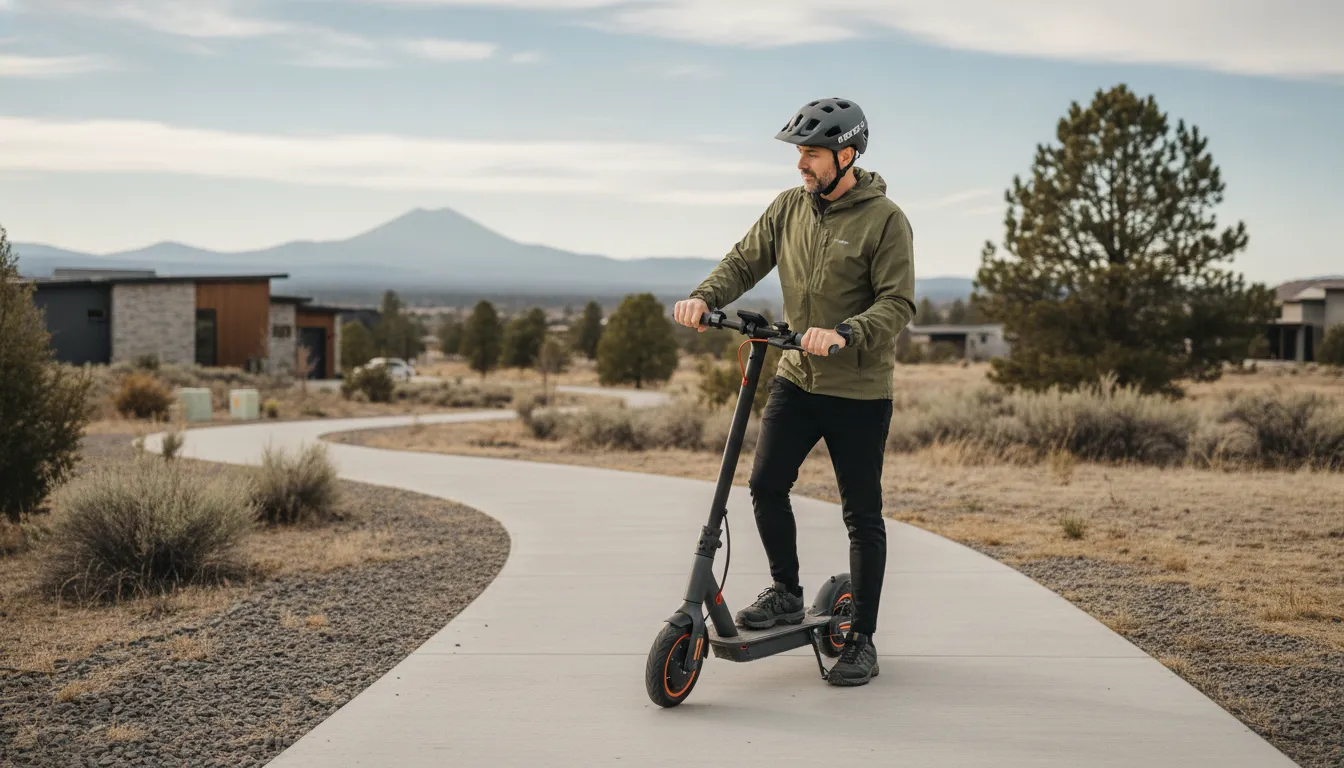
Storage matters too. Measure the available space with the scooter folded, leave room around the charging area, and keep it in the temperature range specified by the manufacturer. The E3 Pro makes the stronger case for comfort, while the E2 Pro offers a compact-feeling commuter alternative with a clear range tradeoff between riding modes. Match the choice to your route, carrying routine, and tolerance for bumps.
What should owners know about charging, service, and maintenance?
Review answer: Charge your scooter with the supplied equipment in a dry, suitable location, then make a quick safety check before each ride. Routine attention to tires, brakes, fasteners, and controls can catch problems early. When an issue involves electronics, diagnostics, or a brand-specific system, qualified multi-brand service can help identify the right next step.
Charging is easiest to manage when it becomes part of your regular routine. Inspect the charger, cable, and connection before plugging in, and stop using equipment that is damaged, unusually hot, or behaving differently than expected. Follow the model's manual for charging conditions, storage, and any recommended operating limits. Avoid treating a generic charger or an improvised cable as an interchangeable replacement. If you are setting up a connected Segway or Ninebot model, complete the app or manual setup before relying on ride modes, alerts, or display information.
A short pre-ride inspection is worthwhile even when the scooter feels normal. Check that both tires are properly inflated according to the manufacturer's guidance. Look for visible cuts or embedded debris, and test the brakes at low speed in a clear area. Confirm that the stem, folding mechanism, handlebar, and other accessible fasteners feel secure. Controls should respond predictably, and lights or reflectors should be in their expected condition for the route and time of day.
Service becomes especially useful when a warning code persists, braking feels inconsistent, or a wheel develops play. It is also useful after impact or water exposure, or when a battery and charging problem cannot be isolated safely. A technician can inspect mechanical components and, where supported, use diagnostics to separate a setup issue from a component problem. Voltaire Cycles describes an in-house service center with certified technicians and multi-brand repair capabilities. Owners in Bend can explore electric bike service and repairs for support across electric mobility products.
These practices support dependable ownership, but they cannot promise a particular range, battery lifespan, repair outcome, warranty decision, or service cost. Those details depend on the exact model, use, storage, condition, and current manufacturer or retailer policies. Keep the owner's manual available, document unusual symptoms, and ask for model-specific guidance rather than assuming every Ninebot model uses the same settings or parts.
Are Segway Ninebot scooters safe and legal in Oregon?
Review answer: Segway Ninebot scooters can be used responsibly in Oregon when the specific model, route, and rider behavior fit the applicable rules. Oregon's motor-assisted-scooter and powered-micromobility provisions address public-road use, access restrictions, protective headgear, signals, passengers, and roadway conduct. Because local agencies and land managers may set additional limits, confirm the current rule before each ride.
A scooter-specific safety review should begin with control, not just motor output. Practice starting, braking, turning, and using the throttle in a quiet area before riding near traffic. Keep both hands available for steering, look well ahead for surface changes, and slow before driveways, intersections, blind corners, pedestrians, and parked vehicles. A Ninebot's compact wheels can react differently from a full-size bicycle when they meet gravel, potholes, wet leaves, or uneven pavement.
Where can a motor-assisted scooter go?
Oregon rules do not create a blanket permission slip for every sidewalk, bike path, trail, or park. Local governments and state agencies with authority over bicycle lanes, bicycle paths, sidewalks, and trails may prohibit powered micromobility devices in specified places. The current Oregon statute and enrolled transportation legislation should be read alongside posted signs and the rules of the agency managing the route.
That distinction matters in Bend and throughout Central Oregon, where a route may move between city streets, multi-use paths, private property, and managed recreation land. Do not assume that a path allowing bicycles also allows a motor-assisted scooter. Check the entrance sign, municipal guidance, and land-manager rules. State parks and other recreation areas can have their own restrictions, including rules that differ from nearby public roads. If a route is unclear, choose a clearly permitted road or path rather than treating silence as permission.
How should you ride around traffic and other path users?
Use the scooter's signals when turning or changing position, and make sure other road users can see what you intend to do. Obey traffic controls, travel predictably, and yield when required. On shared paths, reduce speed near people, announce yourself before passing when appropriate, and leave extra stopping distance. A scooter should never be operated at a speed that prevents a controlled stop within the visible riding space.
Do not carry a passenger unless the scooter and the applicable rule expressly allow it. A second rider changes balance, braking distance, steering, and visibility. Keep the deck clear, secure loose clothing and straps, and avoid riding while distracted or impaired. At night or in poor visibility, use the required lighting and make yourself conspicuous to drivers and path users.
What protective gear makes sense?
Protective headgear is a prudent baseline for every scooter ride, especially for new riders, higher-speed travel, traffic exposure, and unfamiliar surfaces. Oregon's current provisions cover motor-assisted scooters and other listed micromobility vehicles in defined public-use situations, while requirements can depend on the rider's age, location, and vehicle classification. This is general information, not legal advice. Review the current statute and ask the relevant agency when your situation is unusual.
Finally, inspect tires, brakes, the stem, folding mechanism, throttle, lights, and battery condition before leaving. If anything feels loose, inconsistent, or damaged, postpone the ride and have it checked. A careful pre-ride inspection and a route-specific permissions check do more for a safe Segway Ninebot electric scooter review than a generic claim that every scooter is legal everywhere.
Who should buy a Segway Ninebot scooter, and who should choose another ride?
Review answer: A Segway Ninebot scooter is a strong fit for riders who want a compact, approachable ride for short trips on suitable paved routes, with simple storage and easy walk-up use. It is a weaker match for rough terrain, long unsupported journeys, frequent carrying, or riders who need a seated, higher-comfort platform. Your route and daily routine matter more than the badge.
Choose the Ninebot when your typical trip is predictable. It makes the most sense for neighborhood errands, first-mile connections, and short commutes where you can use smooth pavement, manage the scooter's weight without strain, and store it securely indoors. Riders who appreciate a small footprint may also prefer it when a full-size electric bike would be inconvenient in an apartment, office, or vehicle.
It can also suit an adult or retiree who wants a straightforward personal mobility option, provided balance, standing comfort, and the controls feel natural. A test ride is especially useful here. Pay attention to how confidently you start, stop, turn, and hold your posture after more than a few minutes. A scooter that feels manageable in a showroom may feel different over a longer route or on imperfect pavement.
Choose another ride when comfort, cargo, or terrain leads the decision. A seated electric bike may be better for longer rides, frequent stops, or anyone who wants a more relaxed position. A full-size e-bike is usually the more practical choice when you need carrying capacity, a familiar bicycle setup, or greater route flexibility. For trails, gravel, steep grades, or rough surfaces, look for a vehicle designed and permitted for that environment rather than assuming a commuter scooter can handle it.
Storage and carrying deserve an honest check. If you must lift the scooter into a vehicle, carry it up stairs, or move it repeatedly during the day, confirm that you can do so comfortably. Also consider support after the sale. A local retailer with rental orientation and multi-brand service can help you compare controls, learn safe operation, and identify whether a different format better fits your use. Voltaire serves Bend and Central Oregon, including Redmond, Sisters, and Sunriver, while access rules vary across local paths and trails. Check posted guidance before riding, and keep your intended route in mind during the review.
Visit Voltaire Cycles in Bend for a hands-on test ride and practical guidance.
Frequently Asked Questions
Which Segway Ninebot electric scooter is the best fit for my commute?
Match the scooter to your route, storage, and carrying needs. The Segway E3 Pro is listed for riders age 16 and older who are at least 5 feet 3 inches tall. The E2 Pro is designed as a compact urban commuter. Compare your daily distance, hills, stairs, and riding surface before choosing a model.
How much range can I realistically expect from a Segway Ninebot scooter?
Published range is a test estimate, not a guarantee for every ride. For example, Segway lists the E3 Pro at up to 34 miles in its efficiency mode and about 17.5 miles in Sport mode. The E2 Pro is listed at up to 24.9 miles in Eco mode. Speed, rider weight, temperature, hills, and surface change results. Segway's E2 Pro specifications describe its test conditions.
Will a Segway Ninebot scooter feel smooth, and is it easy to carry?
The E3 Pro uses front and rear elastomer suspension and weighs about 40.1 pounds. The E2 Pro weighs about 41.4 pounds and has no suspension listed in its specifications. Both fold for storage. That makes them practical for mixed commuting, but riders should test the folded weight before planning to carry one up stairs.
What should Oregon riders know about routes and service?
Oregon treats a qualifying motor-assisted scooter as a vehicle with specific operating rules. State law also allows local governments and agencies to regulate where these devices operate, including trails and other public ways. Check posted route rules before riding, and choose a retailer or service provider that can help with model-specific setup, inspections, and maintenance.
Ready to Test a Segway Scooter in Bend?
A hands-on ride can help you compare the Segway Ninebot's feel, controls, and everyday fit with your routes and comfort preferences. Visit Voltaire's Bend showroom to talk through the model and get practical guidance before you choose. Schedule a hands-on Segway scooter test ride and have a model-fit conversation with the local team.