

Electric Scooter in Rain: Ratings, Riding, and Storage
Can you ride an electric scooter in rain? Sometimes, but the safe answer depends on the scooter's design, its IP rating, the weather, and the condition of the route. Rain changes traction, braking, visibility, and electrical risk. This guide explains how to make a careful decision without treating water resistance as waterproofing.
Call for a free wet-weather scooter consultation
What does an electric scooter in rain need to handle?
An electric scooter in rain needs more than a sealed display. The tires must maintain contact with a wet surface, the brakes must work consistently, and the electrical system must have an appropriate level of protection. Fenders can reduce spray, while lights and reflective details help other road users see you.
Before riding, inspect the forecast and the route. A brief light shower on a familiar, paved path is different from heavy rain, standing water, lightning, or a route covered with leaves and mud. If the ride is optional, waiting for better conditions is often the safest choice.
Use the same conservative approach when choosing equipment. A properly fitted helmet and visible clothing do not make a scooter safe in every storm, but they are useful parts of a broader riding routine. Consider whether you can keep both hands on the controls, see clearly through the rain, and stop within the space you can see.
Wet-weather readiness is also a condition issue. A scooter may have been tested when new, but a crash, loose fastener, damaged cable, cracked housing, or missing charge-port cover can change its protection. The model's documentation and its current condition matter together.
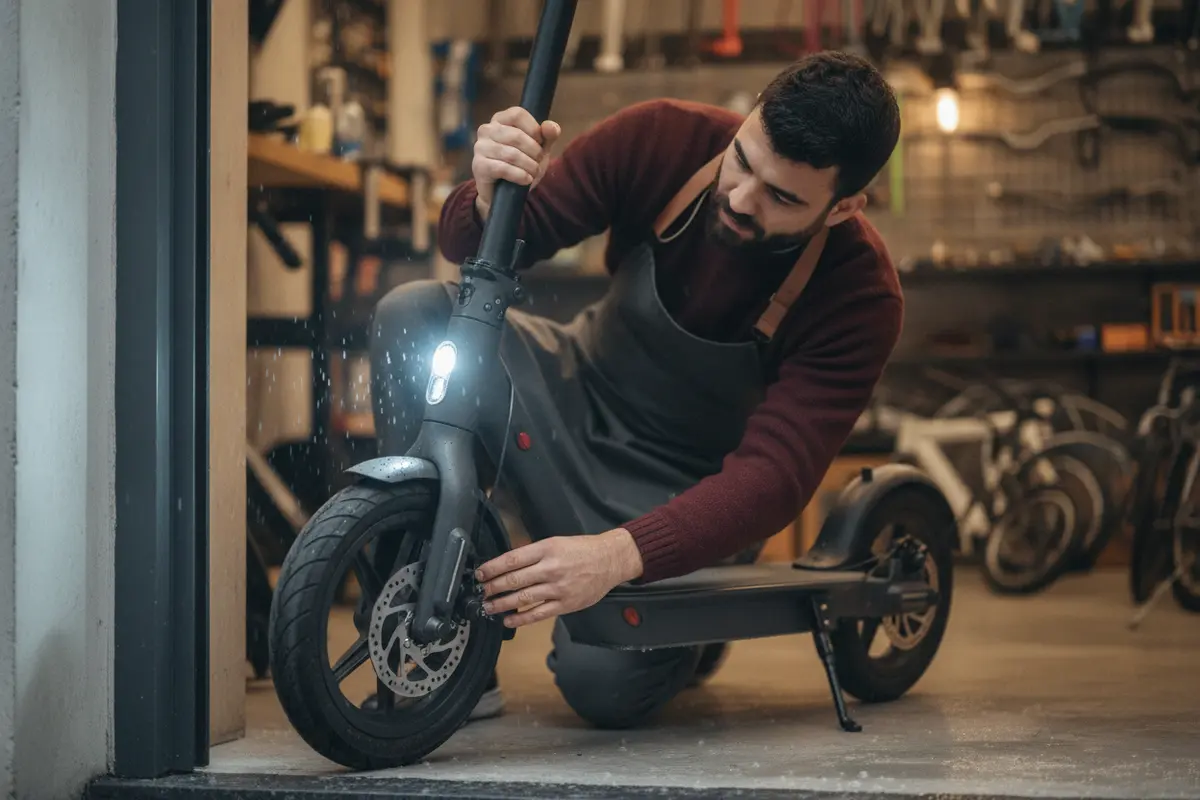
How should you read an IP rating before riding an electric scooter in rain?
Short answer: An IP rating describes protection against solids and water under defined test conditions. It does not mean a scooter can be submerged, ridden through deep puddles, or left outdoors indefinitely. Check the manufacturer's manual for the exact limits of your model before riding.
IP stands for ingress protection. The first digit concerns solid particles. The second digit concerns water. In general, a higher water digit indicates more tested protection, but the number alone does not tell you how a scooter behaves after years of use, a crash, a loose seal, or an improperly closed charging port.
| Water rating information | What it may indicate | What it does not prove | Rider decision |
|---|---|---|---|
| Manufacturer does not list an IP rating | Water protection is unclear | That the scooter is suitable for rain | Avoid wet riding unless the manufacturer gives written guidance |
| Low or limited water protection | Some resistance under specific conditions | Protection from heavy spray, puddles, or immersion | Use extra caution and follow the manual closely |
| Published IP rating with rain guidance | Tested protection within stated conditions | Waterproof performance in every situation | Stay within the stated limits and avoid standing water |
| Damaged, modified, or poorly sealed scooter | The original protection may be compromised | That the original rating still applies | Do not ride wet until it has been inspected |
Look for the rating in the owner's manual or the manufacturer's product documentation. Do not infer it from a phrase such as “weather resistant.” If the documentation is unclear, treat the scooter as having unknown wet-weather limits. Also check whether the guidance separates light rain from heavy rain, spray, puddles, storage, and charging.
Keep a copy of the manual on your phone or note the relevant limits before a trip. If the scooter has been modified with a different display, battery, controller, lighting system, or accessory that affects a seal, ask whether the original water guidance still applies. A rating is not a substitute for an inspection.
What should you check before riding an electric scooter in rain?
Start with a short inspection. Water exposes weak points that may not be obvious during dry-weather riding. Give yourself enough time to cancel the trip if a control, tire, light, or seal does not look right.
- Tires: Check tread, inflation, and visible cuts. Reduce speed on wet pavement rather than relying on the tire alone. Uneven wear or a soft tire can make steering less predictable.
- Brakes: Test both braking controls at low speed in a safe area. Wet brake components may respond differently, and worn parts deserve attention before a wet ride.
- Controls and display: Make sure buttons, throttle controls, and the display are secure and free of damage. Do not ride if a control sticks or behaves intermittently.
- Charging port: Confirm the cover is fully closed. Never charge with moisture in or around the port.
- Lights: Check the headlight, taillight, and brake-light function. Rain reduces contrast and visibility, even during daylight.
- Fenders: Confirm they are secure and do not rub the tire. A loose fender can become a distraction or contact a wheel.
- Fasteners and folding parts: Check that the steering column, folding mechanism, and visible hardware are secure according to the manual.
- Route: Look for puddles, painted lines, metal covers, leaves, gravel, steep slopes, and locations where runoff crosses the path.
Carry only what you can secure. A loose bag or hood can affect balance and visibility. If you need additional carrying capacity, confirm that any rack or accessory is designed for your scooter before installing it; a bicycle rack such as the TOPEAK BEAM rack should not be assumed to fit an electric scooter.
Do a low-speed brake test after you leave, not only in your driveway. Choose a clear area, keep the scooter upright, and learn whether the first brake application feels different. If it feels weak, grabs, squeals unusually, or pulls to one side, stop and investigate rather than continuing into traffic.
How can you brake and steer an electric scooter in rain more safely?
Short answer: Slow down before corners, leave more stopping distance, and make smooth control inputs. Wet pavement can reduce available traction, while water on brake components may change the first part of a stop.
Keep both hands on the controls and scan farther ahead than usual. Begin braking earlier and apply it progressively. Avoid abrupt steering, hard acceleration, and sudden braking while leaning. Cross painted markings, metal covers, and puddles as straight as practical, at a controlled speed.
Plan each stop before you need it. On a dry ride, you may be able to react close to an intersection or driveway. In rain, identify the stopping area sooner and reduce speed before the surface changes. Keep extra space from vehicles because a driver may stop suddenly or have limited visibility through a wet windshield.
Cornering deserves special care. Brake while upright before the turn, then use a gentle steering input. Avoid leaning aggressively on slick paint, leaves, wet metal, or dark patches whose depth you cannot judge. If the route forces you across a hazard at an awkward angle, slow further or dismount.
Do not assume a puddle is shallow. It may conceal a pothole or debris, and water can reach components that are not designed for immersion. If water is flowing across the road or collecting deeply, dismount and choose another route. Never use speed to make a puddle feel shorter.
Visibility matters in both directions. Use required lights, wear reflective or bright layers, and assume drivers may have reduced visibility through a wet windshield. A rear light or reflective accessory can help, but it cannot replace defensive riding. If you cannot see route hazards or believe others cannot see you, end the ride.
How do you protect the battery and charger after a wet ride?
Keep the battery and charger dry before, during, and after charging. If the scooter is wet, power it down and move it to a dry, ventilated place. Wipe exterior water away with a soft cloth, paying close attention to the charging area, controls, deck seams, and connectors.
Do not plug in a wet scooter or charger. Do not use a household hair dryer, heat gun, or other high heat to force drying. Let moisture evaporate naturally according to the manufacturer's instructions. If water entered the charging port, deck, or battery area, stop using the scooter and ask a qualified technician or the manufacturer for guidance.
Inspect the charger cable and plug for damage. Store the charger indoors, away from pooled water and damp floors. A replacement charger must match the scooter's requirements; do not substitute one simply because the connector looks similar. Voltaire Cycles can help with general electric mobility guidance and service questions in Bend, including multi-brand support.
Do not diagnose battery safety by appearance alone. A battery that becomes unusually hot, swollen, damaged, or odorous needs immediate attention. Turn the scooter off, keep it away from flammable materials, and follow the manufacturer's safety instructions. Do not open a battery pack yourself unless the manufacturer specifically directs a qualified procedure.
Plan for drying time before you need to charge. Bringing a wet scooter inside does not make it ready to plug in. Wipe it down, leave the charging port open only as the manual permits, and wait until the scooter and charger are dry. When in doubt, ask before connecting power.
How should you clean an electric scooter after rain?
Cleaning should remove grit without pushing water into the scooter. Turn the scooter off first. Use a damp cloth for the frame and deck, then dry the surfaces. Follow the manual for wheels, brakes, and removable components.
- Do not use a pressure washer or strong hose spray.
- Do not spray cleaner directly into the display, controls, motor area, charging port, or seams.
- Remove visible grit before it dries, using a soft brush where appropriate.
- Check that the folding mechanism, fasteners, and fenders remain secure.
- Look for new brake noise, control problems, water marks, or intermittent power.
- Keep cleaning liquids away from brake rotors, pads, tires, and throttle controls.
A small amount of appropriate lubricant may help some exposed mechanical parts, but electrical connectors and brake surfaces are different. Never put lubricant on brake rotors, pads, tires, or throttle controls. An all-weather e-bike lubricant is not automatically the correct choice for every scooter component, so check compatibility first.
After cleaning, move each control gently and inspect the areas where cables enter housings. Do not pull on cables or pry open sealed compartments. Make a note of anything that changed during the ride so a technician can reproduce the issue. Persistent faults are a reason to stop riding.
Voltaire Cycles of Central Oregon services multiple electric mobility brands, and a technician can help determine whether a wet-weather problem needs inspection. The safest service question is specific: explain how much water the scooter encountered, whether it was powered on, and what symptoms appeared afterward.
Where should you store an electric scooter after wet weather?
Store the scooter indoors in a dry, stable location with air movement. Keep it off a wet floor and away from direct heat. Do not cover it tightly while moisture remains on the scooter, because trapped dampness can delay drying.
Choose a location where the scooter cannot fall against a heater, block an exit, or become a trip hazard. Keep the charger separate until both items are dry. If the scooter is stored near an entryway, use a mat or tray to contain drips without allowing the tires or charging connection to sit in pooled water.
Before the next ride, check the charge-port cover, controls, brakes, tires, lights, and folding hardware again. If the scooter was exposed to heavy rain, deep water, or a fall, wait for an inspection rather than assuming it dried safely. A protective vehicle cover can help with dust during storage, but it is not a substitute for dry indoor storage or a waterproofing guarantee.
Keep a simple wet-weather record for recurring rides: the conditions, route hazards, drying time, and any new symptoms. Patterns such as repeated display flicker after rain or a brake change after every wet trip are useful information. They also indicate that the scooter should not be treated as ready for normal use.
When should you skip riding an electric scooter in rain?
Skip the ride when the manufacturer prohibits wet use, the IP rating is unknown, the scooter is damaged, visibility is poor, or the route includes deep water. Also wait during thunderstorms, strong winds, freezing precipitation, or conditions that make it difficult to control the scooter.
A 2024 journal study reports that weather factors influence shared e-scooter usage and identifies rain as an important factor in temperate oceanic conditions. Read the research at ScienceDirect, while remembering that usage research does not replace your scooter's manual or a local safety decision.
Do not ride immediately after suspected water intrusion. Warning signs include flickering displays, unexpected power loss, unusual motor sounds, brake changes, repeated error messages, or a hot, swollen, or damaged battery. Turn the scooter off, keep it away from flammable materials, and seek qualified assistance.
Also skip a ride when you are not prepared for the conditions. If you lack dry storage, cannot protect the charger, have poor visibility, or are carrying something that prevents a secure grip, postponing is a practical safety decision. A scooter trip is optional; forcing it through a storm can turn a minor inconvenience into a repair or injury risk.
Call Voltaire Cycles to discuss your scooter and wet-weather setup
Frequently Asked Questions
Can I ride any electric scooter in rain?
No. Check the manufacturer's water-resistance guidance and IP rating first. If the rating is missing, the scooter is damaged, or the weather includes deep water or poor visibility, avoid riding.
Does an IP rating make an electric scooter waterproof?
No. An IP rating reflects protection tested under defined conditions. It does not guarantee protection from immersion, pressure washing, damaged seals, aging, or every type of rain.
Can I charge my scooter when it is wet?
No. Dry the scooter and charging area first, and follow the manufacturer's instructions. Never charge when moisture may be present in the port, connector, or charger.
What is the safest way to clean a wet scooter?
Power it off, wipe it with a damp cloth, avoid strong spray, and let it dry in a ventilated indoor location. Stop using it if water may have entered electrical components.
Where can I get help with an electric scooter in Central Oregon?
Voltaire Cycles of Central Oregon in Bend provides electric mobility guidance and multi-brand service support. Call before visiting so you can confirm the right next step for your model.
Rain does not have to end every scooter trip, but it should change your decision, speed, route, and after-ride routine. When the manufacturer's limits are unclear, choose the safer option and ask for qualified guidance before riding again.