

Electric Bike Charger Replacement Guide
A missing or damaged charger can make an otherwise dependable e-bike seem unusable, but replacing it is not as simple as matching the plug. The charger must work with the battery system, and a connector that fits can still deliver the wrong electrical output or fail to meet the bike's charging requirements.
An electric bike charger replacement should be confirmed for your specific battery and bike before use. Check the required output, connector, polarity, battery chemistry, and manufacturer guidance rather than relying on physical fit or a universal label. The CPSC advises using a replacement tested and approved for the specific device.
Start with the information printed on your original charger, battery, and bike documentation. If those details are missing, unreadable, or contradictory, pause before connecting a substitute. A careful compatibility check can prevent an expensive mistake and show when manufacturer or qualified service guidance is the safer next step.
What Should You Check Before Buying an Electric Bike Charger Replacement?
Start with the exact bike and battery identity, not the shape of the plug. Find the bike model, battery label, and original manual or charger specifications. Each micromobility battery has specific charging needs, and a charger that fits physically can still be incompatible. The U.S. Consumer Product Safety Commission warns against universal micromobility chargers unless they have been tested and approved for the specific device.
Before choosing an electric bike charger replacement, check these details:
- Model and documentation: Match the replacement to the exact bike or battery model. If the original charger is missing, contact the manufacturer or a qualified service provider for compatibility guidance.
- Battery and charger output: Compare the battery's required voltage and the charger's output rating with the manufacturer's documentation. Do not assume that a similar-looking charger or a charger from another bike is suitable.
- Connector and polarity: Confirm the connector dimensions, pin arrangement, and polarity. Center-positive and center-negative systems are not interchangeable, and a plug that slides into the port is not proof of compatibility.
- Battery chemistry and BMS: Identify the battery chemistry and its battery management system, or BMS. The charging profile and protective controls must suit that battery rather than simply matching the connector.
CPSC specifically advises confirming that a replacement charger has been tested and approved for safe operation with your device. And says not to use a charger from another micromobility product without confirming compatibility. If the label or documentation is incomplete, pause before connecting power. For Bend-area riders, electric bike repair and diagnostics can help separate a charger question from a battery or electrical-system problem. Online shoppers can use the same checklist with the bike manufacturer or a qualified technician before ordering.
How Do Voltage, Amperage, and Polarity Affect Compatibility?
The label on an electric bike charger replacement provides more than a model name. It tells you how the charger is designed to deliver power, and those details must match the battery and charging system. A plug that fits is not enough. The U.S. Consumer Product Safety Commission warns that a charger can physically fit while remaining incompatible, because each micromobility battery has specific charging needs. Read the CPSC compatibility guidance before substituting a charger.
| Check | What it tells you | Why it matters |
|---|---|---|
| Battery voltage | The battery system's nominal voltage, as identified by the manufacturer | It establishes which charging system the battery is designed to use. Do not treat nominal voltage as the same number as charger output. |
| Charger output voltage | The voltage the charger is designed to provide during charging | It must be specified for the exact battery and charging system. A nearby-looking number is not proof of compatibility. |
| Output amperage | The charger's rated current delivery | It affects charging behavior and must stay within the limits documented for the battery, charger, and battery-management system. |
| Polarity | Which connector contact is positive and which is negative | Reversed polarity can make an otherwise matching connector unsafe or incompatible. |
Nominal battery voltage is a label used to describe the battery system. Charger output is the charging voltage the power supply is built to deliver. They are related, but there is no universal conversion chart that makes one charger suitable for every battery with a similar nominal rating. The model documentation or manufacturer-approved replacement should settle the match.
Amperage also should not be treated as a simple speed upgrade. A higher-rated charger may not be approved for the battery-management system, while a lower-rated option may charge differently or fail to meet the system's requirements. Polarity deserves the same care: confirm the positive and negative arrangement from reliable documentation, not from the connector shape alone. If any label, output specification, or polarity detail is missing, pause the purchase and verify the exact model first.
Which Connector and Battery Details Matter?
A connector is more than its outer shape. Before ordering a replacement, compare the plug style, barrel dimensions, pin count, and pin arrangement with the original charger or the manufacturer documentation. Some connectors include additional contacts for communication or sensing, so a plug that slides into the port may still be the wrong electrical match. The U.S. Consumer Product Safety Commission specifically warns that a charger can fit a micromobility device and still be incompatible with it: review its replacement-charger guidance before buying.
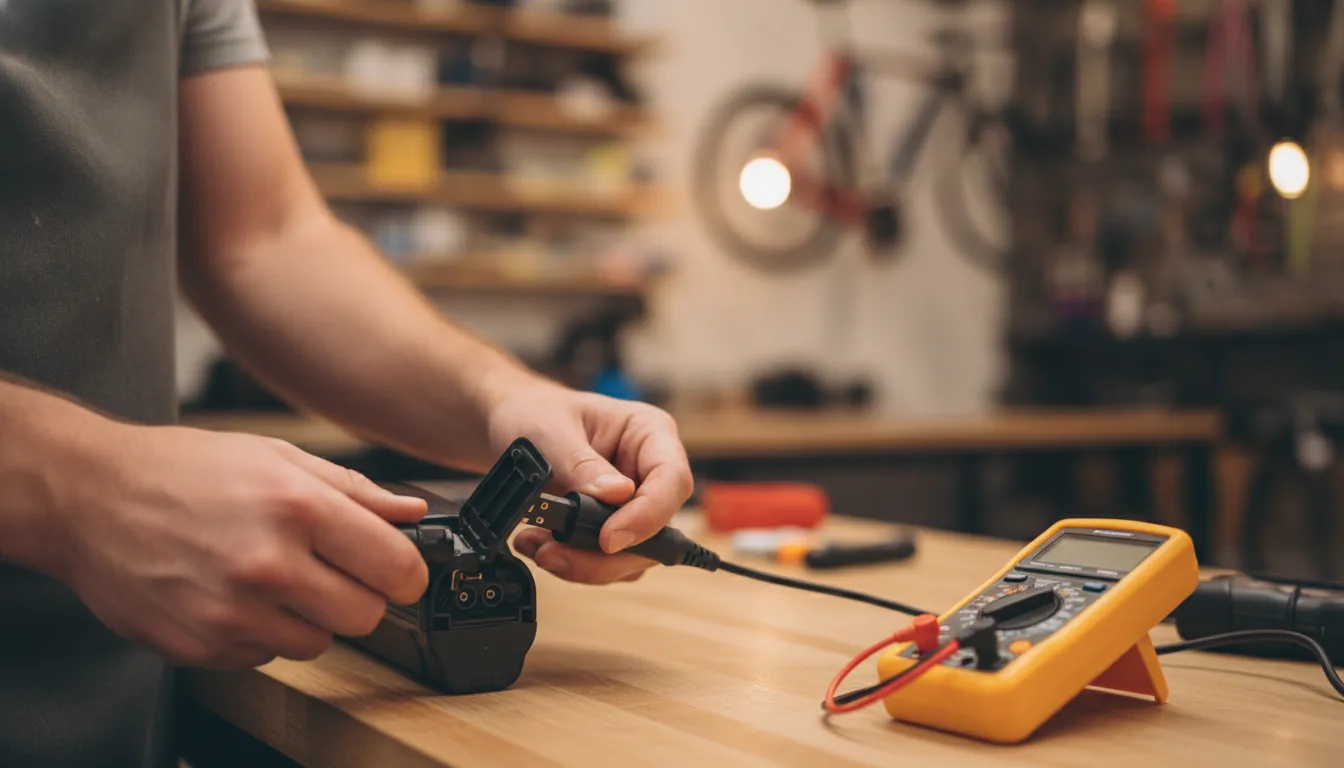
Check polarity, not just pin count
Polarity describes which contact carries positive voltage and which carries negative voltage. A common example is center-positive or center-negative barrel wiring, but do not assume either arrangement. Confirm the polarity marking on the charger, battery, or model documentation. Reverse polarity can damage electrical components, even when the connector looks identical. Battery voltage and charger output must also be compatible, and the charger's amperage should follow the manufacturer's specification rather than a guess based on charging speed.
Match the battery system and its documentation
Battery chemistry and the battery management system, or BMS, are part of compatibility. The BMS manages charging behavior and protection for the battery pack, so a replacement charger should be approved for that specific battery system. CPSC advises contacting the device manufacturer when the original charger is unavailable and confirming that a replacement has been tested and approved for the device. Do not substitute a charger from another bike without that confirmation.
Also inspect the charging port for looseness, corrosion, heat damage, or debris. If the port or battery appears damaged, stop before connecting anything. For uncertain cases, electric bike repair and diagnostics can help separate a charger issue from a battery or port fault.
Are Universal E-Bike Chargers Safe to Use?
Usually, you should not assume a universal e-bike charger is safe. A plug that slides into the charging port only proves physical fit. It does not confirm the charger has the right output voltage, current, polarity, connector wiring, battery chemistry, or battery-management-system requirements. Each battery has specific charging needs.
The U.S. Consumer Product Safety Commission warns consumers not to use chargers marketed as universal for micromobility products unless they have been tested and approved for the specific device. Its warning matters because an incompatible charger can cause a battery to ignite and create a serious fire. CPSC reported 156 fires and thermal incidents involving universal micromobility chargers between January 1, 2023, and May 16, 2024.
Use documentation, not the connector, as your starting point
For an electric bike charger replacement, identify the exact bike and battery model first. Check the manufacturer documentation and the original charger's label for the required specifications. If those details are missing, contact the bike or battery manufacturer, or ask a qualified service technician to verify them. Do not rely on a marketplace listing that says a charger fits many e-bikes.
Follow a safer replacement decision path
- Use the supplied charger when it is available and in good condition.
- If it is lost or damaged, choose a replacement documented as tested and approved for your specific bike and battery.
- Do not share a charger from another e-bike, scooter, or other micromobility device without confirmed compatibility.
- If the model, specifications, or battery condition are uncertain, stop before connecting it and seek a compatibility check.
That extra verification is more useful than guessing from a matching barrel plug. It protects the battery and gives you a clear answer before charging.
How Can You Test a Charger Problem Without Guessing?
Start with a visual inspection, not a replacement order. Unplug the charger and examine the wall cord, power brick, cable, connector, and charger housing. Look for cuts, crushed sections, exposed wire, bent pins, cracks, liquid exposure, or a loose connection. Check the outlet with another suitable device, then confirm that the charger indicator behaves as the manufacturer documentation describes.
Next, compare the charger label with the battery and bike documentation. The output voltage, amperage, connector, polarity, battery chemistry, and battery-management requirements all need to match. A plug that fits is not proof of compatibility. The U.S. Consumer Product Safety Commission warns that chargers marketed as universal may fit while still being incompatible. And recommends confirming that a replacement has been tested and approved for the specific device: CPSC charger safety guidance.
Do not open the charger or battery to test components yourself. If the battery, connector, or charger becomes unusually hot, smells chemical or burnt, shows swelling, sparks, or has visible damage, stop charging and move away from the equipment. Do not keep cycling power to see whether the symptom disappears.
A charger that stays dark may have an outlet, cord, or charger fault. A charger that appears normal while the battery does not accept a charge can also point to a damaged charging port, a battery-management issue, or a battery fault. That is why repeated swapping with another device's charger is not a reliable test. CPSC advises using the supplied charger and remaining present while charging, then unplugging the device when charging is complete.
For a more detailed symptom-by-symptom process, see this guide to troubleshoot an e-bike charger. If the evidence still does not identify the failed component, qualified service can test the electrical system and battery without turning a safe diagnosis into a risky experiment.
When Should You Ask a Bend E-Bike Service Team?
Ask for help when the evidence is incomplete or the problem may involve more than the charger itself. That is especially important if you are choosing an electric bike charger replacement for a bike with missing documentation, an unfamiliar battery system, or a damaged charging port.
Bring the bike, battery, original charger if you have it, and any model information you can find when:
- You cannot confirm the model requirements. A connector that fits does not prove that the voltage, polarity, battery chemistry, or battery-management system is compatible. If the manual or manufacturer cannot confirm the replacement, pause before connecting it.
- The battery, charger, cable, or port is damaged. Cracks, exposed wiring, scorching, unusual heat, swelling, or a loose port are reasons to stop charging and request an inspection. Do not open a battery or charger to diagnose it yourself.
- The bike will not charge after basic checks. A failed charge cycle can involve the outlet, charger, port, battery, controller, or related electrical system. Replacing parts at random can create more risk and expense than testing the system first.
Voltaire Cycles in Bend provides electrical-system diagnostics, battery testing and replacement, controller programming, and software support. The service team works with multiple electric-vehicle brands, including brands not sold in the showroom. So online customers and Central Oregon riders can ask about the right next diagnostic step rather than guess at compatibility.
Ask Voltaire about electric bike repair and diagnostics before connecting an uncertain charger.
A careful inspection can identify the fault, document the work, and support quality-control checks before the bike returns to service. That approach is more useful than treating every charging problem as a simple charger purchase.
Frequently Asked Questions
How do I find a compatible replacement charger for my e-bike?
Start with the bike and battery model, then compare the manufacturer's documented charging requirements with the replacement charger's output, connector, and polarity. If the original charger is missing, the U.S. Consumer Product Safety Commission recommends contacting the device manufacturer and confirming that the replacement was tested and approved for your specific device: CPSC guidance.
Is matching the voltage enough when choosing a charger?
No. The voltage is only one part of compatibility. The charger must also match the battery system's charging requirements, connector, polarity, and supported charging controls. A plug that fits or a label that shows the same voltage does not prove the charger is safe for that battery.
Can I use a charger from another electric bike?
Do not share chargers between bikes unless compatibility has been confirmed for the specific device. The CPSC specifically warns consumers not to use a charger from another micromobility product without confirmation. Different batteries can require different charging behavior even when their connectors appear identical.
When should I stop using a charger and seek service?
Stop charging if the charger, cable, connector, or battery shows damage, unusual heat, smoke, odor, swelling, or other abnormal behavior. Do not open the charger or battery to diagnose it. Uncertain cases can be evaluated through electrical-system diagnostics and battery testing by a qualified service team.
Ready to Confirm Your Charger Choice?
If the voltage, connector, polarity, or battery details do not line up clearly, a compatibility check can help you avoid an unsafe substitution. Contact us to review the information you have and determine whether electric bike service is the right next step.
Contact Voltaire Cycles about charger compatibility or service