

Electric Bike Battery Winter Storage Guide
Cold, dry winters can make e-bike ownership in Bend and Central Oregon feel more complicated than it needs to be. The battery is the component that deserves the most deliberate seasonal routine, especially when a bike moves between a warm home, an unheated garage, and freezing outdoor rides.
Ask about e-bike battery winter storage and service
For reliable electric bike battery winter storage, remove the battery when the model allows it. Keep it in a dry location at the maker's recommended conditions, and do not charge it while it is cold, wet, damaged, or showing unusual behavior. Your specific model manual and charger instructions should determine the details.
That guidance matters whether you are shopping online from across the country or choosing a model at a Bend showroom. Battery design, removable access, charger requirements, and warranty guidance can vary between commuter e-bikes, cargo models, and higher-powered bikes. Start by understanding what seasonal storage actually involves, then use that framework to compare the model and support you are considering.
What does electric bike battery winter storage involve?
Electric bike battery winter storage is the plan for keeping a battery safe and ready during a period when you will ride less or stop riding. It is different from winter riding, which requires guidance for repeated cold, wet, or changing conditions. Start with the exact bike and battery manual, then confirm the approved charger and the maker's remove-or-leave-on-bike instructions.
That distinction matters because there is no single storage routine that fits every e-bike. A removable battery may have a prescribed storage process separate from the bicycle. An integrated battery may remain on the frame, but the manufacturer can still specify how the bike should be positioned, protected, inspected, and charged. Before buying, ask where the battery is located, whether it can be removed without special tools, and which charger is approved for that model.
What should you confirm before storing the battery?
- Read the model-specific manual. New and used e-bikes can have different battery systems, controls, and storage directions. New York's Division of Homeland Security and Emergency Services also advises following the manufacturer's instructions for charging, storage, and use: review its battery safety guidance.
- Identify the correct charger. Use the charger supplied with the bike or one approved by the manufacturer. Do not assume that a plug that fits is electrically appropriate.
- Plan for support. If the manual is missing, the battery will not release normally, or the bike has an unfamiliar system, model-specific advice is more useful than a generic winter checklist. Voltaire offers all-brand e-bike repair and diagnostics, along with technical consultations for applicable systems.
For shoppers comparing models, storage is part of ownership convenience. Consider the battery's access, the space available in your home, and whether local service can help when questions arise. Voltaire serves Bend and Central Oregon through its showroom while also selling online, so you can compare electric bicycles with support needs in mind.
How should you handle electric bike battery winter storage?
For electric bike battery winter storage, remove the battery when the model allows it and keep it indoors in a dry, stable location away from direct sunlight, moisture, and extreme temperatures. Set the charge level according to the manufacturer's manual, inspect the battery periodically, and never charge it while it is frozen or visibly damaged.
Start with the storage location. A clean, dry indoor area is generally more appropriate than an unheated shed, vehicle, porch, or damp garage. New York's Division of Homeland Security and Emergency Services advises keeping devices and batteries in a cool, dry place and away from direct sunlight. It also cautions against extremely high or low temperatures. Its guidance is useful for establishing the basics, but your battery manual remains the controlling source for the exact conditions.
Charge level is one area where generic advice can become misleading. Washington State University Environmental Health and Safety warns that keeping lithium-ion batteries at either 100% or 0% for extended periods can stress them. Some guidance for long-term storage uses a partial charge, while another WSU example says to keep a stored battery at a minimum of 80% and check it every few months. Those recommendations are not interchangeable instructions for every e-bike. Follow the charge percentage and storage-duration guidance supplied for your specific battery, bike, and charger.
Before putting the bike away, check the case, contacts, cable, and charger for swelling, punctures, crushing, drops, leaks, discoloration, or other damage. WSU identifies damage, overheating, overcharging, and excessive charger current as possible contributors to battery failure. If anything looks abnormal, stop using or charging the battery and seek model-appropriate advice rather than attempting a repair or modification yourself.
Storage duration matters, too. If the bike will sit for several months, add the inspection interval specified by the manual to your calendar. When winter is over, let a battery that has become very cold or frozen return to the maker's recommended temperature before charging. WSU specifically says never to charge a frozen battery and to let it warm to room temperature first. For questions about safe inspection, all-brand e-bike repair and diagnostics can help you evaluate the bike and battery before riding season.
What temperature and moisture conditions matter in winter?
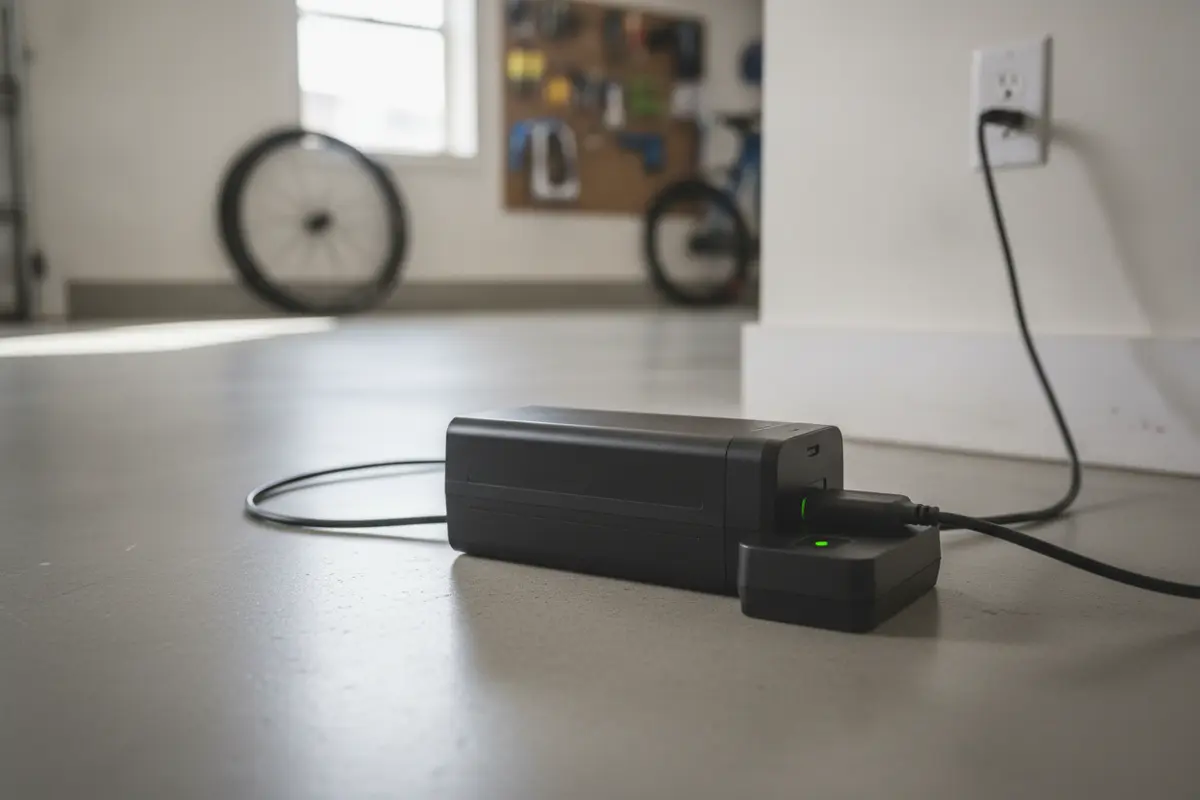
For electric bike battery winter storage, keep the battery cool, dry, and protected from temperature extremes. Do not charge a battery below 32 F or above 105 F, and let a cold or frozen battery warm gradually to the maker's recommended conditions before charging. Your model manual may set a stricter range than general safety guidance.
Cold storage is not the same as cold charging. A battery that has been in an unheated garage, vehicle, or shed may still be too cold to connect to the charger safely, even if the air indoors now feels comfortable. The New York Division of Homeland Security and Emergency Services advises against charging below 32 F or above 105 F and recommends following the manufacturer's instructions for charging, storage, and use. See its lithium-ion battery storage guidance for the full recommendation.
Cold, freezing, and gradual warming
If the battery has been exposed to freezing conditions, move it to a dry indoor area and allow it to warm naturally. Do not use a space heater, hair dryer, radiator, oven, or other direct heat source to speed up the process. Rapid heating can create additional stress, while a cold battery may also develop condensation as its surface warms. Washington State University Environmental Health and Safety specifically says to let a frozen battery warm to room temperature before charging. That is useful general guidance, but the battery and bike maker's manual remains the controlling source for your model.
Moisture, condensation, and direct sun
After a wet ride, wipe the battery and its contacts dry and give the bike time to dry before storage or charging. Keep the battery away from puddles, wet floors, dripping gear, and other liquids. Avoid sealing a damp battery in a bag or container, since trapped moisture can linger around connectors. Store it in a cool, dry location out of direct sunlight. NY DHSES also advises keeping batteries out of extremely high or low temperatures and away from direct sunlight.
WSU Environmental Health and Safety guidance lists 50-77 F as an example storage range, but that is not a universal rule for every electric bike battery. Treat it as a reference point, then check the manual for your exact model, storage charge guidance, and charging limits. If the battery remains wet, frozen, damaged, swollen, or unusually warm, do not charge it. Set it aside and seek model-specific service advice before riding or charging again.
Can you charge an e-bike battery after a cold ride?
Yes, but do not charge an e-bike battery while it is still frozen, wet, damaged, or unusually warm. Bring it into a dry area and let it return to the temperature range specified by the bike or battery maker before connecting the approved charger. Then charge it on a clear, stable surface while you are nearby, and disconnect it when full.
Cold weather changes the charging decision, even when the ride itself went normally. If the battery came in from freezing conditions, allow it to warm gradually at room temperature. Do not use a heater, heat lamp, oven, or other direct heat to speed that process. A temperature difference can also create condensation, so wait until the battery and its contacts are visibly dry. The New York Division of Homeland Security and Emergency Services recommends avoiding charging below 32 F; your owner's manual may provide more specific limits for your model.
Use the charger and outlet the system expects
Use the charger supplied with the e-bike or an exact replacement approved by the manufacturer. A charger that fits the connector is not automatically electrically compatible. Plug it directly into a wall outlet rather than a power strip, and place the battery on a flat, dry, nonflammable surface away from liquids, direct sunlight, loose clothing, paper, bedding, and other materials that could burn. Keep the charging area clear so the battery cannot fall or be covered.
Stay present while the battery charges. Follow the maker's full-charge instructions, then disconnect the charger and battery when charging is complete. Avoid leaving the system connected indefinitely unless the manufacturer specifically instructs you to do so.
Know when not to charge
Stop and seek qualified service if the battery is swollen, cracked, punctured, leaking, dropped hard, or shows discoloration. Do not charge it if you notice an unusual odor, excessive heat, smoke, changed charging behavior, rapid discharge, reduced range, or inconsistent power. Never open or modify the pack. Those signs can indicate internal damage that a normal cold-weather recharge will not fix.
What should buyers ask about electric bike battery winter storage?
Before buying an e-bike for year-round use, ask how the battery should be stored, charged, and inspected during winter. The correct routine depends on the manufacturer and battery system, so request the manual, confirm the approved charger, and clarify what support is available if the bike is stored for months or returns from a cold ride.
| Buyer situation | Question to ask | Why it matters |
|---|---|---|
| New bike | What does the maker's manual say about storage temperature, charge level, and charging after cold exposure? | Manufacturers can specify different limits. NY DHSES advises following the maker's instructions for charging, storage, and use. Read the storage and charging guidance. |
| Used bike | Can you show the original charger, battery identification, and any service or damage history? | A compatible, approved charger matters. Swelling, punctures, crushing, or drop damage are reasons to pause and seek qualified evaluation rather than assume the battery is ready for winter. |
| Service-supported bike | Who can inspect the battery, charger, contacts, and storage setup before and after the season? | Multi-brand diagnostics can help when the battery will not charge, shows damage, or has been stored in uncertain conditions. Ask about all-brand e-bike repair and diagnostics. |
Also ask whether the battery can be removed for indoor storage and how the bike should be protected from moisture. A cool, dry location away from direct sunlight is the general guidance cited by NY DHSES, but do not treat one temperature range or charge percentage as universal. WSU EHS, for example, lists 50-77 F as an ideal range and says a frozen battery should warm to room temperature before charging. Follow the specific manual.
For a new purchase, compare the ownership guidance alongside motor and range specifications in Voltaire's electric bicycle collection. A clear answer about winter storage, approved charging equipment, and service access is part of choosing a bike that fits your routine.
How do you restart an e-bike after winter storage?
Restarting an e-bike after winter storage is a gradual inspection, not a rushed first charge. Check the battery case, terminals, charger, and cable; let a cold battery return to the maker's recommended conditions; then use the approved charger for a supervised initial check. Stop if anything looks, smells, or behaves unusually.
- Inspect before connecting anything. Remove the battery if the model allows it, and look for swelling, cracks, punctures, leakage, discoloration, or a deformed case. Check the charger, plug, cable, and battery contacts for damage, corrosion, or moisture. A little dust is a routine maintenance concern; a damaged or leaking battery is an active hazard and should not be charged.
- Let a cold battery warm gradually. If the battery was stored in an unheated garage or came in from freezing conditions. Follow the manufacturer's instructions and allow it to return to the recommended temperature before charging. WSU Environmental Health and Safety specifically advises letting a frozen battery warm to room temperature before charging. Do not use a heater, hair dryer, or other shortcut.
- Use the correct charging setup. Confirm that the charger matches the bike and is supplied or approved by the manufacturer. Place the battery on a flat, dry, stable surface away from liquids and combustible materials, and plug directly into a wall outlet. Stay nearby during the first charge rather than leaving it unattended. New charger questions are a good reason to ask for all-brand e-bike repair and diagnostics.
- Run a short initial check. Once the battery has reached the maker-recommended condition and the system powers on normally, test the display, controls, lights, and assist at low speed in a safe area. Watch for unusual heat, odor, noise, rapid discharge, inconsistent power, or a charging time that seems materially different from normal. Disconnect it when fully charged, following the manual.
- Stop when behavior changes. Swelling, leaking, excessive heat, smoke, or a sharp chemical odor is not a routine winter-storage issue. Do not open, modify, or repeatedly recharge the battery to troubleshoot it. Move away from the battery if there is an active hazard and seek qualified guidance. For broader seasonal ownership planning, review the site's electric bike outdoor storage guidance.
Get all-brand e-bike repair and diagnostics
Frequently Asked Questions
Where should I store an e-bike battery during winter?
Store the battery in a cool, dry location away from direct sunlight, liquids, heat sources, and anything that could damage the case. Follow the exact storage instructions for your bike and battery model. The New York Division of Homeland Security and Emergency Services also advises following the manufacturer's instructions.
Can I charge an e-bike battery while it is cold?
Not until it has returned to the charging conditions specified by the manufacturer. After a cold or wet ride, move the battery to a dry area and allow it to warm gradually. Do not charge a battery that is wet, damaged, swollen, unusually hot, or showing other warning signs.
What charge level is best for winter storage?
Use the charge level stated in your battery or bike manual rather than applying a universal percentage. Remove the battery from the charger when it reaches the maker's specified level, and check it periodically during extended storage if the manual calls for it. Use only the supplied or manufacturer-approved charger.
When should I ask for help before using the battery again?
Stop using the battery if you notice swelling, cracks, leaks, smoke, unusual heat, a strong odor, or unexpected performance. Do not open or modify it. Set it aside safely and consult the manufacturer or a qualified e-bike service professional for model-specific guidance before charging or riding.
Ready to review your winter storage setup?
Review your winter battery storage setup with Voltaire Cycles
If you are unsure whether your electric bike battery, charger, or storage routine matches the model maker's guidance. A focused review can help you plan the next step with more confidence. For model-specific questions or support with an e-bike battery issue, contact Voltaire Cycles through the all-brand repair and diagnostics page. Share the bike and battery details available to you so the team can better understand what you need.