

Ebike Charger Compatibility: Voltage, Connector, and Safety
Choosing a charger that physically plugs into a battery does not prove that it is safe to use. Ebike charger compatibility depends on several details working together: the battery’s required charging voltage, the charger’s output, current, connector wiring and polarity, battery chemistry, and the manufacturer’s instructions. Check each item before connecting anything, and do not guess when a label is missing or unclear.
Call the shop for charger guidance
What does ebike charger compatibility mean?
In brief: A compatible charger is one explicitly suited to the battery’s specifications and charging system—not merely one with a matching plug. Confirm the battery chemistry and charge-voltage requirement, check the charger’s output label, verify connector and polarity, and follow the bicycle or battery maker’s documentation. If you cannot confirm every item, keep the charger unplugged and ask a qualified service technician.
A battery charger controls how electrical energy enters a battery. A mismatch can prevent charging, damage equipment, or create a safety hazard. The charger and battery should therefore be treated as a system. A charger advertised for an e-bike, or one that came with a different bike, is not automatically suitable for yours.
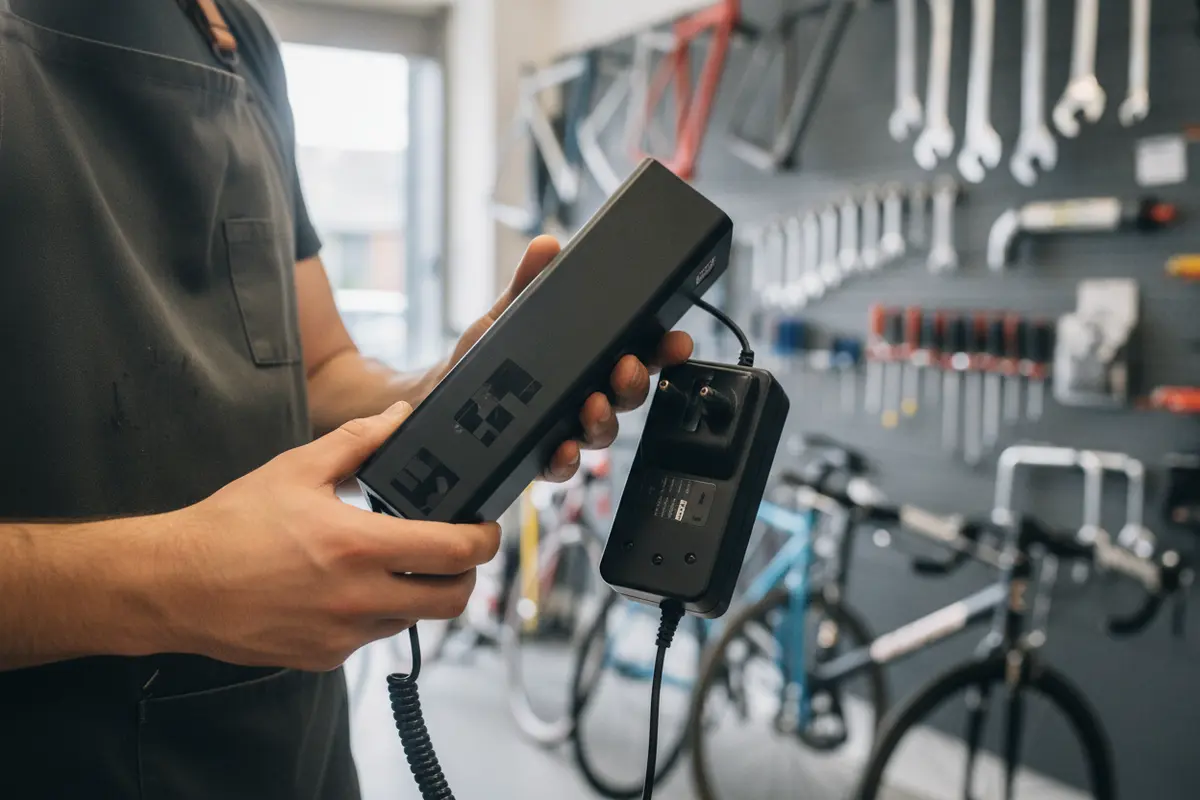
Start with the battery label and the original charger, if available. Record the manufacturer, model, battery chemistry, nominal voltage, and the charger’s output voltage and current. Compare those details with the owner’s manual or the battery maker’s charging instructions. Do not infer specifications from the bicycle’s display, motor, or the shape of the plug.
How do voltage and charge voltage affect compatibility?
In brief: The charger’s output voltage must match the battery system’s specified charging voltage. The number used to describe a battery’s nominal voltage is not necessarily the voltage a charger should output. Use the battery maker’s documented charger specification rather than selecting a charger based only on a “36V” or “48V” label.
Battery voltage labels generally describe a system’s nominal voltage. During charging, the charger follows a controlled profile and may reach a different output voltage. That is why a charger marked with the same nominal voltage as the battery can still be wrong. Check the exact required charger output in the manual or on a reliable label.
Do not try a higher-voltage charger because you want a faster charge, or a lower-voltage charger because it seems safer. Either choice can fail to charge correctly or cause problems. A charger should be selected for the specific battery configuration and its approved charging limits.
- Find the battery’s model and charging specification.
- Read the charger’s output label—not only its input information.
- Compare charger output voltage with the manufacturer’s stated requirement.
- Stop if labels conflict, are damaged, or do not identify the battery clearly.
Does charger amperage need to match?
In brief: Amperage describes the current a charger can provide. A charger with greater current capacity is not automatically safe or approved for a battery. Follow the battery maker’s maximum charging-current guidance and use the charger specified for that battery; do not assume that a lower or higher amp rating is acceptable without confirmation.
Current affects charging speed and the load placed on the battery system. Two chargers may share a voltage rating but have different current outputs. The right choice depends on the battery’s design, charging electronics, and maker’s limits. A larger number on the charger label is not a universal upgrade.
Compare the charger’s output current with the documentation. If the manual gives a permitted range, stay within it and use a charger approved for the battery. If the documentation lists only a supplied charger model, ask the manufacturer or a qualified technician before substituting another one.
Why is a matching connector not enough?
In brief: A connector that fits can still have the wrong wiring, polarity, or electrical rating. Check the exact connector type and pin arrangement against documentation for both charger and battery. Never force a plug, modify a connector, or rely on appearance alone to establish compatibility.
There are multiple connector designs in use, and similar-looking plugs can be wired differently. Polarity describes which contacts are positive and negative. If polarity is reversed, connecting the charger may damage components. Some connectors also carry signals or use more than two contacts, so a visual match does not establish that each pin has the correct function.
Do not cut or splice wires to make an unsuitable charger fit. Do not use an adapter unless the battery or charger manufacturer specifically approves that adapter for the exact system. An adapter changes the physical connection; it does not correct an unsuitable voltage, current, polarity, or charging profile.
How does battery chemistry change the answer?
In brief: Different battery chemistries can require different charging methods and limits. A charger intended for one chemistry should not be used on another unless the manufacturer explicitly documents compatibility. Confirm the chemistry from the battery label or product documentation rather than guessing from age, appearance, or voltage.
Many e-bikes use lithium-ion batteries, but not every battery is identical. Battery management electronics and cell configuration also matter. A charger designed for a different chemistry or battery system may not provide the proper charging behavior, even if its voltage and connector seem plausible.
Look for a battery model number and manufacturer documentation. If the label is unreadable, contact the bicycle or battery maker with the model and serial information. Avoid opening a battery pack to identify its cells; this is not a safe or necessary way to select a charger.
What should the charger’s safety certification tell you?
In brief: Certification marks and credible manufacturer documentation can help you assess whether electrical equipment was evaluated against applicable safety requirements, but they do not prove that a charger is compatible with your particular battery. Verify compatibility separately and buy from a reputable source. The U.S. Consumer Product Safety Commission offers general consumer product safety information at CPSC.gov.
Inspect the charger for a legible manufacturer name, model identifier, input and output ratings, and any certification markings. Be cautious of unbranded products with vague descriptions, inconsistent labels, or claims that one charger works with every e-bike. A certification mark should be genuine and traceable; an unfamiliar symbol by itself is not proof of safety.
Follow the battery maker’s instructions for charging location and handling. Stop using a charger or battery that is damaged, unusually hot, swollen, emitting an odor, or behaving unexpectedly. Disconnect power if it is safe to do so, keep people away from a suspected battery hazard, and seek appropriate professional guidance.
How can you compare charger options safely?
Use this checklist to organize the information before purchasing or connecting a replacement. The table is a screening aid, not a substitute for manufacturer confirmation.
| Check | What to compare | When to stop |
|---|---|---|
| Battery identity | Brand, model, chemistry, and documented charging specification | Model or chemistry cannot be confirmed |
| Voltage | Charger output against the battery maker’s required charging voltage | Only nominal voltage is known or the figures conflict |
| Current | Charger output current against approved battery limits | Maximum current guidance is unavailable or exceeded |
| Connector and polarity | Exact connector, pin assignment, and polarity from documentation | Plug fit is the only evidence or wiring is uncertain |
| Charging system | Battery chemistry and manufacturer-approved charger model | Charger is intended for another chemistry or system |
| Condition and provenance | Legible ratings, intact cables, credible maker, and safety markings | Damage, suspicious labeling, or uncertain product source |
When comparing an original charger with a replacement, write down both model numbers and specifications. Check whether the battery manufacturer lists the replacement as approved. For product browsing, Voltaire Cycles carries options such as the 36V Advanced 300W e-bike charger and a 36V 4A e-bike battery charger. These are examples of product listings, not a claim that either one suits every 36V battery. Confirm the exact battery requirements before ordering.
Use a simple side-by-side record rather than relying on memory. Note the battery model, charger model, output voltage, output current, connector configuration, and the source of each specification. If one item is missing, mark it as unknown instead of filling in a likely answer. This makes it easier for a manufacturer or service technician to help you without having to interpret assumptions.
Be especially careful with information copied from a marketplace listing. Titles may group several products together or describe a charger by nominal voltage while leaving out current, polarity, or supported battery models. Review the product details and manufacturer documentation, and ask the seller to confirm a specific battery model in writing when necessary. A broad claim such as “universal charger” is not enough to establish that it is appropriate for a particular pack.
Also distinguish charger input from charger output. Input describes the power the charger draws from a wall outlet; output describes what it supplies to the battery. The output line is the relevant starting point for matching the charger to battery charging requirements. If the label is confusing or uses symbols you do not understand, do not experiment with the charger. Photograph the label and ask the battery maker or a qualified technician to interpret it.
Compatibility is not the only consideration when deciding whether to keep using existing equipment. Check cables, strain reliefs, casing, and plug contacts each time you inspect the charger. Keep the charger dry and use it according to its manual. Avoid covering it during operation or placing it where it can be knocked, crushed, or exposed to moisture. Follow the battery maker’s recommended charging and storage procedures rather than relying on generic advice that may not apply to your model.
What steps should you take before charging?
- Identify the battery. Read its label and note the brand, model, chemistry, and charging instructions.
- Identify the charger. Record the model, output voltage, output current, connector, and any polarity information.
- Check the manufacturer’s documentation. Confirm the specified charger or approved replacement for that battery model.
- Inspect the equipment. Look for cracked casing, exposed wires, bent contacts, moisture, or other damage. Do not use damaged equipment.
- Connect only when confirmed. Use the proper outlet and follow the manual’s charging procedure. Do not leave a questionable charger connected while seeking an answer.
- Monitor for abnormal behavior. If the battery or charger becomes unusually hot, makes unusual sounds, smells odd, or shows damage, stop and seek help.
For a routine replacement, compare the old charger’s label with the battery documentation; do not assume the old charger is correct if it was borrowed or purchased separately. Keep the manual and charger model information together so it is available when buying parts or requesting service.
When should you ask a technician?
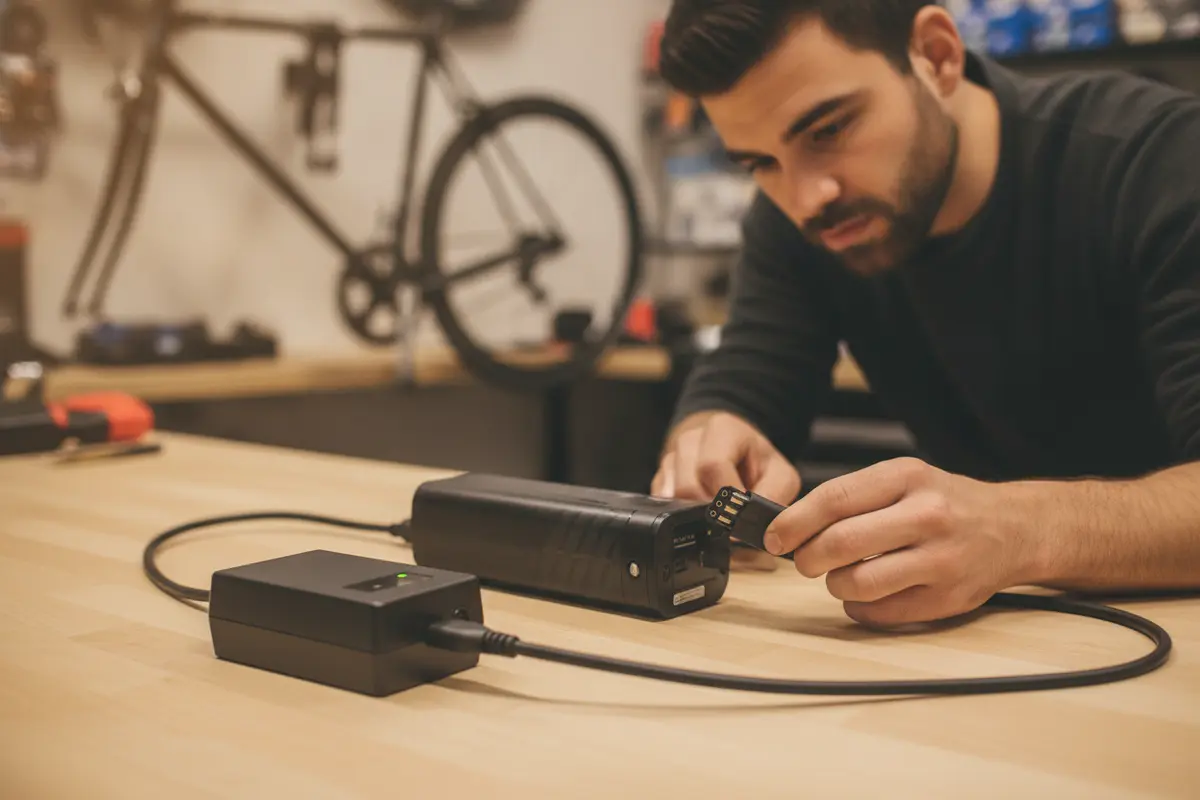
Ask for qualified help when the battery label is missing, the charger and manual disagree, the connector has multiple pins you cannot verify, or a replacement listing does not name your battery model. A technician can help interpret labels and identify the right next step. Voltaire Cycles provides service and repair support; start with the all-brands bicycle repair and service page to find service information.
Never use a charger simply because it fits, matches a nominal voltage, or was recommended for a different bike. If compatibility cannot be established from reliable documentation, leave the system disconnected. The cost and inconvenience of checking first are preferable to risking an incompatible charging setup.
Frequently asked questions
Can I use any charger with the same plug?
No. Plug shape does not confirm voltage, current, polarity, chemistry, or pin wiring. Use only a charger documented as compatible with your specific battery.
Can a higher-amp charger charge my battery faster?
Not necessarily, and it may exceed the battery’s approved charging current. Follow the battery maker’s instructions and do not upgrade charger current without confirmation.
Is a 36V charger always right for a 36V battery?
No. The nominal battery voltage alone does not confirm the required charger output or charging profile. Check the battery’s exact model documentation.
What if I cannot read the battery label?
Do not guess. Find the battery model in the original purchase records or contact its maker or a qualified service technician with the bicycle and battery details.
Talk with the shop before choosing a charger
Confirm the battery and charger specifications before connecting them, and pause whenever a detail remains uncertain. Safe charging starts with a verified match, not a plug that happens to fit.