

Can You Charge an Ebike at Home? A Practical Guide
Can you charge an ebike at home? In most cases, yes: many e-bikes charge from a standard household outlet using the charger intended for that battery. The exact routine depends on the bike and battery, so follow the manufacturer’s instructions rather than assuming every charger or battery works the same way.
Explore electric bikes and compare options
Can you charge an ebike at home safely?
Usually, home charging is straightforward when you use the supplied or manufacturer-approved charger, place the battery on a stable surface, and follow the model’s instructions. Pick a dry, clear spot near an outlet, keep the charger and battery away from heat and flammable clutter, and stay alert for damage or unusual behavior.
For a removable battery, take it off the bike only if the manual says it is designed to be removed for charging. For a fixed battery, connect the charger as directed. Do not force connectors or use an adapter to make an incompatible charger fit. If you are unsure whether the charger matches, stop and check with the bike maker or a qualified service provider.
What should you check before plugging in?
Start with the owner’s manual and the charger label. Confirm that the charger is specified for your particular battery system. Similar-looking plugs do not prove that voltage, polarity, or charging controls are compatible. Use the equipment supplied with the bike or an approved replacement, and do not modify plugs or wiring.
- Inspect the charger, cable, plug, and battery case for cracks, exposed wires, moisture, or other damage.
- Use an indoor outlet and a dry area. Do not charge in rain or where water can reach the connection.
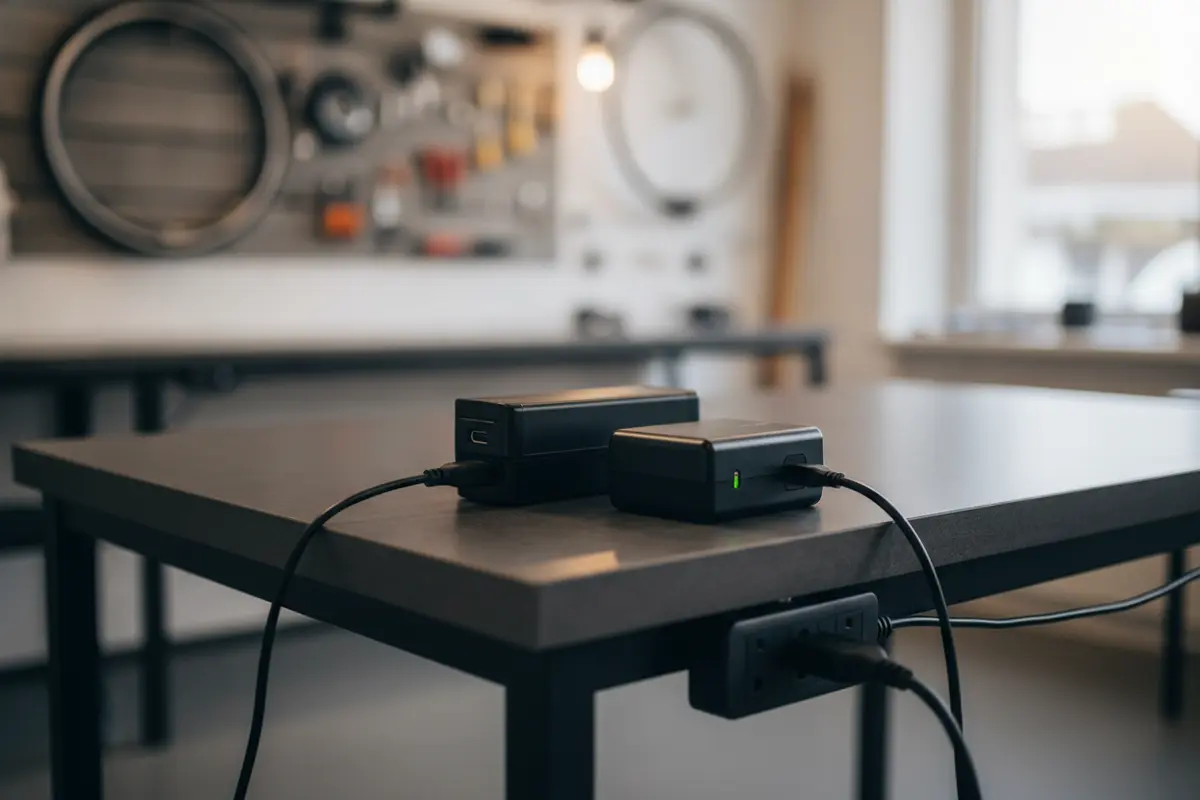
- Set the battery and charger on a hard, stable surface, not a bed, couch, pillow, or pile of clothing.
- Keep the area clear and provide the ventilation recommended by the manufacturer.
- Keep children and pets away from the charging setup and cable.
Massachusetts fire officials likewise advise charging on a hard, stable surface and following the manufacturer’s instructions. Read their e-bike fire safety reminder alongside your bike manual.
How does charging a removable battery differ from charging on the bike?
Some e-bikes allow the battery to be removed and charged separately; others are intended to charge while installed. Follow the model-specific directions. Removing a battery may make it easier to bring indoors, but it also means handling and storing the pack carefully and reconnecting it correctly.
Before removing a pack, switch the system off and use the release method described in the manual. Avoid dropping it or carrying it by the charging cable. When reinstalling it, check that it is seated and locked as intended before riding. If the battery does not release normally, do not pry it loose.
Charging on the bike can be convenient if the bike can be parked in a dry, protected place near an outlet. Arrange the cable so nobody can trip over it and the bike cannot be knocked over. If the bike must remain outside, do not leave the charger or exposed connection in wet conditions; consult the manual for safe storage and charging limits.
What charging setup works for a home?
Look for a spot where you can park or place the battery without blocking a doorway or escape route. A garage, utility area, or other dry location may work if it meets the manufacturer’s requirements. An outlet that is easy to reach helps reduce cable strain. Avoid extension cords unless the manufacturer explicitly permits one and gives the required rating and instructions.
Think about your routine as well as the outlet. If the battery is removable, decide where it can cool and rest after a ride before charging, as directed by its maker. Keep the charger where it will not be crushed, covered, or exposed to water. Unplug and store it according to the manual when charging is complete.
| Charging choice | When it may suit you | What to confirm |
|---|---|---|
| Charge a removable battery indoors | You can safely carry and store the battery indoors. | Removal and charging steps in the manual; a dry, stable surface. |
| Charge the battery on the bike | The bike can be parked in a protected location near an outlet. | That on-bike charging is allowed and the cable can be routed safely. |
| Use a replacement charger | The original charger is lost or needs replacement. | Written manufacturer compatibility for the specific battery system. |
What is a practical home charging routine?
A home charging routine is a short sequence you can repeat without guessing. It starts with the manual for that battery. Use only the charger supplied for it, or a replacement the maker approves. End with the pack stored the way the maker describes. The steps below are a checklist to pair with those instructions, not a substitute for them.
- Read the charging section of the manual and match the charger label to that battery system before the first use.
- Park the bike, or place a removable battery, on a hard, stable surface in a dry spot that does not block a door or walkway.
- Inspect the plug, cable, connector, and battery case. Stop if you see cracks, exposed wire, moisture, swelling, or a loose connection.
- Connect the charger in the order the manual specifies, then confirm the indicator shows a normal charge.
- Leave the setup uncovered and undisturbed. Do not drape clothing, bags, or blankets over the charger or battery.
- When charging is finished, disconnect as directed, unplug the charger, and store both pieces where they stay dry and cannot be crushed.
If a step in the manual conflicts with this list, follow the manual. Model differences cover whether the battery should cool after a ride and whether it may stay connected after the indicator changes. They also cover whether it can charge while installed on the bike. A routine only helps when those model rules stay in charge.
Households with more than one rider should agree on the same spot and the same check. A shared garage is easier to manage when the cable has a fixed path and the charger has a labeled home. Nobody should move a charging battery to make room for storage. If lifting a removable pack is awkward, compare that with a bike that charges while the battery stays installed. Ask Voltaire Cycles to show the release and port on the model you are considering.
How should you charge an ebike at home in Bend weather?
Bend and the rest of Central Oregon swing from hot, dry afternoons to cold nights. A garage can sit outside the temperature range a battery maker allows. Before you charge, check the manual for the permitted charging temperature. If the battery was outside in freezing weather or in a hot vehicle, bring it into the allowed range first instead of plugging it in immediately. Do not use a space heater, hair dryer, or enclosed bin to speed that change.
A covered carport is not automatically a safe charging spot. Wind-driven rain, irrigation spray, and melting snow can reach a connector that looks sheltered. Charge indoors, or in a dry garage area the manual allows, and keep the charger off the concrete if the instructions call for a raised, stable surface. After a dusty trail ride, wipe grit away from the port area only as the manual permits. Do not open the battery to clean it.
Winter storage is a separate decision from tonight's charge. If the bike will sit for weeks, use the maker's storage charge level and recheck interval rather than leaving it full or empty. For a deeper look at cold-weather storage, read how temperature affects winter battery storage. That guide covers storage conditions. This one stays on the everyday question of charging at home between rides.
If a charge will not start after a cold night, do not swap in another charger to test the battery. Recheck the outlet, the seating of the connector, and the temperature limits. A charger that will not start, a warning light that stays on, or a battery that was dropped on a cold garage floor is a service question. Voltaire Cycles can inspect multi-brand electric bikes in Bend and talk through whether the pack, the charger, or the setup is the issue.
How can you make charging part of your routine?
Charge when it fits the battery maker’s guidance and the next ride, rather than relying on a universal rule for how long every pack should remain connected. Charging time varies by battery capacity, charger, and starting charge. Use the charger’s indicators and the manual to understand when the process is complete. Never guess from the appearance of a connector or assume that a different charger will charge faster safely.
A simple routine can help. Check the battery and cable, then connect them in the order the manual specifies. Place them where they will stay dry and undisturbed, and check the charger indicators. When finished, disconnect as directed and put the charger away. If the battery will be stored for a longer period, use the maker’s storage guidance for charge level, temperature, and inspection.
How can you plan charging around daily use?
Consider where the bike will be parked between rides and how far the outlet is from that spot. A convenient charging place should not depend on stretching a cable across a walkway or leaving a door partly open. If you live in a shared building, check the property’s rules and choose a location that does not block hallways, stairwells, or other shared routes. The battery manual remains the authority on permitted storage locations.
For commuting, build charging into the end of a ride rather than waiting until just before departure to discover a depleted battery. Check the display or other battery indicator in the way your model recommends, then allow the charge time specified by the manufacturer. For occasional recreational use, consult the maker’s instructions about battery storage between outings instead of leaving assumptions to determine whether it should stay connected.
Keep a clear path around the bike and charger, especially in a busy household. A cable routed along a wall or secured away from foot traffic is less likely to be pulled or damaged. Put accessories and bags elsewhere so they do not cover the charger or battery. These small details make it easier to notice a loose connector, unusual light, or other change during a normal check.
What should you do if charging seems wrong?
Stop charging if you notice a damaged cable, loose connector, liquid exposure, a strong unusual smell, smoke, or abnormal heat. Do not open the battery or charger, attempt a repair, or keep testing a questionable setup. If there is smoke or fire, move away and contact emergency services; do not handle a hot or smoking battery.
If the charger does not appear to work, check only the basic items the manual permits. That may include whether the outlet works and whether the connection is fully seated. Do not bypass safety features. Contact the manufacturer or a qualified technician if a warning light persists, the battery will not accept a charge, or the equipment has been damaged. Voltaire Cycles offers multi-brand repair and maintenance support; see the bicycle repair and service page to learn about service options.
What should you consider when choosing an ebike for home charging?
Charging convenience is one part of ownership. Ask whether the battery is removable, where the manufacturer says it can be charged, whether the charger is included, and what the manual recommends for storage. Also consider where the bike will be parked and whether you can reach an appropriate outlet without creating a trip hazard.
Compare complete bike options rather than focusing only on a battery specification. Think about your usual ride, fit, cargo needs, and the kind of local support you want. Bend-area shoppers can visit the Voltaire Cycles showroom for hands-on product guidance and test rides. Shoppers beyond Central Oregon can review the Segway collection online and check the product listing for model-specific equipment and details.
What questions help you compare home-charging options?
Before choosing a bike, ask practical questions that connect the charging setup to your actual home. Can you carry the battery comfortably if it is removable? Is there a dry, stable place where it can be charged without being covered or disturbed? Can the bike itself be stored near an outlet if the battery is fixed? The answers can reveal whether a model’s charging routine fits your space.
Ask how the charger is identified for that battery and where to find the model-specific instructions. If you order online, save the product and battery documentation so it is easy to consult when the bike arrives. If you shop in person, ask staff to show how the charging port or battery release works, if the model permits removal. Hands-on guidance can make the setup less mysterious without replacing the manual.
Also consider access for everyone in the household. The charger should not sit where children or pets can pull on its cord. Only someone who can move the battery safely should handle it. If lifting or carrying a pack is difficult, that is useful information when comparing fixed and removable battery designs. A bike’s charging process is part of everyday usability, not just a technical detail.
For charging and bike guidance, contact Voltaire Cycles. The contact page lists the shop phone, (844) 394-3809, and a note form.
Frequently asked questions about charging an ebike at home
Can I plug an ebike charger into a normal household outlet?
Many e-bike chargers are designed for a standard household outlet, but check the charger label and manual for your specific model. Use a suitable, dry outlet and follow any instructions about circuit requirements or extension cords.
Can I charge an ebike battery overnight?
Do not assume overnight charging is suitable for every system. Follow the battery maker’s directions for charging duration, supervision, and disconnecting. Use the charger indicators and avoid leaving a damaged or questionable battery connected.
Can I use a different charger if the plug fits?
No. A matching plug alone does not establish compatibility. Use the supplied charger or a replacement the manufacturer approves for that exact battery system.
Can I charge an ebike battery in a bedroom?
Choose a location based on the manufacturer’s instructions and fire-safety guidance, with a hard, stable surface and clear space. Avoid soft furnishings and keep the battery and charger away from exits, clutter, and heat sources.
Can I charge the battery immediately after a ride?
Follow the manual. It may specify whether the battery should cool or otherwise rest before charging. Do not apply a universal timing rule when the manufacturer provides model-specific guidance.
For a bike you can charge confidently at home, start with the exact battery and charger instructions, then choose a setup that stays dry, stable, and clear.