
Can You Build an Electric Dirt Bike with 1k?
Can you build an electric dirt bike with 1k? Only in a narrow case. You need a sound donor bike you already own, tools on the bench, and the skill to wire a matched motor, controller, and battery yourself. Even then, the result is a light pit-style project, not a full-size trail bike that can take adult weight, rocks, and repeated hits.
The battery, the motor and controller, and the chassis eat the money first, and shipping, tax, a worn tire, or a bad mount can push the total past the cap before the first ride. A $1,000 parts pile is not the same thing as a supported machine you can service in Bend.
Book a free consultation if you want a local tech to look at a donor bike, or to compare that project with a complete electric dirt bike you can test in person.
This guide stays on the budget question. It does not rank the cheapest complete bikes, walk through a pedal-bike conversion, or price one model line by line. Those are separate decisions. Use the numbers below to decide whether the project is realistic before you buy parts.
Can You Build an Electric Dirt Bike with 1k?
Yes, but only as a small, light-duty build, and the honest version starts with a rolling chassis you already have. That means the frame, wheels, brakes, seat, and controls are already paid for. You then spend the $1,000 on a matched electrical system and the small parts that make it rideable.
If you must buy the chassis too, the budget gets tight fast, though a used pit-bike frame in fair shape can still fit. A bare frame plus new suspension, wheels, and brakes usually cannot. Starting from a pile of new parts and calling it a $1,000 dirt bike is how these projects stall in a garage.
What you get is closer to a backyard pit bike than a motocross bike, so expect short rides, modest speed, and a machine you maintain yourself. Do not expect the suspension, brakes, or range of a purpose-built electric dirt bike sold as a complete unit.
What a $1,000 Parts Budget Actually Buys
Prices move with condition, shipping, and seller, so the ranges below are planning bands, not a quote. They show why the battery takes the largest share and why there is almost no spare cash once the electrical system is chosen.
| Part. | Planning range. | What it has to cover. |
|---|---|---|
| Rolling chassis if you do not own one. | $100 to $250. | Frame, wheels, brakes, seat, and controls in usable shape. |
| Motor and controller. | $200 to $350. | A matched pair, plus throttle and basic harness. |
| Battery, BMS, and charger. | $350 to $500. | A pack with known cells and a charger made for that pack. |
| Final drive. | $60 to $120. | Chain or belt, sprockets, and hardware that lines up. |
| Wiring and mounts. | $40 to $90. | Connectors, fuse or breaker, and fasteners. |
| Wear parts. | $75 to $150. | Tires, brake pads, bearings, grips, or cables. |
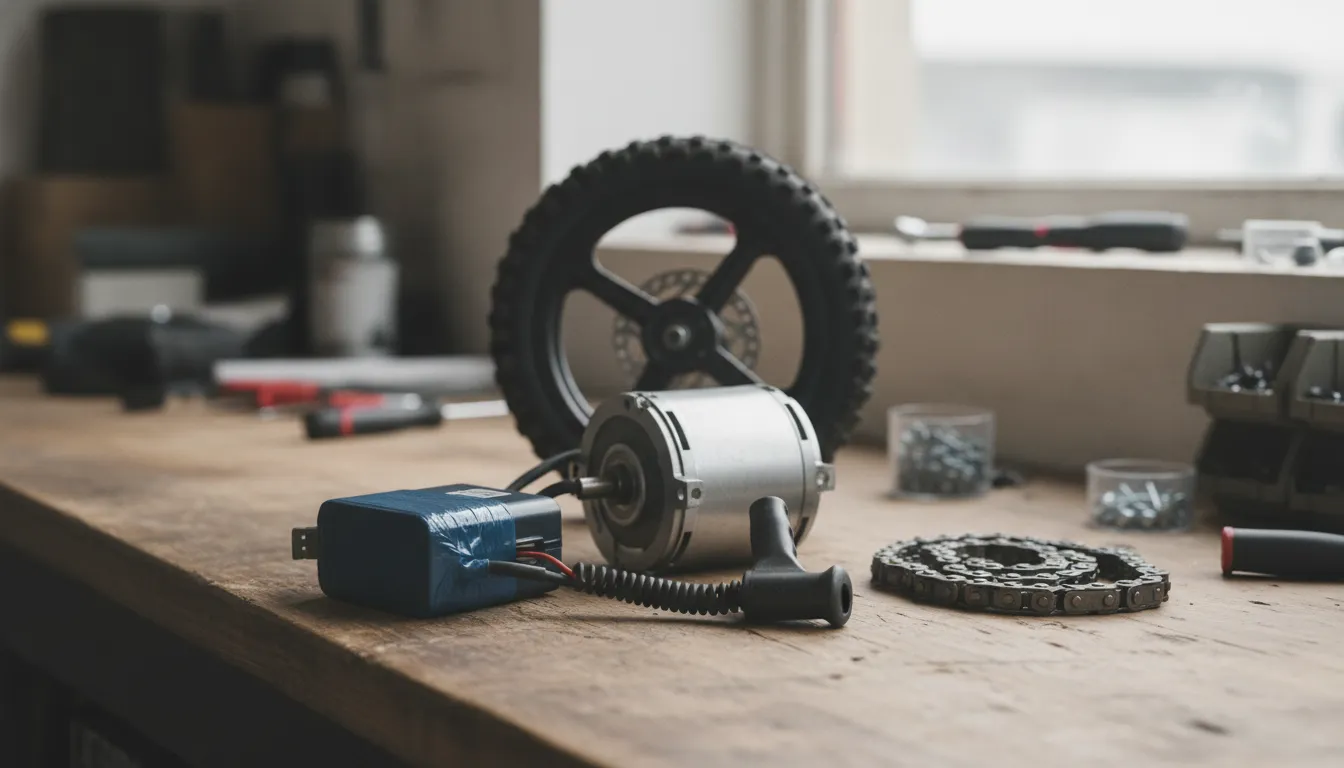
Add those bands and the top of the range already passes $1,000 before tax and freight. A build stays inside the cap only when the donor needs almost no repair and you already own the tools. If the parts list hits $1,000 before you start, leave room or stop. There will be a missing connector or a tire that will not hold air.
Read the kit contents before you compare prices, because some motor kits include the controller and throttle. Many leave out the battery, charger, sprockets, and mounts. A low kit price that excludes the battery is not a $1,000 build. It is a down payment.
Which Donor Bike Can Stay Inside the Cap?
The donor decides the project more than the motor wattage printed on the box. Three starting points show up again and again, and only one is a comfortable fit for this budget.
A used pit bike you already own
A small gas pit bike with a dead engine can work if the frame, wheels, and brakes are sound. The motor and battery still need a place to mount, and the chain line has to be straight. Fabrication beyond simple brackets is where the budget breaks.
A worn electric pit bike
A used electric pit bike with a tired pack can be the cleanest donor. The frame already expects a motor and a battery. You still have to confirm that a replacement pack matches the controller voltage and current. A connector that looks the same is not proof that the pack is safe to use.
A mountain bike
A bicycle frame is cheaper to electrify, and many riders already own one. It is still a bicycle. The wheels, brakes, and frame were not built for motorcycle weight, torque, or off-road hits. Federal rules define a low-speed electric bicycle in 15 U.S.C. § 2085. It needs working pedals and a motor under 750 watts. Motor-only speed must stay under 20 mph on level pavement with a 170-pound rider. A dirt bike without pedals, or one built to go much faster, is a different kind of vehicle. Do not assume a bicycle conversion is legal, or safe, as a dirt bike.
Where the $1,000 Build Falls Apart
Most overruns are ordinary. They are not exotic failures. Plan for them before you order the motor.
- The battery is undersized or unlabeled. A cheap pack with unknown cells can sag, shut down, or fail under load. Replacing it costs more than buying a known pack first.
- Voltage and current do not match. The battery, controller, motor, and charger have to agree. A mismatch can mean weak power, constant cutouts, or damaged parts.
- The charger is wrong. It must match the pack chemistry and charge voltage. The plug shape does not prove that.
- The chassis needs parts. A soft brake, a bent rotor, or a dry wheel bearing can consume the margin you saved for the battery.
- Shipping and tax were ignored. Heavy packs and frames are expensive to ship to Central Oregon.
- You need tools you do not own. A press, a welder, or a diagnostic meter turns a weekend project into a shop job.
Leave $100 to $200 unspent until the bike is together. If you cannot, the project is already over budget. That reserve is for the part the listing did not mention.
What Performance Should You Expect?
A careful $1,000 build can be fun on flat dirt, a field, or a short private loop. It is a poor bet for steep Central Oregon trails, long fire roads, or an adult rider who wants motorcycle feel.
Power on the label is not the power you feel. Controller limits, gearing, total weight, and battery current all change how the bike pulls. A larger wattage number does not help if the pack cannot supply the current or the brakes cannot stop the weight.
Range will be short if the pack was chosen to hit a price. Cold weather, hills, and a heavier rider cut it further. Plan the ride so you can walk the bike back. Do not treat a seller's top-speed claim as a promise.
Brakes and suspension are the safety limit. A light pit bike that stops well is more useful than a fast one with wooden forks and glazed pads. If the donor's brakes are marginal before you add battery weight, fix that before the first ride, even if it means waiting.
How Should You Check Parts Before You Buy?
Do this on paper first. A list is cheaper than a return shipment.
- Write down the donor: wheel size, brake type, chain line, and where a battery can sit low and centered.
- Pick a voltage, then choose a controller and motor rated for that voltage.
- Choose a battery whose management system can support the controller's current, and a charger made for that pack.
- Price the final drive, mounts, fuse, and connectors as their own line, not as leftovers.
- Add tax, shipping to Bend, and a wear-parts reserve. If the total is over $1,000, cut scope or stop.
- Confirm you can get help if the bike will not power up. A silent controller is not a roadside fix.
If any line is a guess, it is not a budget yet. Guessing the battery size is the usual way these builds jump from $1,000 to well past it.
When Is a Complete Bike the Better Buy?
Buy a complete electric dirt bike when you need predictable brakes, a known battery, and someone who can service it. That machine will cost more than $1,000. The gap is the support, the matched parts, and the riding time you do not spend diagnosing a homemade harness.
Voltaire Cycles in Bend sells and services electric dirt bikes, including the Segway Xaber 300. The live price guide lists that model at $5,299.99, which is a different class of bike from a $1,000 parts build. Read the Segway Xaber 300 price guide for what that money covers, and the Segway X260 buyer's guide if you are comparing another supported dirt model. Neither page is a $1,000 build plan. They show what a finished, serviceable bike looks like beside a home project.
A shop build is also different from this budget. The custom electric bike build guide covers a planned shop build, and the conversion kit guide covers when a kit fits a donor bicycle. Use those if your question is how to build with support. Stay here if your question is whether $1,000 is enough for a dirt bike you assemble yourself.
Service matters after the first ride. All-brands repair in Bend is the right next step when a complete bike needs brakes, a battery check, or a diagnosis you do not want to guess at. A one-off wiring job may be outside what any shop can support, so ask before you assume a custom harness can be repaired later.
A Simple Way to Decide
Choose the $1,000 build only if all three are true. You already have a sound small chassis. You can wire and mount the system without buying new tools. And you accept a short-range pit bike, not a trail bike.
Choose a supported bike if any of these are true. You need to carry an adult rider on real trails. You do not want to diagnose battery faults. Or the parts list is already at $1,000 before tax, shipping, and wear items. In that case the project is not a $1,000 dirt bike. It is an open-ended one.
If you are near Bend, bring the donor or the parts list to the shop before you spend the money. A short look can show a brake, a mount, or a battery mismatch that the listing photos hide. That check is cheaper than a second pack.
Call (541) 350-0669 or visit the Bend showroom to talk through a donor bike, a test ride, or service on a complete electric dirt bike.
Frequently Asked Questions
Can you build an electric dirt bike with 1k if you already own the frame?
That is the only comfortable version of the budget. The $1,000 then goes to the motor, controller, battery, charger, and small parts. A bare frame with no wheels or brakes usually cannot stay inside the cap.
Will a $1,000 electric dirt bike be fast enough for an adult?
It may move an adult on flat ground. It will not feel like a full-size electric motocross bike. Brakes, suspension, and battery current limit it long before the motor label does.
Is a converted mountain bike the same as an electric dirt bike?
No. A pedal bike with a small motor can be a low-speed electric bicycle under federal rules. A dirt bike without pedals, built for higher speed and rougher use, is a different machine with different parts and different legal treatment.
What is the first part that blows the budget?
The battery. A pack with known cells, a proper management system, and a matching charger costs more than a no-name block with the same advertised voltage. Buying the cheap pack twice is the expensive path.
Can Voltaire Cycles finish a $1,000 home build?
Ask before you buy parts. The Bend shop builds and converts electric bikes and can service many complete brands. A homemade harness with mismatched parts may not be something a shop can safely support. A consultation is the right first call.