

What Are the Best Electric Dirt Bikes?
What are the best electric dirt bikes? The best option is the one that fits the terrain you can legally ride, your experience and body position, the distance you need to cover, and the support available after purchase. A headline speed or range figure cannot answer all of those questions. Start with your actual use, then compare handling, fit, battery expectations, and service as a complete package.
What are the best electric dirt bikes for your kind of riding?
Short answer: Choose according to where you will ride most often, how you will transport the bike, and whether you can manage its controls comfortably. A compact local loop, a long route with climbs, and a rough technical trail call for different priorities. First define the ride, then shortlist models whose intended use and support fit those needs.
“Best” is not one universal specification. A bike that feels capable on an open, familiar route may be difficult to turn around on a narrow trail. Another option may be easier to manage but not suited to the surfaces you expect. Decide what a successful ride means to you: predictable starts, stable handling, enough battery reserve, straightforward loading, or access to qualified service.
Write down three typical rides before shopping. Include the surface, elevation changes, likely duration, and whether you will ride alone. Add a separate list of less frequent trips. This keeps an occasional ambitious outing from dominating a purchase meant for regular use. If you do not yet know your preferred terrain, make versatility and fit more important than a highly specific performance claim.
How should you compare electric dirt bikes?
Short answer: Compare each candidate against the same set of questions: intended terrain, power response, battery and charging, fit, handling, transport, and service. Use the manufacturer’s manual and current product details for exact specifications. If a detail is unclear, ask the seller to show where it is documented rather than filling gaps with assumptions.
Keep a comparison sheet and record facts separately from impressions. “The controls felt easy to reach” is a useful ride impression; “the bike will cover my whole route” is a claim that needs conditions and evidence. Ask how performance and range statements were measured, whether the configuration being discussed is the one available, and what limitations the manufacturer lists.
| Factor | What to check | Useful question |
|---|---|---|
| Intended use | Surfaces, grades, and use limits | What terrain does the maker recommend? |
| Power delivery | Low-speed response and controllability | Can I feel the response in a supervised demonstration? |
| Battery | Capacity, charging, and range conditions | What assumptions support the range estimate? |
| Fit | Reach, stance, balance, and stopping | Can I maneuver it comfortably at low speed? |
| Service | Parts, diagnostics, and repair scope | Who can inspect this specific model? |
| Access | Land manager and vehicle classification | Is this exact route open to this vehicle? |
Do not treat a category name as proof that a route is open. Access can depend on the land manager, the vehicle’s classification, and the particular trail or road. Check the current rules for the exact place you intend to ride. The U.S. Forest Service provides information about national forests; consult the applicable forest’s current travel guidance rather than relying on a general assumption.
How do terrain and range affect the choice?
Short answer: Terrain changes both the effort required from the bike and the rider’s energy use. Loose ground, steep climbs, repeated stops, and a faster pace can use battery differently from steady riding on firm, level ground. Treat range as an estimate tied to conditions, not as a guaranteed distance.
Describe the route in segments. For example, a loop might begin on a firm access road, climb on a rocky section, cross loose soil, and return through a series of slower turns. Each part asks something different of tires, clearance, suspension, power response, and rider control. Ask whether the model’s intended use matches the most demanding section, not only the easiest portion.
For battery planning, map the entire out-and-back or loop, including the return and any detour. Note the longest climb, softest surface, and places where you may need to stop and restart. Ask what conditions were used for any advertised distance and whether the maker provides a range estimate by mode or riding style. Avoid assuming a test result will match your weight, pace, temperature, or terrain.
A conservative first ride is a practical way to learn. Choose a route with an easy exit, avoid stacking several unfamiliar challenges at once, and check battery use during the ride if the display supports it. Afterward, record distance, terrain, pace, and remaining charge. This gives you a more useful personal reference than a single number detached from conditions. Keep a reserve for the return; do not plan a route that depends on using every bit of displayed capacity.
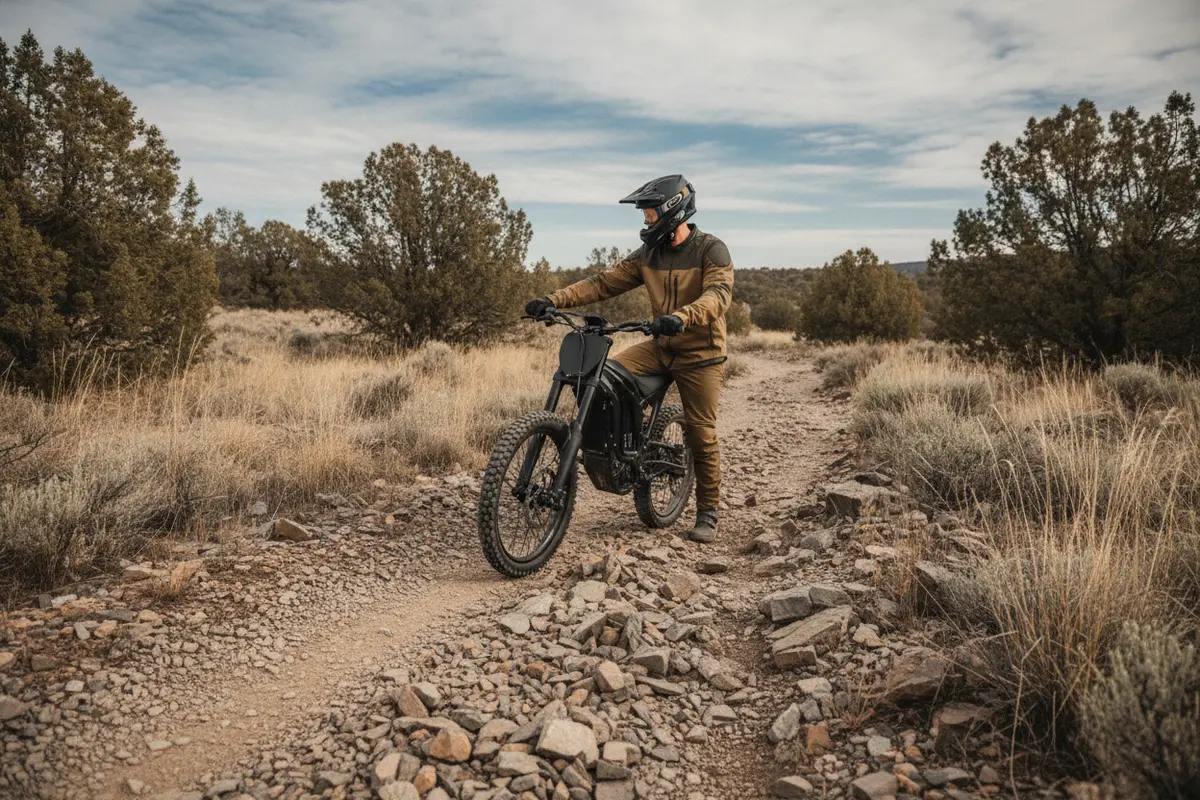
What should you look for in fit and handling?
Short answer: A suitable bike should let you reach controls, balance at low speed, stop securely, and reposition the bike without feeling overwhelmed. Assess it while seated and standing if the design allows, and ask a qualified retailer how to evaluate its fit safely. A brief straight-line ride does not reveal every handling issue.
Check the relationship between your hands, feet, and the controls. Can you maintain a relaxed grip while reaching the brake and other controls? Can you stand in a stable position and shift your weight without feeling cramped? When stopped, can you support the bike and move it into a turn? The answers depend on rider proportions and model geometry, so another person’s preference may not transfer to you.
Try low-speed maneuvers in a controlled area before judging speed or acceleration. A smooth start, a broad turn, a controlled stop, and a restart on a mild incline can reveal whether the power response feels predictable. Follow the retailer’s demonstration instructions and the manufacturer’s guidance. Do not test abrupt maneuvers in a crowded or unsuitable space.
Also consider what happens off the bike. You may need to roll it into storage, turn it around in a garage, load it into a vehicle, or move it across a short uneven stretch. Check the actual weight and dimensions from current specifications, and consider whether your rack, vehicle, doorway, and storage area can handle them. Do not assume that a rack rated for an ordinary bicycle is suitable for a heavier electric model.
Which questions should you ask before choosing?
Short answer: Ask specific questions that uncover fit, restrictions, ownership needs, and service arrangements. The most useful answers are tied to the exact model and written manufacturer information, not to general statements about electric bikes.
- What is the intended terrain? Ask what surfaces and grades the manufacturer identifies, and whether the bike has limits that rule out your planned routes.
- How does power respond at low speed? Ask to experience a controlled start and slow turn. Focus on predictability and comfort, not just maximum output.
- What affects the range estimate? Request the method or conditions behind it. Ask how speed, repeated acceleration, hills, surface, temperature, and rider input may change actual use.
- What charging equipment is included? Confirm the compatible charger, charging instructions, and any restrictions in the manual. Do not substitute a charger based only on a connector that appears to fit.
- What routine checks are required? Ask what to inspect before rides, what maintenance the maker specifies, and which items require a trained technician.
- What is the repair pathway? Confirm whether local service can inspect the model, what parts or diagnostics may be required, and how warranty questions are handled.
- What safety equipment and transport setup do I need? Discuss protective gear appropriate to the activity and verify rack capacity and secure loading before carrying the bike.
- What rules apply to my intended location? Check with the land manager for the precise road or trail and vehicle type before traveling.
Take notes while comparing rather than relying on memory. Ask the same questions about each candidate. If two options seem close, write down the tradeoff: one may feel easier to handle, while another may better match your typical terrain. Make sure the advantage matters on rides you actually expect to take.
How can you make a test ride useful?
Short answer: Treat a test ride as a structured fit and control check. Choose a safe, authorized demonstration area, follow the retailer’s instructions, and test the actions you will use regularly. A demonstration is not a substitute for checking trail access or manufacturer limits.
Before starting, confirm that the bike is adjusted appropriately and that you understand its controls. Wear suitable protective equipment. Begin at a pace that lets you assess the response and braking. If you feel uncertain, stop and ask for help rather than trying to prove that you can manage a difficult maneuver.
Use a short sequence:
- Stand beside the bike and check whether you can support and turn it comfortably.
- Mount and dismount in a controlled space, paying attention to clearance and balance.
- Start gently and notice whether the response is smooth and predictable.
- Ride slowly through a broad turn, then stop without rushing.
- Repeat a start and stop if the area and demonstration rules permit.
- Afterward, note discomfort, uncertainty, or anything you want to investigate before purchase.
Do not evaluate every detail in one short session. A test ride may help you judge reach, balance, and basic control, but it will not prove real-world battery distance, long-term reliability, or access permission. Use product documentation and follow-up questions for those topics. If there is no suitable demonstration available, ask what other ways you can review fit and controls before deciding.
How do service and ownership support fit in?
Short answer: Before buying, find out who can maintain the exact bike and how parts, diagnostics, and warranty support work. Electric off-road models can differ in their systems and service requirements. A shop that repairs one category or brand may not support every model, so confirm the scope directly.
Ask for the owner’s manual and read its charging, storage, inspection, and maintenance sections. Keep the charger and battery instructions with your records. Follow the manufacturer’s advice about temperature, storage state, cleaning, and inspection; do not improvise battery procedures. If a warning, unusual noise, or damage appears, stop riding and consult the appropriate service provider.
Voltaire Cycles of Central Oregon offers electric mobility retail and service in Bend. Its repair and service information is a useful starting point, but confirm whether a particular electric dirt bike falls within the shop’s current service scope. Ask how to arrange an inspection, what information to bring, and whether the model’s manufacturer has specific service requirements.
Ownership support also includes practical planning. Identify where the bike will be stored, how you will charge it according to the manual, and how you will transport it. Keep purchase documents, serial information, service notes, and warranty instructions together. These steps make it easier to ask informed questions later and reduce the chance that a trip is disrupted by an avoidable preparation issue.
How can you choose among the options you have shortlisted?
Short answer: Score each model against your regular rides and your non-negotiable requirements, then resolve any unanswered safety, access, or service questions before deciding. Do not let a single impressive specification outweigh a poor fit or a mismatch with your routes.
One simple method is to mark each factor as “fits,” “uncertain,” or “does not fit.” Use factors such as terrain, low-speed control, fit, range planning, charging, transport, and service. Give the most weight to requirements that could prevent you from using the bike as intended. For instance, a route-access issue is not a minor drawback, and a bike that is hard to control at low speed may not be a sensible choice merely because its top-line specifications look attractive.
Imagine two candidates for a rider whose regular outing is a short, hilly loop with several tight turns. Model A has a range claim that looks generous, but the rider cannot reach the controls comfortably. Model B has a less compelling headline figure but feels stable during a controlled demonstration and has a clear service pathway. The sensible next step is not to assume Model B is automatically superior; it is to verify that its documented intended use and expected battery performance cover the route with reserve, then compare its maintenance and transport needs.
For a different rider planning occasional longer outings, the order may change. Battery conditions, charging plans, route exits, and service support deserve more attention. If the route includes land managed by multiple agencies, verify each section separately. There is no value in optimizing for distance if a key segment is not open to the vehicle, or if the return plan depends on an uncertain range estimate.
When the facts are incomplete, pause the decision and find the missing information. Ask for current specifications, consult the manual, or contact the relevant land manager. This is more useful than filling a comparison chart with assumptions. The best match is the one whose documented limits, practical fit, and support align with the rides you can responsibly take.
Where can you compare electric dirt bike options?
Voltaire Cycles serves electric mobility shoppers through its Bend showroom and online store. You can browse the electric bicycle collection and review the QuietKat Apex XD listing as one off-road-oriented product example. Do not assume that a product listing establishes compatibility with every trail or that every model is currently available. Verify current specifications, stock, and service scope directly before planning around a specific option.
For a local visit, prepare your intended route description, rider fit questions, transport details, and any models you want to discuss. For online shopping, gather the same information and ask for clarification on unresolved items. Either way, the goal is a useful comparison, not a rushed choice. A local consultation can help you understand the options, while the manufacturer’s documentation remains the source for exact operating limits and instructions.
Frequently asked questions
Are electric dirt bikes allowed on every trail?
No. Access depends on the land manager, route, and vehicle classification. Check current rules for the exact location before riding, including any separate sections along your planned route.
Can I rely on the advertised range?
No single range figure guarantees what you will achieve. Terrain, pace, hills, repeated acceleration, temperature, rider input, and other conditions can change battery use. Ask how an estimate was established and plan conservatively with a return reserve.
Should I choose the model with the most power?
Not automatically. Consider controllability, fit, intended terrain, maintenance, and whether the bike suits your experience. A powerful option is not a good match if its response or size makes ordinary maneuvers uncomfortable.
What should I bring to a showroom consultation?
Bring a description of your typical routes, the surfaces and grades you expect, your transport and storage constraints, and questions about fit, charging, and service. This makes it easier to compare relevant options and identify information that still needs verification.
Compare the bike against your real routes, verify access and specifications, and choose an option you can handle and support responsibly.