

Off-Road Electric Skateboard Review Guide
An off-road electric skateboard can feel very different on rough pavement, loose gravel, or dirt than it does on a smooth path. That is why a useful review needs more than a list of advertised speed and range figures. It should explain the terrain, rider conditions, controls, braking approach, and limits behind every conclusion.
In short: An off-road electric skateboard review is most trustworthy when it separates verified Exway product specifications from results that still need hands-on testing. It then evaluates comfort, control, range, braking, maintenance, and route suitability for the intended rider.
This guide does not present unverified first-hand results. Instead, it gives Bend and Central Oregon shoppers a practical framework for comparing capable boards. Check manufacturer guidance, then decide which questions to answer during a showroom consultation or test ride. The first step is defining what evidence a review should provide.
Review current Exway product details before comparing boards
What makes an off-road electric skateboard review useful?
A useful review tells readers how the conclusions were reached. That means disclosing whether the board was actually tested, how many units were involved, and whether comparisons were made under similar conditions. In this article, we use a repeatable review rubric rather than presenting a hands-on test that Voltaire did not perform. The customer research does not provide complete first-hand results for the Exway X1 Max Riot across terrain, comfort, range, braking, controls, weather, or maintenance.
That distinction matters because a product page and a ride evaluation answer different questions. The Exway X1 Max Riot product page can establish catalog details, such as the integrated battery and speed controller, longer deck, reinforced edges, and available drivetrain configuration. Those are specifications or product descriptions, not measured proof of how the board behaves on a particular trail.
What should a repeatable rubric measure?
A strong off-road electric skateboard review separates ride comfort, range, braking, speed, hill performance, and beginner friendliness instead of reducing the decision to one ride impression. A complete test plan should also disclose the route, surface, temperature, rider weight, tire setup, battery starting point, and control settings. Dirt, gravel, obstacles, and rough pavement can reveal handling and stopping behavior that smooth pavement does not.
| Review area | What to document |
|---|---|
| Terrain | Surface, obstacles, slope, traction, and clearance |
| Comfort | Tire setup, deck feel, vibration, and rider stability |
| Control | Acceleration, braking, remote response, and speed modes |
| Range | Rider weight, route, temperature, pace, and battery reserve |
- Define the route and rider conditions.
- Inspect the board and record its configuration.
- Test comfort, control, braking, and range separately.
- Report limitations instead of turning one result into a guarantee.
Measured results should remain separate from marketing specifications. Range and top speed should be labeled as observed results only when measured under stated conditions. A controlled braking test is more useful when it reports stopping distance. A hill assessment should identify the grade and method. Terrain and rider weight can materially change range, so a flat-pavement figure should not be treated as a promise for varied Central Oregon routes.
This approach gives shoppers a clearer basis for questions. Before buying, verify current product details, availability, weather guidance, and maintenance requirements on the live page. Then compare those facts with your route, comfort needs, and experience level.
Review the Exway X1 Max Riot product details and current options
How should you test terrain, tires, and deck comfort?
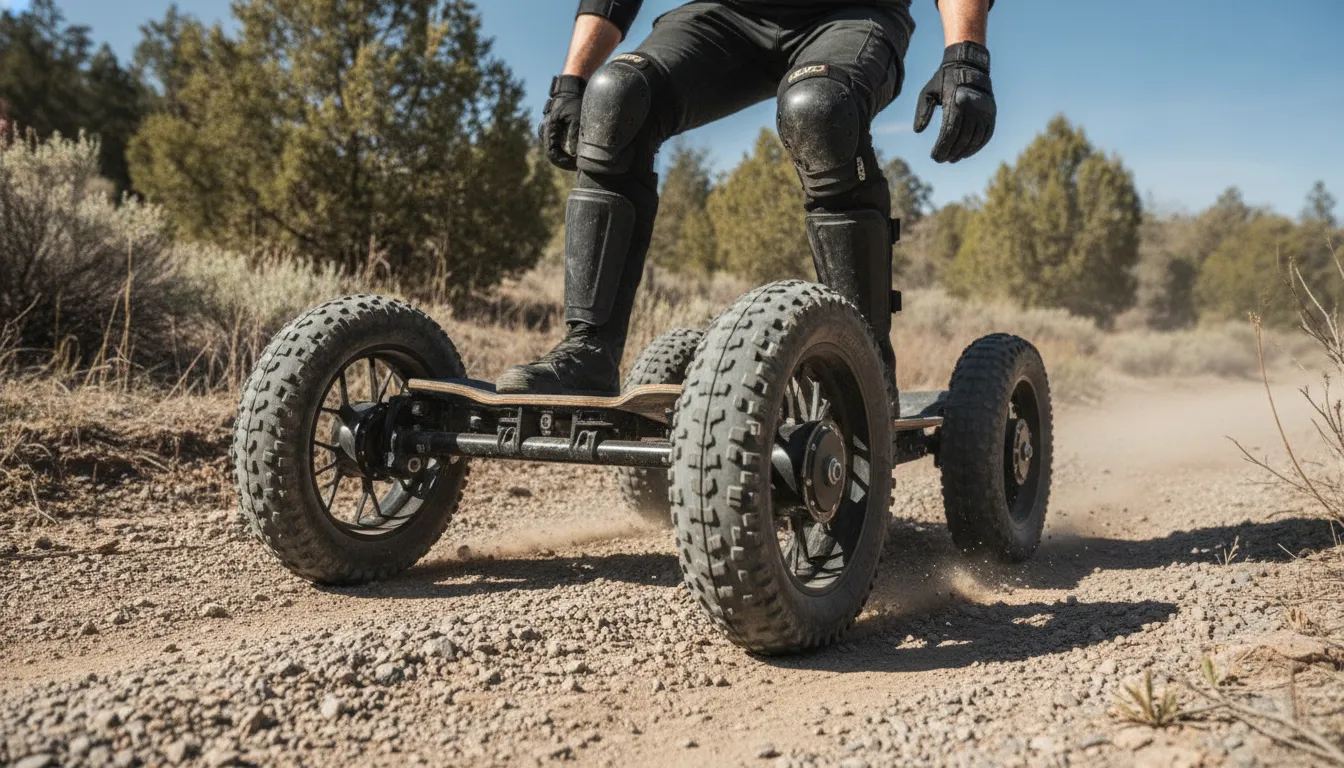
A useful terrain evaluation moves beyond a smooth parking lot. Start on familiar rough pavement, then document how the board responds to cracks, patched surfaces, gravel, packed dirt, loose dirt, and small obstacles. The goal is not to claim that one ride proves off-road capability. It is to identify where traction, clearance, comfort, and rider control begin to change.
Compare tire construction and size
Hard polyurethane wheels can transmit more vibration on rough pavement. Pneumatic all-terrain tires can provide a smoother ride when their pressure and condition are appropriate. Airless all-terrain tires are another configuration worth evaluating because they may offer a larger contact surface without an inner tube. These are design considerations, not guarantees of performance.
Tire size also matters. Smaller wheels may feel less forgiving over cracks, while larger wheels can change ride height, turning feel, and the types of surfaces a rider can approach confidently. Published examples describe pneumatic 7-inch tires as contributing to comfort. 6-inch wheels as helping with common paved-trail cracks, and an 8-inch setup as a deliberate move toward off-road use. Those examples should inform questions, not substitute for the actual board's specifications.
Check clearance, flex, and stability
Look underneath the deck before entering uneven ground. Deck clearance should be sufficient for the planned surface and should be assessed around the motors, trucks, and other low points. On gravel or dirt, note whether stones or sticks can contact the deck or drivetrain. On obstacles, approach slowly and record whether the board keeps its line, scrapes, or unsettles the rider.
Deck flex affects how the board absorbs vibration and how stable it feels under acceleration. A stiffer deck may feel more direct, while a more flexible deck can change foot pressure and balance. Neither is automatically better. Test standing position, turning effort, stopping confidence, and control at a speed appropriate for the terrain. Keep the rider's footwear, weight, tire pressure, surface condition, and tire setup consistent so the observations remain useful. An off-road electric skateboard review should label these as evaluation criteria unless the same conditions were actually tested.
How do range, braking, and remote controls perform off road?
Short answer: Off-road range and control performance depend on terrain, rider weight, speed, tire setup, and riding technique. A credible review should document those conditions, measure braking on a repeatable route, evaluate hills separately, and give riders time to learn the remote before faster sections.
Range should be treated as a test result, not a fixed promise. Record rider weight, tire configuration, temperature, route surface, elevation changes, wind, riding mode, and average pace. A flat-pavement figure may not represent a ride that includes loose dirt, repeated climbs, rough surfaces, or frequent acceleration. Varied terrain can consume more battery than smooth pavement, so an off-road electric skateboard review should report the route and conditions alongside any observed range.
Rider weight belongs in that record as well. Two people can produce different results on the same board, especially when one rider is carrying more mass or using more throttle on hills. The useful question is not whether a claimed maximum is possible under ideal conditions. It is whether the available battery gives the intended rider enough reserve to complete the planned route without treating the final miles as a gamble.
Braking deserves its own controlled test. Start on a clear, predictable surface at a defined speed, apply the brake consistently, and record stopping distance. Repeat the test before drawing conclusions, then evaluate a separate low-speed hill approach. Do not borrow a competitor's measured distance as a product claim. A braking system may also require an adjustment period, so beginner-friendly testing should include gentle stops before emergency-style practice.
Speed modes can help riders introduce power gradually. Begin in the lowest practical mode, confirm how acceleration and braking respond, and increase speed only after the remote feels familiar. Practice releasing the throttle, applying the brake smoothly, and stopping without looking down. Controls should remain intuitive when the surface becomes uneven or attention shifts to an obstacle.
Finally, protect the remote as deliberately as the board. Falls and bailouts can send it into rocks or pavement, and a cover may reduce everyday impact damage. The right accessory depends on the remote design, so verify compatibility before purchase. For any model, follow the manufacturer instructions and test the remote at walking speed before heading onto a longer off-road route.
What weather and safety limits should a review disclose?
Answer: A trustworthy review states the weather conditions, surfaces, protective equipment, and battery checks used during testing. It should also identify what was not tested, avoid inventing an IP rating, and tell readers to confirm route rules and manufacturer limits before riding.
Wet weather deserves a clear boundary, not a guess. Unless the manufacturer provides a current, product-specific weather rating and operating guidance, a review should not describe the board as waterproof or safe in rain. Explain whether testing took place on dry pavement, damp ground, standing water, mud, or not at all. If wet-weather performance was not tested, say so plainly. Readers should consult the live product page and manufacturer documentation for weather, charging, cleaning, and storage instructions before relying on the board in changing conditions. Product specifications and safety limits can change, so verify them before publication at the current Exway product page.
Route choice is part of the safety assessment. A dirt road, paved path, private property, and designated multi-use trail may have different rules. A review should identify the type of surface it evaluated without implying that every trail permits an electric skateboard. In Bend and throughout Central Oregon, riders should check the actual route manager's rules, seasonal closures, and local restrictions. General trail availability is not proof that motorized boards are allowed.
Protective equipment should be described as practical risk control, not an accessory afterthought. A properly fitted helmet is a baseline. Gloves or wrist protection, knee and elbow pads, and sturdy footwear can also be relevant while learning braking and uneven-surface control. A recent adult motorized-board injury analysis found that 61.8% of injuries involved an upper extremity, with the wrist the most common fracture site. The study also associated motorized-board injuries with multiple fractures and hospital admission. The PubMed study is useful context, not a prediction of an individual rider's outcome.
Finally, battery condition belongs in every serious review. The CPSC recall notice documents a case in which an electric skateboard battery pack could overheat and smoke, creating a fire hazard. Reviewers should note whether the battery showed damage, swelling, unusual heat, smoke, or charging problems, and should check applicable recall notices. Stop using a suspect battery and follow the manufacturer's or recall administrator's instructions. These disclosures help readers understand the tested limits without turning one ride into a blanket safety guarantee.
What maintenance should an off-road electric skateboard need?
Off-road riding puts more stress on a board than smooth pavement does, so maintenance should be part of the ownership routine rather than an emergency response. After each rough ride, look over the tires or wheels for cuts, embedded debris, unusual wear, and loss of pressure where applicable. If the board uses a belt drive, inspect the belts and pulleys for grit, fraying, or excessive slack. Belts will require maintenance at some point, and dirt that stays in the drivetrain can accelerate wear.
Check the truck hardware, motor mounts, wheel nuts, and other accessible fasteners for looseness. Do not tighten by guesswork if a component requires a particular torque setting. Follow the manufacturer's instructions, and stop riding if you find a cracked deck, damaged enclosure, exposed wiring, or a control that does not respond normally.
Battery care deserves extra attention. Charge with the correct equipment on a stable, nonflammable surface, and inspect the pack and charger for swelling, impact damage, heat damage, smoke, or unusual odor. Do not use a damaged battery or continue charging a pack that behaves abnormally. Electric skateboard battery packs can overheat and smoke, creating a fire hazard, so check current manufacturer guidance and recall information before returning a questionable board to service: CPSC recall guidance.
Keep the remote dry and protected from drops, and confirm that its controls pair and respond before entering a rough section. Clean the board with a dry or lightly damp cloth as appropriate for the manufacturer's guidance. Avoid directing water into the battery, motors, charging port, or controller. Do not assume that a product is weatherproof because it is marketed for off-road use. Verify the live product page and manufacturer's limits for the specific board before riding in wet conditions: the Exway X1 Max Riot product page is the place to confirm current details.
For battery testing, electrical diagnostics, motor or controller concerns, wheel service, or a systematic inspection, ask a qualified technician what support is available for your specific skateboard. Voltaire's service operation includes those broader diagnostic and service capabilities, but skateboard-specific repair should be confirmed before you bring in the board. A hands-on check at the Bend showroom can also help identify whether the issue is routine maintenance or a reason to stop riding.
Verify the current product documentation before adopting a maintenance routine.
Is an Exway board worth evaluating locally in Bend?
Short answer: An Exway board may be worth evaluating in Bend when you want to compare fit, deck feel, controls, and current configuration before buying. This article does not claim first-hand Exway test results. The product page and a local consultation can help verify what is available, but neither replaces checking the manufacturer's current guidance for your intended route and conditions.
The Exway X1 Max Riot is described in the catalog as having an integrated battery and speed controller. With no visible electronics, a longer deck than its prior generation, reinforced edges, and a swappable belt or hub drivetrain. Those are catalog descriptions, not observed conclusions about comfort, acceleration, range, braking, or off-road control. Review the Exway X1 Max Riot product page for the current configuration. Then confirm that the live details still match the version you are considering.
What should you verify before choosing a configuration?
Ask which drivetrain is currently supplied, and verify the tires, braking system, remote controls, expected range, charging requirements, and any stated weather guidance. A belt and a hub drivetrain can involve different maintenance considerations and ride characteristics, so do not assume the catalog wording applies to every available setup. Availability can change as well. The researched catalog snapshot was not a substitute for a current inventory check.
It can also be useful to compare the Exway X1 Max Riot with the Exway Atlas electric skateboard without treating either model as the automatic winner. The right choice depends on your body position, terrain, carrying needs, experience with a remote, and willingness to follow the product's operating limits.
What can a Bend showroom visit tell you?
A showroom conversation and test ride can reveal practical fit questions that specifications cannot. You can assess whether the deck feels manageable, whether the controls are intuitive, and whether your stance and confidence match the board. Voltaire's Bend showroom supports hands-on product evaluation and test rides, but a brief ride is not a full durability or range test. Ask to verify the route, current product status, and safe operating expectations rather than assuming every Central Oregon trail permits electric skateboards.
For ownership planning, Voltaire describes services such as electrical diagnostics, battery testing, motor and controller work, and wheel service. Confirm skateboard-specific scope before relying on it, and use the repair and service page as a starting point for that conversation. A careful local evaluation is valuable because it helps you identify unanswered questions before purchase, not because it creates test results this review does not have.
Check current Exway details before comparing off-road boards
Frequently Asked Questions
What is the best off-road electric skateboard for all terrain?
There is no single best board for every route. Start with tire construction and size, deck clearance, braking control, rider weight capacity, range under comparable conditions, and the availability of parts or service. A board that feels capable on gravel may still be a poor fit for wet routes, steep terrain, or a rider who needs easy carrying and transport.
What are some good electric off-road skateboards for adults?
Good options are the ones that match the adult rider's terrain, experience, body size, and control preferences. Compare pneumatic or airless all-terrain tires, speed modes, remote ergonomics, stopping behavior, and deck stability. Newer riders should prioritize predictable low-speed control and practice braking in a clear area before attempting uneven ground.
How should I judge range on an off-road electric skateboard?
Do not treat the advertised maximum as a guaranteed trail distance. Record rider weight, temperature, terrain, hills, tire setup, speed, and remaining battery after the route. Rough or varied ground generally uses more energy than smooth, flat pavement, so compare measured results only when the test conditions are documented.
Can I ride an off-road electric skateboard in wet weather?
Only if the specific product documentation supports the conditions and the route is appropriate. Do not assume that an off-road design is waterproof. Verify the manufacturer's weather limits, protect the battery and electronics, and check local rules for the actual surface. After a ride, inspect the board before charging, and stop using it if the battery is damaged, unusually hot, or shows other warning signs.
Ready to choose an off-road electric skateboard?
A thoughtful next step is to compare the board's terrain fit, controls, safety limits, and support needs with your actual routes and riding goals. Voltaire Cycles can help you review current Exway options and identify questions to ask before buying, whether you are near Bend or shopping online. Contact Voltaire Cycles to review your options and get product guidance.