

Electric Skateboard Maintenance: Wheels, Battery, and Deck
Regular electric skateboard maintenance helps you spot loose hardware, worn parts, and charging concerns before they interrupt a ride. The best routine is simple: inspect the board before riding, clean it carefully afterward, and follow the manufacturer’s instructions for the battery, charger, and electronics.
Call for electric mobility service guidance
Electric skateboards vary. A belt-drive board and a hub-motor board do not have the same service points, and battery systems differ by model. Use your board’s manual as the authority for torque values, cleaning limits, firmware steps, and component replacement. The checklist below covers general care, not a substitute for a model-specific service procedure.
What does electric skateboard maintenance include?
Electric skateboard maintenance means checking the parts that affect grip, steering, braking, propulsion, and electrical safety. It includes the deck and mounting hardware, trucks, wheels, belt or hub motors, battery enclosure, charger, and software. Routine care is mostly inspection and gentle cleaning. Opening a battery or motor enclosure is a different level of work and is best left to a qualified technician unless the manufacturer explicitly authorizes owner service.
Before any inspection, switch the board off and disconnect the charger. Set it on a stable surface. Never test a powered wheel while fingers, loose clothing, or tools are near moving parts.
How should you check an electric skateboard before every ride?
A short pre-ride check can reveal a problem while the board is still on the bench. Look over the whole board in good light, then roll it slowly by hand if the manufacturer’s instructions allow.
- Deck: Look for cracks, deep chips, delamination, water intrusion, or a battery enclosure that has shifted. Stop riding if the deck or enclosure appears structurally damaged.
- Trucks and hardware: Check that truck mounting bolts and accessible fasteners are present and appear secure. Do not guess at torque; use the manual’s specification and appropriate tool.
- Wheels: Look for cuts, chunks missing, flat spots, embedded debris, and unusual side-to-side play. Spin each wheel and notice rubbing, grinding, or a wobble.
- Drive: On belt-drive models, inspect visible belts for fraying, missing teeth, cracks, and abnormal slack. On hub-motor boards, check the wheel surface and motor cable area without pulling or bending wires.
- Controls: Check remote charge and connection, lights, and brake response according to the model’s manual in a safe, controlled area.
Do not ride if the board behaves unpredictably, a wheel binds, a cable is damaged, braking is inconsistent, or the battery enclosure is compromised. A quick inspection is not a reason to perform an improvised repair at the roadside.
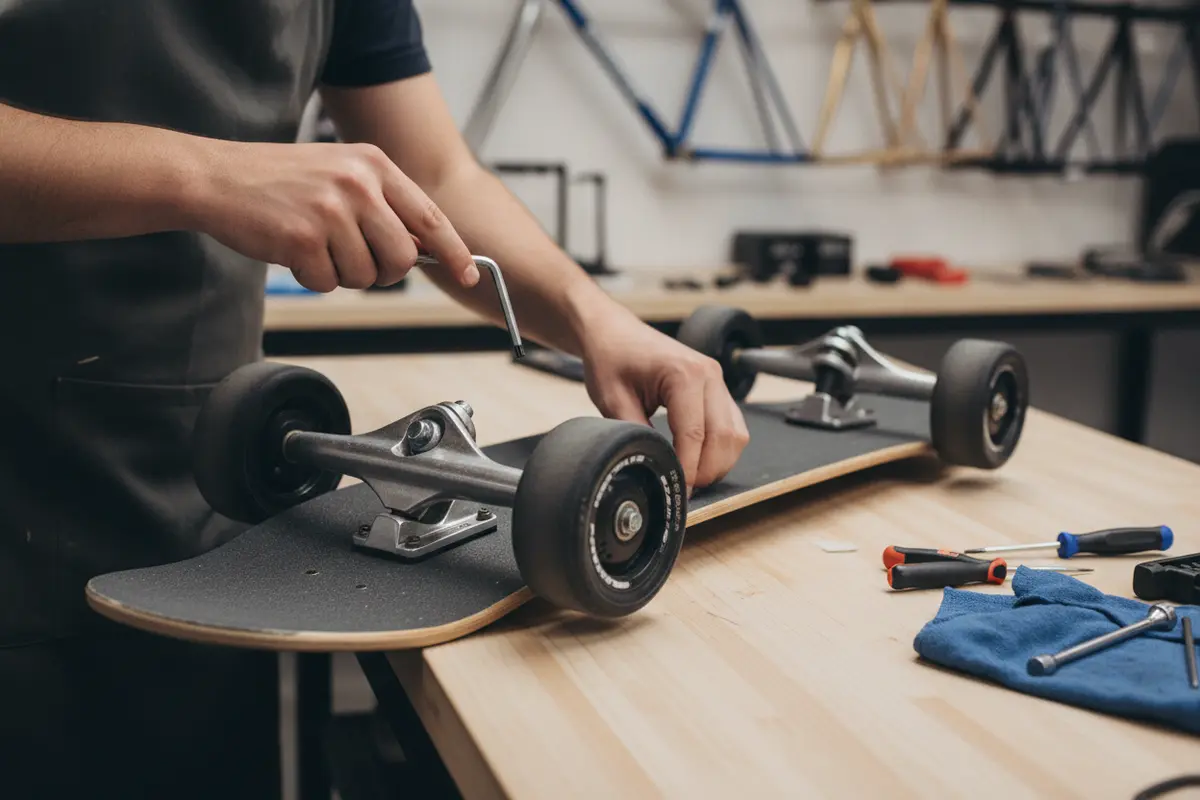
How do you care for the deck and trucks?
After a ride, wipe away dust with a dry or slightly damp cloth. Keep water away from seams, charging ports, motor connectors, and the battery enclosure. A board described as water resistant is not necessarily waterproof. Avoid pressure washing, soaking, or spraying cleaner directly onto electrical components.
Inspect the deck edges and underside for impact damage. A small cosmetic scuff is different from a crack that reaches through the deck or a section that flexes differently than before. If the board has taken a hard impact, inspect it before riding again, even when no damage is obvious at first glance.
Trucks govern how the board turns and feels underfoot. Look for looseness, damaged bushings, bent parts, or a new clunk during turns. Do not tighten kingpins simply to eliminate every bit of movement; adjustment changes handling and depends on rider preference and the board design. Make small changes only if the manufacturer permits them, and test at low speed in a clear area.
When should you rotate or replace electric skateboard wheels?
Wheel wear depends on riding surface, turns, rider load, wheel material, and drive layout. Inspect them often rather than relying on a fixed replacement interval. Uneven wear can sometimes be addressed by rotating wheels, but only when the manufacturer’s layout allows it. A driven wheel may not be interchangeable with a non-driven wheel.
Replace a wheel when it is cracked, badly chunked, has exposed internal material, or no longer runs true. Check bearings for grit, corrosion, roughness, and excess play. Keep bearing lubricant away from belts and braking surfaces. If a wheel or bearing binds after cleaning or replacement, stop and have the assembly checked rather than forcing it to turn.
How does care differ for belt-drive and hub-motor boards?
The drive system changes what you can inspect. A belt-drive board has exposed wear components that may need periodic replacement or adjustment. A hub-motor board has its motor inside the wheel, so there is no external belt to tension. Neither design is maintenance-free: both still need inspection of wheels, cables, fasteners, and unusual noise or heat.
| Area | Belt-drive board | Hub-motor board |
|---|---|---|
| Routine visual check | Look at belt condition, teeth, alignment, and visible debris. | Look at motor-wheel surface, cable routing, and wheel movement. |
| Common warning signs | Fraying, skipped teeth, squeal, or a belt that has shifted. | Grinding, unusual motor noise, rough rotation, or cable damage. |
| Owner care boundary | Adjust or replace only as the manual permits and with correct parts. | Do not open the motor hub or pull on motor wires without authorization. |
| When to seek service | Persistent noise, damaged pulleys, or alignment that will not hold. | Motor faults, damaged wiring, or resistance that remains after inspection. |
A Cal Poly student project on electric skateboard design describes a hub motor as enclosed within the wheel and discusses modular replacement in its particular design (read the project report). That is not a maintenance specification for every commercial board, but it illustrates why construction differs by model. Consult your own manual or service provider for the right procedure.
Belts and pulleys can collect grit. Remove visible debris gently with the board powered off. Do not apply oil to a belt. If belt tension or alignment is unclear, use the manufacturer’s procedure or request service. Repeatedly adjusting by feel can increase noise or wear.
How can you protect the battery and charger?
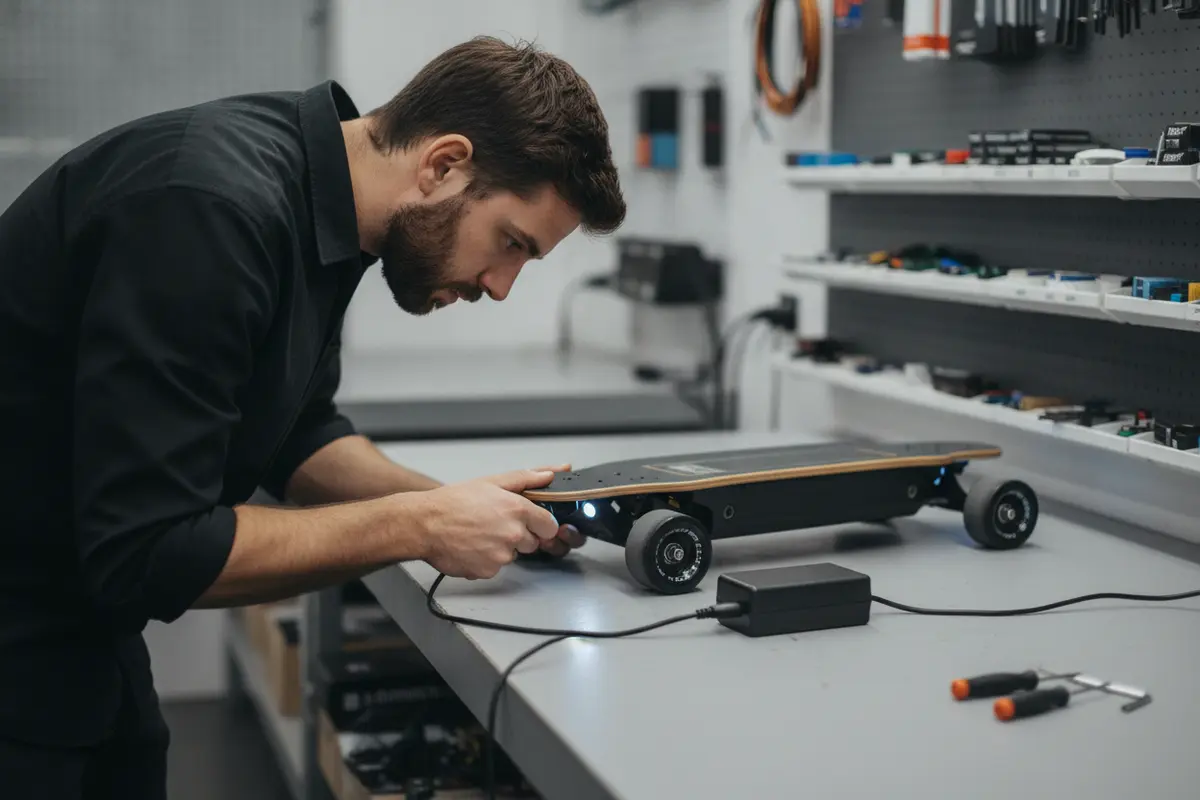
The battery deserves conservative handling. Check the enclosure for cracks, swelling, impact damage, or a new smell, and watch for unusual heat during charging. If you notice swelling, smoke, leakage, a burning odor, or excessive heat, stop using and charging the board. Keep it away from people and combustible materials when safe to do so, and contact the manufacturer or a qualified service provider for direction. Do not open or attempt to repair a lithium-ion battery pack.
Use only the charger specified for your exact board. Before plugging in, inspect the charger, cable, plug, and board port for damage, moisture, or debris. Connect and disconnect as directed in the manual. Charge on a stable, non-combustible surface in a dry, ventilated place, and do not cover the charger while it operates. Avoid leaving charging equipment unattended for extended periods, and unplug it when charging is complete if the manufacturer directs.
Never force a connector or use a charger because its plug happens to fit. Voltage, current, polarity, and charging communication may not match. Keep charging away from extreme heat, freezing conditions, and wet environments. If the battery will not charge normally, stop repeated attempts and seek model-specific support.
Do firmware and remote updates belong in routine care?
Firmware can affect how the board and remote communicate, but updates should be deliberate. Check the manufacturer’s instructions for compatible versions, required battery levels, and update order. Do not interrupt an update or ride while installation is in progress. If the app reports an error or the remote loses connection afterward, follow the manufacturer’s recovery steps rather than experimenting with unofficial software.
Before a ride, confirm the remote pairs correctly and the throttle and braking controls respond as expected in a safe, open space. Keep the remote charged and protected from moisture. If control response changes suddenly, stop riding and diagnose the issue before using the board again.
How should you store an electric skateboard?
Store the board indoors in a dry place, away from direct sun and large temperature swings. Keep it out of damp garages and do not leave it in a hot vehicle. Follow the manual’s recommended battery charge level for storage and check it at the intervals the manufacturer specifies. Battery self-discharge and ideal storage procedures vary, so avoid applying a universal percentage or schedule.
Keep the charger and board together only if their cables can be stored without kinks or strain. Protect the charging port from dust, but do not insert improvised plugs or objects. Before bringing a cold board into a warm room to charge, allow it to reach the temperature range specified by its manufacturer.
Which maintenance can you do, and when is professional service safer?
Most riders can handle visual checks, careful exterior cleaning, and checking for loose or damaged external parts. Some manufacturers also permit owners to replace wheels, bearings, or belts. Follow the board-specific manual and use compatible parts. If a step requires opening the battery, motor, or controller enclosure, soldering, testing live electrical circuits, or guessing at a fastener specification, pause and get qualified help.
Seek service for persistent motor noise, a board that cuts out, battery or charger concerns, damaged wiring, braking problems, recurring loose hardware, or damage after a crash. A technician can assess the issue without relying on guesswork. Voltaire Cycles of Central Oregon offers service and repairs across brands; call to discuss whether the shop can help with your specific board before bringing it in.
For general electric mobility service information, see the repair and service page. Riders may also find useful basic workshop supplies in the shop, such as a patch kit, bicycle lubricant, and compact multi-tool; these are general cycling items, not a claim that they fit every electric skateboard. Confirm compatibility before using any product on your board.
Frequently asked questions
Can you ride an electric skateboard in the rain?
Check the exact model’s water-resistance rating and instructions. Do not assume that a sealed-looking deck or enclosure is waterproof. Water can affect bearings, connectors, and electronics, so avoid wet riding unless the manufacturer explicitly allows it, and never charge a wet board.
How often should you inspect an electric skateboard?
Do a brief safety check before every ride and a more careful inspection after hard impacts, wet or dusty conditions, or unusual sound or handling. Follow the manual for service intervals; use and component design determine how quickly parts wear.
Can you use any skateboard charger with the same plug?
No. Use only the charger specified for your board. A matching connector does not establish electrical compatibility, and the wrong charger can create a serious battery hazard.
What should you do if a wheel or motor makes a new noise?
Stop riding, switch the board off, and inspect for visible debris or damage without opening electrical components. If the noise persists, the wheel binds, or the motor behaves differently, arrange service before riding again.
Call Voltaire Cycles to discuss board service
A consistent inspection routine helps you notice changes early, while careful battery handling and model-specific service guidance protect both the board and rider. When a problem involves electronics, damaged structure, or uncertain repair steps, leave the guesswork aside and ask a qualified service provider.