

Electric Bike Battery Storage Temperature: What Is Safe?
Choosing a safe electric bike battery storage temperature is less about finding one universal number and more about avoiding extremes, moisture, and charging outside the maker’s limits. Heat can speed battery aging, while very cold conditions can reduce performance and may restrict charging. Your owner’s manual is the final word for the specific battery.
Call the Bend shop for a battery service question
What does electric bike battery storage temperature mean?
Short answer: Store the battery in a dry place with a moderate, steady temperature, following the range in its manual. Keep it away from hot cars, direct sun, freezing exposure, and damp areas. If the manual gives separate storage, operating, and charging limits, use the storage range for a battery that is not in use.
Battery temperature guidance can be confusing because three different activities are involved. Operating means riding or using the battery. Charging means connecting it to a charger. Storage means leaving it unused for a period of time. The acceptable range for one activity is not automatically safe for another. A battery may tolerate a cold ride but still need to warm up before charging, for example.
There is no single temperature figure that fits every electric bike battery. Cell chemistry, battery design, protective electronics, and the manufacturer’s testing all matter. Do not substitute a range found in a general online article for the instructions supplied with your bike. Check the battery label and manual, and contact the maker or a qualified service professional if the information is missing or unclear.
How do heat and freezing temperatures affect a stored battery?
High temperatures are a reason to move a battery out of direct sun and away from heat sources. A vehicle interior can become much hotter than the air outside, and a sunny window can create a hot spot even in a room that otherwise feels comfortable. Avoid storing a battery beside a heater, boiler, stove, or other heat-producing equipment. Do not leave it in a parked vehicle unless its manufacturer specifically permits that storage condition.
Very low temperatures can temporarily reduce how much power a battery delivers. Cold may shorten the useful range during a ride, and many lithium-ion battery makers specify that charging should take place only within a stated temperature range. Never assume that because a battery still powers the bike, it is ready to charge. If it has been in the cold, bring it to a dry place and let it reach the manufacturer’s permitted charging temperature before connecting the charger.
Repeated exposure to extreme heat or cold is not a good storage plan. A shed, porch, or unheated garage might be convenient, but its temperature can swing widely through a day or season. Consider the conditions where the battery itself will sit, not just the thermostat inside your home. If you cannot maintain the recommended conditions in the whole room, a stable indoor location may be a better choice.
Where should you store an electric bike battery?
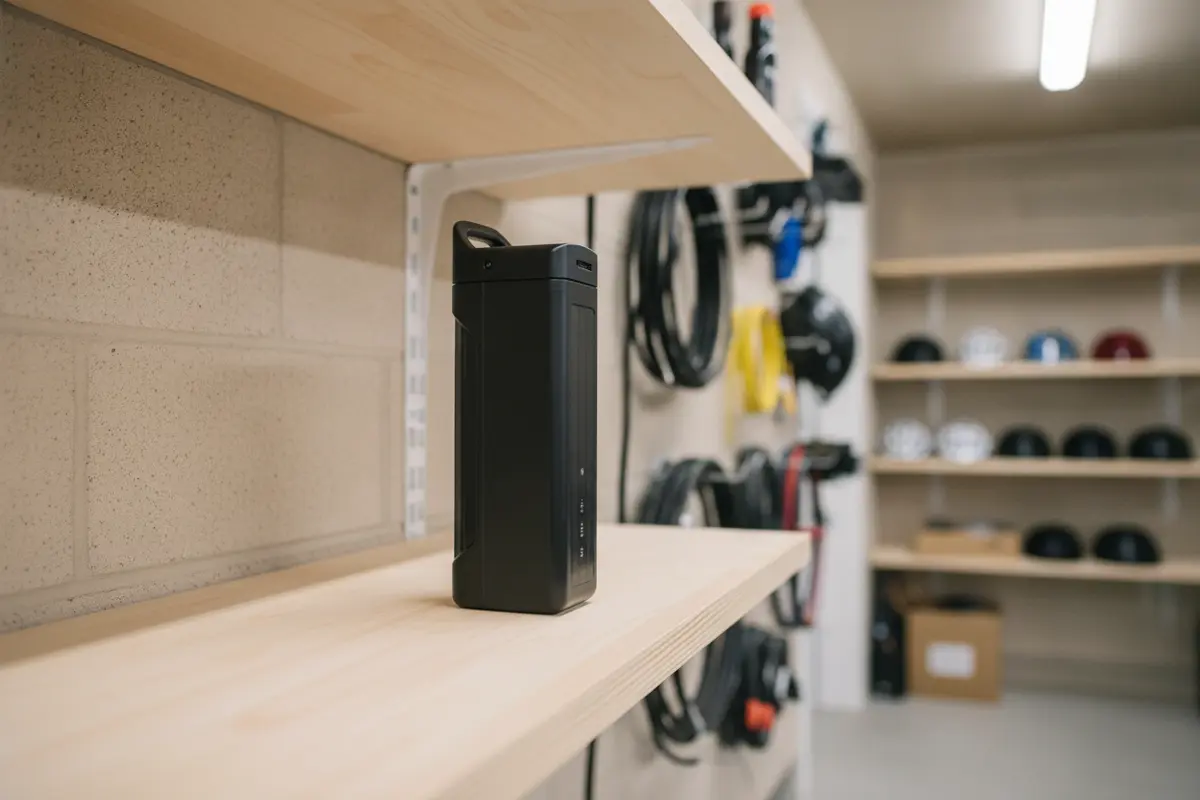
Choose a dry indoor location that stays within the battery maker’s storage limits and has little temperature variation. Use a stable shelf or another protected place where the battery cannot be knocked over, crushed, or covered by clutter. Keep it away from direct sunlight, water, damp floors, and heat sources. Follow the manual about whether the battery should be removed from the bicycle for long storage.
- Dry: Avoid damp basements, leaking sheds, and places where condensation regularly forms.
- Moderate: Choose a location without severe seasonal or daily temperature swings.
- Protected: Keep the battery out of pathways where it could fall or be struck.
- Clear: Do not cover it with clothing, paper, or other items, and keep the area orderly.
- Accessible: You should be able to check it periodically without moving heavy objects.
Think about both the battery and the bicycle. If the bike needs to be moved to a more suitable indoor location, plan a safe lift and use equipment only within its rated limits. A hitch rack option may help with transport, but it is not a storage-temperature solution; check your vehicle, rack, and bike instructions before loading. Follow the bicycle manual for battery removal and transport.
How do you check electric bike battery storage temperature during seasonal changes?
Short answer: Check the conditions where the battery rests, then compare them with the model’s storage range. A room thermometer can show whether the location becomes too hot or cold, but it does not tell you the battery’s internal temperature or override its manual.
Check the storage spot during the season’s warmest and coldest periods, not only on a mild day. A garage can stay comfortable in the afternoon and become cold overnight; a shelf near a window can receive direct sun for several hours. If the space regularly falls outside the maker’s limits, move the battery to a more stable location before the extreme weather arrives.
After moving a battery from one environment to another, give it time to adjust naturally before charging, especially if it was very cold or warm. Do not rely on touching the case to decide whether it is ready; surface feel is not a measurement of internal conditions. Use only temperature checks and procedures allowed by the manufacturer. Never open the case or insert a thermometer or probe into it.
It can help to keep a short note with the manual: storage location, date placed into storage, and any check the maker requires. This gives you a repeatable routine and helps you notice a seasonal problem early. If you cannot tell whether the conditions meet the guidance, ask the battery maker or a qualified service professional rather than guessing.
Can you charge a battery straight from cold storage?
Do not charge a battery outside the charging temperature range in its manual. After cold storage, allow it to reach the approved temperature naturally in a dry place before charging. Do not use a heater, hair dryer, radiator, or hot-water method to warm it. Quick, uneven heating can create additional risks and does not replace the manufacturer’s instructions.
The same caution applies after exposure to heat. If a battery feels unusually hot, has been sitting in direct sun, or seems different from normal, do not connect the charger just to test it. Move away from it if you can do so safely, keep people clear, and seek advice from the manufacturer or a qualified service professional. Never leave charging equipment connected in a way the manual prohibits.
Use only the charger specified or approved for the battery. Check that the plug and cable are undamaged and that the charging area is dry. Charge where you can keep an eye on the process, and follow the maker’s instructions for whether to remove the charger when charging is complete. For broader lithium-ion battery safety information and consumer guidance, consult the U.S. Consumer Product Safety Commission. For a converted bike, verify that the battery, charger, and controller are a compatible system; a bike conversion product listing is a starting point for questions, not a substitute for the exact system’s documentation.
How do you prevent condensation when temperatures change?
Condensation can form when a cold battery moves into warm, humid air. Moisture around electrical contacts or the battery case is a reason to pause, not to rush into charging. Let a battery adjust gradually in a dry location. Before installing it or connecting a charger, check for visible moisture and follow the manual’s cleaning and drying instructions. Do not open the battery housing or insert tools into ports.
Moving a bike between a cold outdoor area and a warm room can create the same issue. If the bike or battery is wet, dry the exterior with a clean cloth as directed by the maker and allow it to dry fully. Avoid placing a wet battery on a heater or wrapping it tightly in material that traps moisture. If water may have entered the battery or its connection points, stop using it and ask the manufacturer or a qualified technician what to do.
How should you prepare a battery for longer storage?
Start with the specific storage instructions for your model. Some manufacturers recommend a particular state of charge for extended storage; others set different steps. Do not assume that a fully charged or fully depleted battery is best. If the manual gives a charge level or inspection interval, follow it. If you cannot find this information, ask the manufacturer or a service professional before putting the battery away for a long period.
- Read the manual. Locate storage, charging, temperature, and inspection guidance for the exact battery.
- Inspect without opening it. Look for visible damage, swelling, leaks, unusual odor, or heat. Do not use a battery that appears damaged.
- Prepare the bike separately. Clean and dry the bicycle according to its instructions. For routine chain care, use a suitable product only as directed; a bicycle lubricant listing is not battery-care guidance.
- Choose the location. Keep the battery dry, stable, and within the storage temperature range provided by its maker.
- Set a reminder. If the manual calls for periodic checks, record the date and follow its schedule.
- Review before reuse. Check the case, contacts, and cables for visible issues. If anything looks or smells unusual, do not charge or ride before getting advice.
Long storage is also a good time to keep the bicycle itself ready for use. Check tires and other components according to the bike manual before the next ride. A compact bicycle pump can be part of ordinary tire preparation, but it has no role in checking or changing battery temperature. If you are unsure whether a battery should remain installed or be removed, ask before attempting removal.
Which storage conditions should you avoid?
| Condition | Why it is a concern | Safer next step |
|---|---|---|
| Direct sun or a hot vehicle | The battery may become hotter than the surrounding air and exceed its storage limit. | Move it to a dry, shaded indoor location within the maker’s temperature range. |
| Freezing or very cold storage | Cold can affect performance and may put the battery outside its permitted charging range. | Check the manual and let it warm naturally before charging, if allowed. |
| Damp shed or wet floor | Moisture and condensation can affect electrical connections. | Choose a dry location; stop and seek help if water may have entered the battery. |
| Near a heater or flame | Localized heat and unsafe surroundings add avoidable risk. | Keep the battery away from heat sources and follow the manufacturer’s placement guidance. |
| Unattended charging against instructions | Charging outside the maker’s stated conditions or with unsuitable equipment is unsafe. | Use the approved charger and follow the manual’s charging precautions. |
When should you stop using the battery and contact service?
Do not charge or ride with a battery that is visibly damaged, swollen, leaking, unusually hot, producing an unusual odor, or making unexpected sounds. Do not try to repair, puncture, open, or test the battery yourself. Keep people away and follow the manufacturer’s emergency guidance. If there is smoke, fire, or immediate danger, move away and contact emergency services.
For less urgent questions, give the service professional useful context: the bike and battery make or model, how long it was stored, the conditions it experienced, and what happened when you tried to use or charge it. Do not ship or carry a suspect battery unless the manufacturer or service provider gives you safe, specific instructions. Batteries may have special handling and transport requirements.
Voltaire Cycles of Central Oregon provides electric mobility service and repair support in Bend. If you have a question about a battery that appears normal but has unclear storage instructions, ask for guidance before taking a guess. For a battery that is damaged or behaving abnormally, stop use and arrange appropriate professional advice rather than attempting a DIY fix.
Ask the Bend team about battery service
Frequently asked questions
Is there one safe temperature for every electric bike battery?
No. Storage, riding, and charging limits vary by battery and manufacturer. Use the temperature range in the manual for the exact model rather than applying a general number to every battery.
Can I leave an e-bike battery in my garage over winter?
Only if the garage stays within the battery maker’s storage range and remains dry. If it freezes, becomes damp, or experiences large temperature swings, choose a more stable indoor location if the manual allows it.
Should I charge the battery to full before storing it?
Follow the manufacturer’s long-term storage directions. Some manuals specify a storage charge level or periodic check. Do not assume full or empty is best when the guidance for your battery is available.
What if the battery is cold but looks fine?
Do not charge it until it has reached the manufacturer’s permitted charging temperature. Let it warm gradually in a dry place, and do not use an external heat source to speed the process.
Can I use a battery that got wet?
If water may have entered the battery or its electrical connections, stop using and charging it. Follow the manufacturer’s directions and contact a qualified service professional. Do not open the case or attempt to dry the inside yourself.
The safest storage routine is simple: follow the exact battery manual, avoid temperature extremes and moisture, and stop if you notice damage or unusual behavior. When the instructions are unclear, get help before charging or riding.