
Do You Need a License for an Electric Scooter?
Buying an electric scooter for trips around Bend or Central Oregon raises an important question before you choose a model: what does Oregon actually consider a street-legal scooter? The answer depends on the vehicle's design, power, and maximum capability, not just its product label.
For a qualifying Oregon motor-assisted scooter, do you need a license for an electric scooter? Generally, no driver's license is identified in the current Oregon DMV guidance, but the scooter must fit the state's definition, and riders must be at least 16. A model with different specifications may fall under another vehicle category.
Explore Segway electric scooters
Oregon's definition includes details such as a maximum electric output of 1,000 watts. The power source must top out at 24 mph on level ground, while riding is limited to 15 mph. We will start with that classification, then separate statewide requirements from local route, sidewalk, path, and park rules.
Do you need a license for an electric scooter in Oregon?
For an electric scooter that meets Oregon's definition of a motor assisted scooter, the key question is classification, not simply whether it has a motor. Oregon defines this category by features such as wheel count, operator support, power source, wattage, and speed capability. This section is informational, not legal advice.
Under Oregon DMV guidance, a motor assisted scooter can have no more than four wheels. It must have a foot support or seat and may be propelled by a motor or by human power. For an electric model, the motor output must be no more than 1,000 watts. Its power source must also be incapable of propelling it faster than 24 miles per hour on level ground.
Those details come from the statutory definition in ORS 801.348. In practical terms, do not assume that every vehicle marketed as an electric scooter receives the same treatment. A scooter that exceeds the definition's power or speed limits, or that has a different design, may fall into another vehicle category. The Oregon DMV specifically directs readers to its motorized vehicle guidance for scooters, mopeds, pocket bikes, and similar vehicles that do not qualify as bicycles.
That distinction matters because Oregon's driver licensing rules are written around driving privileges and vehicle classifications. ORS 807.020 addresses exemptions from the requirement to have an Oregon license or permit, but it should not be read as a blanket answer for every electric vehicle. Whether a license, permit, or another requirement applies depends on what the vehicle legally is, not only what a product listing calls it.
A qualifying motor assisted scooter also has operating rules that are separate from the license question. Oregon guidance says operators must be at least 16, may not exceed 15 miles per hour, and must wear protective headgear, subject to the stated religious-belief exception. Passengers are not allowed, and approved lighting is required in limited visibility. When available, riders must use a bicycle lane or path. These requirements do not convert a nonqualifying high-powered vehicle into a motor assisted scooter.
For a Bend or Central Oregon route, confirm the current rule for the exact scooter and places you plan to use it. State law, city rules, park policies, trail restrictions, and private-property rules may not be interchangeable. When specifications are close to the statutory limits, consult the current Oregon DMV material or an appropriate legal authority rather than relying on a sales label.
Does Oregon require electric scooter registration or insurance?
For an Oregon vehicle that qualifies as a motor assisted scooter, the DMV's current materials list it among vehicle types that are not eligible for an Oregon title. They are also not required to be titled and registered. This classification does not use the ordinary title, registration, and license-plate process for passenger vehicles. The materials do not establish a universal insurance requirement for every electric scooter.
The key is the vehicle classification. Oregon defines a motor assisted scooter as a vehicle with no more than four wheels, a foot support or seat, and motor or human propulsion. Its power source must be incapable of propelling it faster than 24 miles per hour on level ground. For an electric version, the motor output may not exceed 1,000 watts. See the Oregon DMV's Micromobility, Moped and Mini Motorcycle Guide and the statutory definition in ORS 801.348.
Is a title, registration, or license plate required?
Chapter L, the Oregon DMV's Vehicle Types guide, specifically identifies motor assisted scooters as vehicle types that are not eligible for an Oregon title. The same section places them with vehicles that are exempt from, or not required to receive, title and registration. Because the scooter is not going through the ordinary registration process, an Oregon registration plate is not the normal requirement for a qualifying motor assisted scooter.
That statement should not be extended to every device marketed as an electric scooter. A higher-powered vehicle, a moped, a motorcycle, or another vehicle that falls outside ORS 801.348 can have different requirements. A product listing is not a legal classification by itself. Compare the actual motor output, designed speed, wheels, and operating configuration with the current Oregon definitions before riding on a public highway.
| Question | What the current Oregon sources indicate |
|---|---|
| Driver license | Classification-specific. The DMV guide cites a license exemption reference for qualifying electric assisted bicycles, while scooter status still depends on the applicable definition. |
| Title and registration | Motor assisted scooters are listed among vehicle types not eligible for an Oregon title and not required to be titled and registered. |
| License plate | Not part of the ordinary title and registration process for a qualifying motor assisted scooter. |
| Insurance | The cited DMV materials do not establish a universal automobile-insurance requirement for every electric scooter. |
Does a qualifying scooter need insurance?
The DMV Chapter L guide discusses financial responsibility requirements in its passenger-vehicle section, but that section concerns registered passenger vehicles. It does not state that every motor assisted scooter must carry automobile insurance. Nor does the title-and-registration exemption serve as proof that no insurance product could ever be relevant. Oregon's vehicle title and registration laws are collected in Chapter 803. For a definitive answer about a specific policy, route, business use, or accident situation, ask an insurer or qualified Oregon legal professional.
Rules can change, and local agencies or private properties may impose additional conditions. Treat this as general information, not legal advice, and confirm the current rule for the exact scooter and route you plan to use.
What age, helmet, and equipment rules apply?
Oregon's current DMV guide requires motor-assisted scooter riders to be at least 16, wear protective headgear, carry no passengers, and stay at or below 15 MPH while operating. Approved lighting is required in limited visibility. These requirements apply when the vehicle fits Oregon's motor-assisted scooter definition, so confirm the classification and route rules before riding.
For this category, age is not simply a recommendation. The operator must be at least 16 years old. The scooter also must meet the state's definition, including its design, propulsion, maximum capability, and electric motor output limits. If a vehicle falls into another legal category, its requirements may differ. The Oregon DMV Micromobility, Moped and Mini Motorcycle Guide is the best starting point for checking those distinctions.
Protective headgear is required for a motor-assisted scooter rider unless wearing it would violate the rider's religious beliefs. Choose a properly fitted helmet that sits level on the head, covers the forehead, and remains secure when you look up, down, and side to side. Replace a helmet after a significant impact, even if the shell does not show obvious damage.
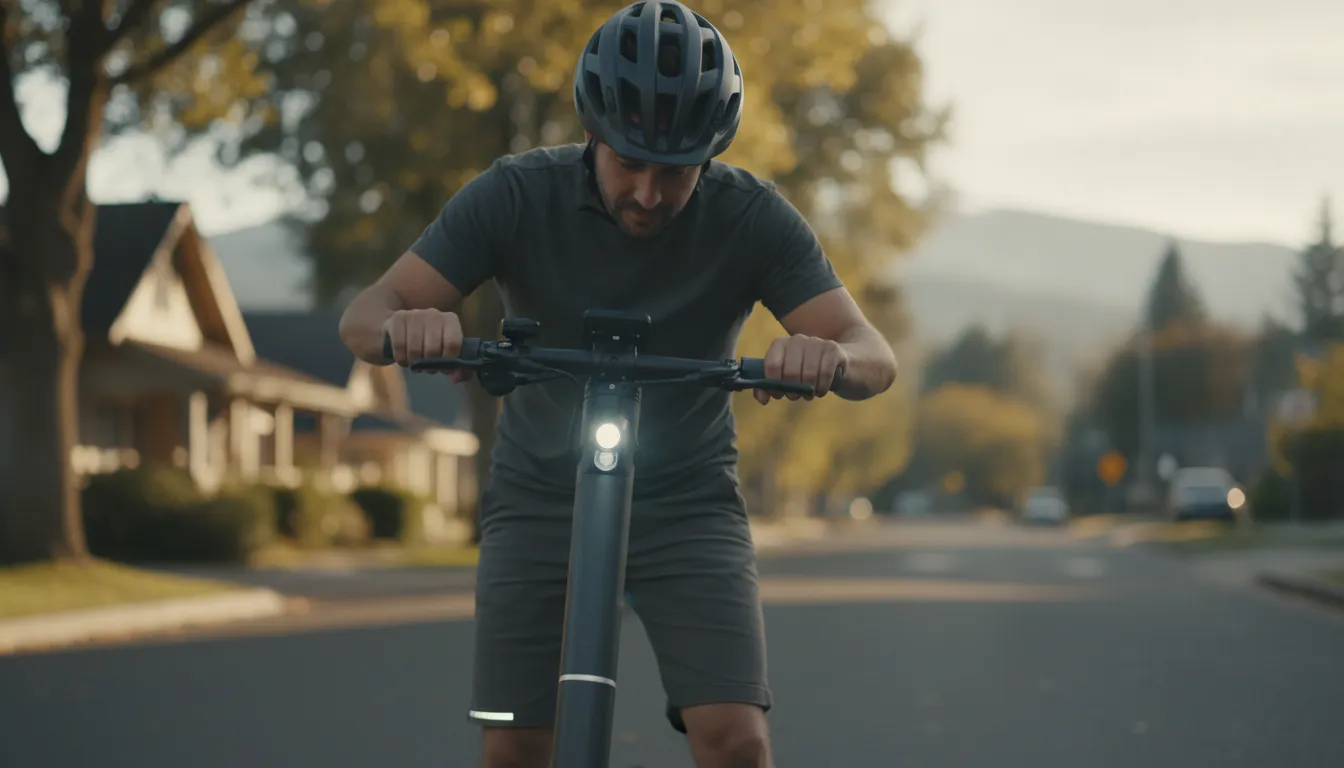
Oregon does not allow passengers on a motor-assisted scooter. Treat the deck or seat as a single-rider position, and do not carry another person, child, or animal in a way that affects steering or braking. The operating limit is 15 MPH, even though the vehicle definition describes a power source that may max out at 24 MPH on level ground. Those are different concepts: the device classification limit does not change the lower operating rule.
Lighting matters whenever visibility is limited. Use approved lighting rather than relying only on a phone flashlight or reflective clothing. Before each ride, check that the front and rear lights work, the brakes engage firmly. The tires have appropriate pressure, the steering feels tight, and the throttle or controls return normally. Secure loose clothing and confirm that the battery and any removable components are properly latched.
These are statewide equipment and operating points, not a complete checklist for every Bend route. Parks, trails, paths, private property, and local agencies may impose additional location rules. Confirm the requirements for the exact route, and do not assume that a product's features alone authorize riding there.
Where can you ride an electric scooter in Bend and Central Oregon?
In Oregon, a qualifying electric scooter generally follows bicycle-style roadway guidance, but that does not create blanket permission for every sidewalk, path, park, or trail. On a public street, travel with traffic and use the bicycle lane or path when the applicable rule requires it. Before riding in Bend, Redmond, Sisters, Sunriver, or elsewhere in Central Oregon, confirm the current rule for the exact route and land manager.
What is the roadway position for an electric scooter?
When riding on a roadway, stay in the same direction as traffic and generally keep to the right. Oregon DMV guidance says that an e-scooter may use the traffic lane when no bicycle lane exists. If a bicycle lane is present, the guidance says to use it. Subject to practical exceptions such as avoiding hazards, parked cars, or a conflict while preparing for a turn. Follow pavement arrows and traffic signals, and do not ride against traffic. The official Oregon Revised Statutes Chapter 814 is the better reference when a general summary and a specific legal provision appear to differ.
Can you ride an electric scooter in a bike lane?
Oregon's DMV materials identify bicycle lanes and paths as places where e-scooters may ride under the applicable statewide guidance. A bike lane is not a separate shortcut around traffic rules. Travel in the marked direction, watch for turning vehicles, yield where required, and use extra care at driveways and intersections. A route-specific city rule can still limit access, so inspect signs and current local regulations before entering.
Are sidewalks and crosswalks allowed?
Do not assume a sidewalk is an ordinary extension of the bike lane. Oregon's scooter guidance distinguishes sidewalk use from roadway and path travel, while Chapter 814 contains separate provisions for sidewalk and bicycle-trail operation. Local governments may also set rules for sidewalks. At a crosswalk, slow down, yield to people walking, and follow the posted control. Crossing at a crosswalk does not automatically authorize riding along the sidewalk before or after the crossing.
What about paths, parks, trails, and private property?
Multi-use paths, parks, and recreational trails can be particularly route-specific. A path may be open to an electric scooter while a nearby natural-surface trail, park segment, or facility is not. Oregon DMV advises checking area rules, and cities, counties, landowners, and park or trail managers can impose their own restrictions. Do not apply e-bike-only signage or trail guidance to scooters unless the rule expressly covers scooters or motor-assisted scooters. Check the exact Bend park, Deschutes County facility, trail system, or land manager before riding.
Private property is different from a public roadway, but permission still matters. Ask the property owner, follow posted speed and access rules, and account for pedestrians and other users. A product's advertised speed or off-road capability does not establish where it is legal to ride. For route planning, Voltaire's adult electric scooter speed guide can help you compare riding conditions, while local signs and land-manager rules control access.
When is an electric scooter treated differently under Oregon law?
Answer: Oregon does not classify every electric two-wheeler as the same type of vehicle. A motor assisted scooter generally must have no more than four wheels, a foot support or seat. Motor or human propulsion, and a power source limited to 24 mph on level ground. An electric version may not exceed 1,000 watts. If a vehicle falls outside those boundaries, a different legal category may apply.
That is why the question do you need a license for an electric scooter cannot be answered from the product name alone. Oregon's statutory definition of a motor assisted scooter focuses on how the vehicle is designed and equipped. The Oregon DMV's Micromobility, Moped and Mini Motorcycle Guide is a useful plain-language reference, but the current statutory text controls when details are unclear.
What details can change the classification?
Start with the basic structure. Oregon looks at the number of wheels and whether the operator has a foot support or seat. It also considers the power source, including an electric motor's output and the vehicle's designed ability to travel on level ground. A scooter built to exceed the statutory speed or power limits may not fit the motor assisted scooter definition, even if a retailer calls it an electric scooter.
Operating behavior matters too. A rider's actual use does not rewrite the vehicle's design. Riding faster than the applicable limit or using a vehicle in an unsuitable way can create separate compliance and safety concerns. Do not treat a speed setting, removable limiter, marketing label, or display reading as the entire legal analysis. Review the complete specifications and the applicable Oregon rule.
How is this different from an e-bike, moped, or motorcycle?
An electric assisted bicycle is treated as a bicycle under Oregon's vehicle code when it meets that category's requirements, including its pedal and assistance design. A motor assisted scooter is a separate defined class. Mopeds and motorcycles are different categories again, with their own rules. Oregon's DMV guidance specifically directs readers to its motorized-vehicle guide for motorized vehicles that do not qualify as e-bikes.
In practical terms, product specifications are a starting point, not a legal determination. Before buying or riding in Bend or elsewhere in Central Oregon, compare the vehicle's wheels. Operator support, motor output, designed speed, controls, and intended operation with the current Oregon definitions. When a model is close to a boundary, confirm the classification and route rules rather than relying on its advertising language.
How should Bend shoppers choose an electric scooter for local riding?
Choose an electric scooter by starting with the route, not the product label. Map your typical trip around Bend, Redmond, Sisters, Sunriver, or another Central Oregon community. Then compare the scooter's designed speed, motor output, range, lighting, tires, controls, and carrying weight with that use. Oregon's current guidance and local rules both matter. So treat this as a shopping checklist rather than a substitute for confirming the law that applies to your exact route.
- Route: Identify the roads, bicycle lanes, paths, sidewalks, parks, and trails you expect to use. Confirm each location's current access rules before purchasing. A route that works on a public street may not be permitted on a particular path, trail, or private property.
- Classification and operating speed: Review the scooter's specifications and understand how Oregon classifies the vehicle. Do not assume that an electric scooter is legally approved for every route because a listing calls it a scooter, or because it carries a familiar brand name. Plan around the applicable operating speed, not only the scooter's advertised top speed. Our adult electric scooter speed guide can help you compare practical speed considerations.
- Rider requirements: Check the minimum age, helmet requirement, and whether passengers are prohibited. Plan for approved lights when visibility is limited, even if you expect to ride mostly during daylight.
- Daily fit: Consider hills, weather, distance, charging access, storage, step-through ease, deck stability, suspension, braking feel, and whether you need to lift the scooter into a vehicle. A lighter model may suit short errands, while a more substantial setup may feel steadier for longer commutes.
- Hands-on confirmation: Ask a knowledgeable retailer to review your intended route and the current specifications. Voltaire Cycles is a Bend-based electric mobility retailer serving Central Oregon, with showroom evaluation, test rides, and expert consultation. Segway is a useful focus for shoppers comparing electric scooter options, but staff should help you assess fit without treating the product name as a legal conclusion.
At the Voltaire showroom, a test ride can reveal details that a specification sheet cannot. Including reach to the controls, turning confidence, braking response, and comfort over the surfaces you actually encounter. That local evaluation can be especially helpful for retirees, commuters, and anyone adapting a scooter to a regular daily routine.
Use this quick sequence before you buy:
- Write down your common roads, paths, sidewalks, parks, and trails.
- Compare the scooter's complete specifications with Oregon's current definition.
- Confirm age, helmet, speed, passenger, lighting, and local access rules.
- Take a test ride and ask about service for your intended routine.
Explore Segway electric scooters
Frequently Asked Questions
Do you need a license for an electric scooter in Oregon?
For a vehicle that fits Oregon's motor-assisted scooter definition, the answer is generally no standard driver license requirement. The classification matters: the scooter must fit the state's design, power, and speed limits. Review the Oregon DMV micromobility guide and confirm unusual models against the applicable statute.
What is the maximum speed for an Oregon motor-assisted scooter?
Oregon's definition covers an electric motor-assisted scooter with a power source that maxes out at 24 MPH on level ground, but the operating limit is 15 MPH. Those are different tests, so do not assume a model is legal simply because its display can show a certain speed. See the Oregon DMV guide for the current specifications.
What age and safety equipment rules apply?
Riders must be at least 16 years old, wear protective headgear unless the stated religious exception applies, and carry no passenger. Approved lighting must be used in limited visibility. These requirements are listed in the Oregon DMV guide.
Can I ride an electric scooter on any Bend path or trail?
No. Oregon guidance addresses bicycle lanes, paths, and traffic lanes, while cities, counties, parks, trail managers, and private landowners may impose additional location rules. Check the rule for your exact Bend or Central Oregon route before riding, especially on a park trail, shared path, or private property.
Get started with a better-fit electric scooter
Choosing an electric scooter involves more than checking a model's features. A conversation about your experience, intended routes, and riding goals can help you narrow the options and plan a practical next step. Shop Segway electric scooters online, or visit the Bend showroom for a test ride and product-fit guidance.