

Best Rack for Two Electric Bikes: Guide
Carrying two electric bikes safely takes more than choosing a rack labeled for two bikes. The right setup must support the loaded weight, fit both frames and tires, stay within your vehicle and receiver limits, and still let you access the hatch or trunk when needed.
The best rack for two electric bikes is the one whose total and per-bike capacity, wheel and frame fit, vehicle access, security features, and installation requirements match your specific bikes and vehicle.
That usually means comparing a hitch platform carrier with other rack styles instead of assuming the most convenient-looking option will work. Measure your bikes, check their weights with batteries installed, and think through how often you will load them, where you will drive, and whether you need help confirming the fit.
Request a personalized rack-fit consultation.
What makes the best rack for two electric bikes?
For two electric bikes, the best rack is the one whose verified capacity, fit, and vehicle limits all work together. Start with the loaded weight of both bikes, then check each bike's individual limit, the hitch receiver rating, and the vehicle's allowable tongue weight. A rack that appears strong enough on one measure can still be unsuitable when another limit is exceeded.
E-bikes differ from many conventional bicycles because motors, batteries, larger frames, and wider tires can add substantial weight and bulk. That makes a two-bike carrier a payload and fitment decision, not simply a question of whether two wheel positions are available. The carrier also needs enough spacing for the bikes to sit securely without handlebars, pedals, baskets, or cables interfering with one another.
First, calculate the total loaded payload: the weight of both bikes plus any equipment that remains attached during transport, such as racks, bags, or accessories. Then compare that number with the carrier's total rating. Check the per-bike limit separately as well. A rack may allow a particular total payload but impose a lower limit on each position, and the heavier bike must fit its own position.
Next, verify the complete connection. Confirm the rack matches the vehicle's receiver size and class, then check the receiver's tongue-weight limit and the vehicle manufacturer's limit for the hitch. Use the lowest applicable rating. If the rack manufacturer specifies reduced capacity when the rack is extended or used in a particular configuration, that condition matters too.
Finally, look beyond pounds. Confirm the tray width, wheelbase range, tire clearance, frame-contact points, and distance between bikes. A platform carrier can be convenient for loading, but convenience does not replace a specification check. Voltaire's electric bike hitch rack options provide a useful starting point, while your exact bike and vehicle measurements determine the right match.
Which two-bike rack style fits your vehicle and bikes?
Short answer: For two electric bikes, a hitch platform carrier is often the easiest style to load and inspect, but it is not automatically the right choice. Compare the loaded weight, per-bike limit, receiver rating, tire and frame fit, rear visibility, and access to your hatch or trunk. A strap-mounted or RV-specific carrier may fit a different vehicle and use case better.
Think about the vehicle first, then the bikes. A receiver hitch gives you a stable mounting point for platform and hanging carriers, but the vehicle and hitch still have their own limits. A trunk or strap carrier may avoid a receiver installation, yet it must match the vehicle's shape and provide secure contact points without interfering with the bikes. For an RV, fifth wheel, or travel trailer, use a carrier specifically approved for that application rather than assuming a passenger-vehicle rack is suitable.
| Rider need. | What to inspect. | Tradeoff. |
|---|---|---|
| Frequent loading of two heavy e-bikes. | Platform trays, ramp availability, total payload, per-bike limit, and receiver rating. | Usually easier to load, but adds weight and may require a hitch. |
| Occasional use with compatible standard-frame bikes. | Hanging-arm spacing, frame contact, bike weight, and adapter requirements. | Can be lighter and compact, but frame shape and loading access can be limiting. |
| No receiver hitch or limited hitch use. | Vehicle-specific fit, strap routing, rear lights, plate visibility, and combined load. | May be simpler to store, but fit and stability depend heavily on the vehicle. |
| Travel with an RV, fifth wheel, or trailer. | RV approval, attachment location, loaded weight, clearance, and movement under tow. | Built for that environment, but not interchangeable with every car rack. |
Platform carriers generally avoid hanging the bikes by their frames, which can help when two e-bikes are heavy or have step-through frames. They still need tray width, wheelbase, tire clearance, and side-by-side spacing checked. Fat tires may require larger trays, and rear-mounted bikes can obscure lights or the license plate, so inspect the loaded setup before travel. For a focused starting point, review Voltaire's electric bike hitch rack options, then confirm the exact rack and vehicle specifications.
How do payload, fat tires, wheelbase, and frame fit affect compatibility?
Answer: A two-bike carrier must fit the loaded weight of both e-bikes, each bike's individual limit, your receiver, and your vehicle. Then check tire width, wheelbase, frame contact points, battery access, and clearance around the hatch, lights, and plate. Treat every specification as model-specific, not universal.
Start with the numbers. Add both bike weights in their travel configuration, then compare that total with the carrier's total payload rating. Check the per-bike limit separately, because a rack can have enough combined capacity yet still reject one heavier e-bike. Your vehicle and receiver also impose limits. Voltaire's electric bike hitch rack options should be evaluated using those three layers: total load, per-bike load, and vehicle or receiver capacity.
Battery removal is a practical fit check, not an automatic rule. One owner reported removing batteries before transport, while another described a RadRover weighing more than 60 pounds with its battery. Removing a removable battery may reduce lifting weight, but secure it separately and follow the battery and bike manufacturer's transport guidance. Do not assume a battery can be left loose inside the vehicle.
Measure the tires and wheelbase before ordering. An owner reported needing larger trays for 4-inch fat tires, so confirm the tray range rather than relying on a general e-bike label. Side-by-side bikes also need enough spacing to prevent handlebars, pedals, racks, and cables from colliding.
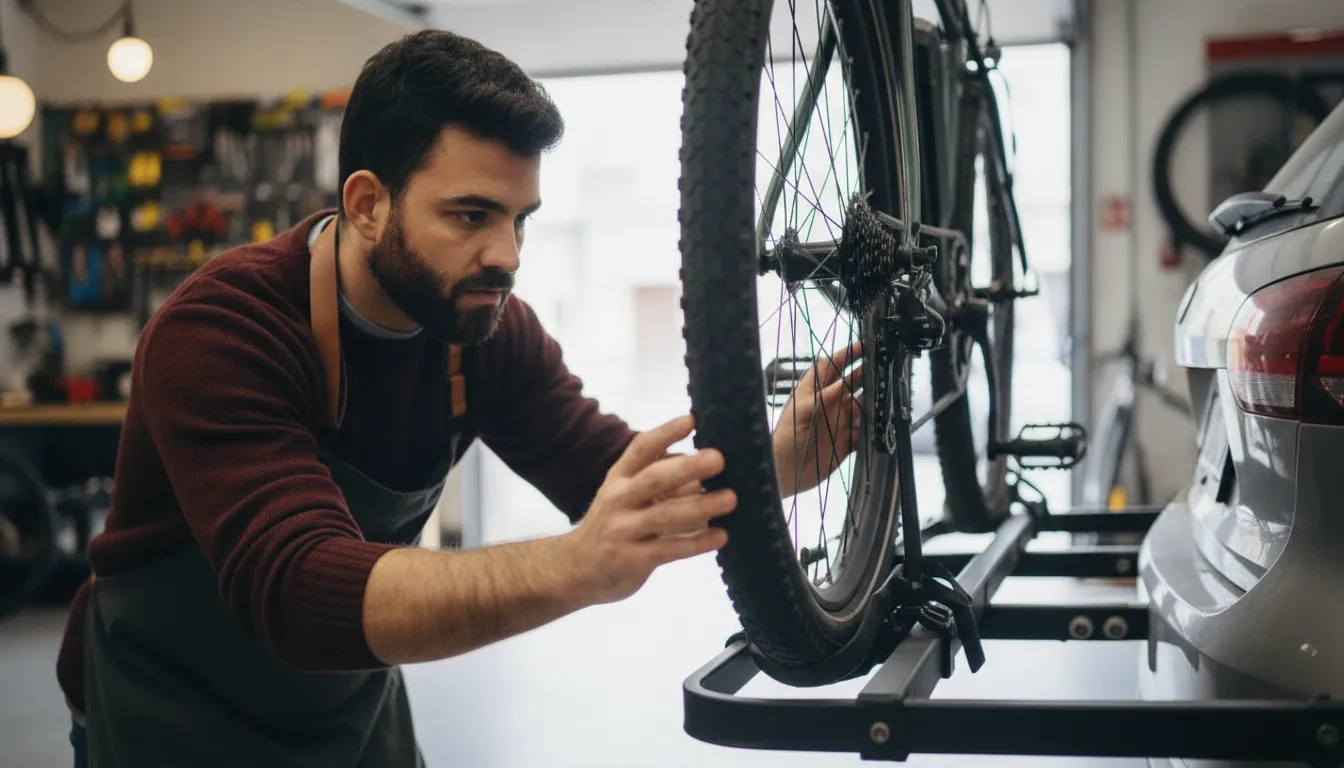
Finally, inspect where the carrier touches each frame. Step-through frames, unusually shaped downtubes, suspension components, and integrated batteries may not provide a safe contact point for a frame clamp. A wheel-first platform can be more adaptable, but it still needs adequate tire support and clearance. Measure before purchase, and ask for help if the fit is uncertain.
What vehicle access, visibility, and security features should you check?
Answer: Choose a two-bike rack that lets you reach the hatch without unloading when possible, keeps taillights and the license plate visible, and provides dependable locks and straps. Tilting and folding features improve day-to-day access, but they do not replace checking your vehicle manual, rack instructions, and local visibility requirements.
Start with access. A rack that folds toward the vehicle when empty can be easier to store, while a tilt function may let you open a hatch or trunk with the bikes loaded. Do not assume every tilt mechanism clears every vehicle. The manufacturer instructions hosted by NHTSA for one rear carrier state that the boot can be opened only when the carrier is folded down, and that the carrier may fold down with bikes loaded. That is a useful example of why the exact rack and vehicle instructions matter: access is a designed feature, not a universal promise.
Visibility deserves the same attention. Two wide tires, fenders, bags, or frame accessories can obscure taillights or the license plate. One rack user reported that fat tires blocked taillights and a bag covered the plate, then added auxiliary lighting. Treat that as a practical fit warning rather than a rule for every setup. Before driving, stand behind the loaded vehicle and confirm the lights, plate, turn signals, and rear camera view are not unnecessarily obstructed.
Security has two parts. First, use the rack's integrated locks or compatible locking hardware to discourage casual theft. Second, secure each bike at its intended frame or wheel contact points with every supplied strap. The NHTSA-hosted manufacturer instructions specifically say bikes must be secured correctly. Keep removable batteries, chargers, bags, and other loose items inside the vehicle or secured separately.
Finally, recheck the receiver connection, tilt mechanism, locks, straps, and clearances before leaving. The same instructions recommend checking the carrier and bikes before driving and at regular intervals during a long trip, up to every 186 miles. A short inspection at fuel or rest stops is a small step that can catch movement before it becomes a problem.
How should you install and load a two-bike rack?
Answer: Install the rack according to its instructions, confirm the receiver and vehicle limits, then load the heavier or more stable bike first. Secure each bike independently, remove loose items, decide whether the batteries should travel separately, and recheck the setup before departure and during a long trip.
- Verify the limits before assembly. Check the rack's total payload and per-bike limit against the actual weight of both bikes in the configuration you will transport. Confirm the vehicle's receiver rating, receiver size, and any vehicle-specific restrictions. Do not assume that a rack that fits the receiver can carry your particular bikes.
- Assemble and attach the rack on level ground. Follow the manufacturer's sequence and tighten every required fastener. Confirm that the rack is fully seated in the receiver and that its anti-wobble or locking mechanism is engaged. Test the rack unloaded before lifting either bike into position.
- Load in a stable order. Place the heavier bike, or the bike that best fits the inner position, on first. Keep the center of gravity low and avoid forcing handlebars, pedals, fenders, or cables against the other bike. If the rack uses wheel holders and an arm over the front tire, position the wheels fully in their trays before closing the arm.
- Secure both bikes separately. Use every specified wheel strap, frame support, and retention point. Check that each strap is tight without crushing a tire or contacting a vulnerable cable or finish. Lock the bikes and rack when the system provides those features, but treat locks as an added layer, not a replacement for proper retention.
- Remove loose items and decide on battery handling. Take off panniers, pumps, bottles, bags, and anything that could fall or obstruct your view. Removing batteries may reduce carried weight, but follow the bike and battery manufacturer's transport guidance. If batteries travel in the vehicle, prevent shifting, accidental operation, and short circuits, as described in federal battery-transport guidance at eCFR Section 173.185.
- Inspect before and during the trip. Check clearance, lights, the license plate, straps, wheel placement, and receiver security before driving. Adapt your driving to the loaded vehicle and recheck the rack and bikes at regular intervals on a long trip. If anything loosens, stop in a safe location and correct it before continuing.
When is local rack-fit and e-bike service support worth it?
Rack selection becomes much easier when you can discuss the complete setup with someone who understands both the vehicle and the bikes. Ask for help when you are unsure about total loaded weight, per-bike limits, receiver size, tire width, wheelbase, frame contact points, or whether two bikes will sit securely without blocking lights or a license plate. These details matter more than choosing a rack based on a generic list of features.
A hands-on evaluation can be especially useful for heavier e-bikes, step-through frames, fat tires, unusual frame shapes, or vehicles with limited rear clearance. In Bend, Voltaire Cycles offers a showroom where local riders can evaluate products and receive expert consultation. Bring the relevant vehicle information and accurate bike details, including the loaded weight and dimensions. The goal is to confirm which questions still need answers before you buy, not to assume that one rack fits every combination.
You can also review the store's electric bike hitch rack options online. Product pages can help you compare receiver fit and intended capacity, but they do not replace checking your vehicle limits or measuring your bikes. If you are deciding between a single-tray design, a two-bike platform rack, or a higher-capacity carrier, explain how you plan to load, access, and store the rack.
Support can remain useful after the purchase, too. Voltaire provides multi-brand service and repair support, including for brands not sold in the store. Ask for guidance on fit, payload, loading order, straps, clearances, or setup checks. Installation should follow the rack and vehicle manufacturer's instructions; do not assume that consultation includes rack installation.
Request a personalized rack-fit consultation
Frequently Asked Questions
Do electric bikes need a special rack?
Many electric bikes need a carrier designed and rated for their loaded weight, tire width, wheelbase, and frame shape. A two-position label alone is not enough. Confirm the total payload, per-bike limit, receiver and vehicle limits, wheel support, and clearance before buying.
How much capacity should a two-bike rack have?
Add the travel weight of both bikes and any accessories that stay attached. Compare that total with the rack's total rating, then check the individual limit for each position. Also use the lowest applicable vehicle, receiver, or hitch rating. Never rely only on the rack's headline capacity.
Is a platform rack better than a hanging rack for two e-bikes?
A platform rack is often easier to load because the bikes rest on wheel trays, but it may be heavier and require a hitch with adequate capacity. Hanging racks can be lighter, yet frame shape, adapter needs, weight, and contact points may limit compatibility. Compare the complete setup rather than choosing by style alone.
Will a two-bike rack fit fat tires?
Only if its trays or wheel holders accept the measured tire width. Fat tires can also affect bike spacing, taillight visibility, and license-plate visibility. Measure both bikes, including fenders and accessories, and confirm wheelbase and tray clearance in the rack instructions.
Should I remove the batteries before transporting two electric bikes?
Battery removal can reduce lifting weight, but it is not an automatic rule for every bike or rack. Follow the bike and battery manufacturer's instructions. If a battery travels inside the vehicle, prevent shifting, accidental operation, and short circuits, and keep it protected from damage.
Ready to choose your two-bike rack?
The right carrier depends on your bikes, vehicle, loading routine, and travel plans. A quick review of those details can help you identify the specifications to verify before purchase.